
MIT Unveils SEAL: A Framework for Self-Improving LLMs

MIT researchers have introduced SEAL (Self-Editing and Learning), a novel framework designed to empower large language models (LLMs) with the ability to autonomously refine their own parameters. This advancement moves beyond static model training, enabling LLMs to learn and adapt by editing their own weights via reinforcement learning. The core innovation lies in allowing the model to identify errors, propose corrections, and integrate those corrections into its own knowledge base, mimicking a human-like self-correction process. Traditionally, improving an LLM involves extensive retraining on new datasets or fine-tuning by human experts. This process is computationally expensive and time-consuming. SEAL offers a more efficient paradigm by enabling the model to act as its own internal editor. The framework operates by framing the self-editing process as a reinforcement learning problem. The LLM is tasked with generating a response, and then a separate component, or the model itself in a different mode, evaluates the quality of that response. Based on this evaluation, a reward signal is generated, which the LLM then uses to update its weights, thereby improving its future performance. This self-improvement loop is critical for developing AI systems that can adapt to new information and correct mistakes without constant human intervention. Imagine a student who not only studies for a test but also reviews their own incorrect answers, figures out why they were wrong, and then uses that understanding to improve their knowledge for the next exam. SEAL aims to imbue LLMs with a similar capability.
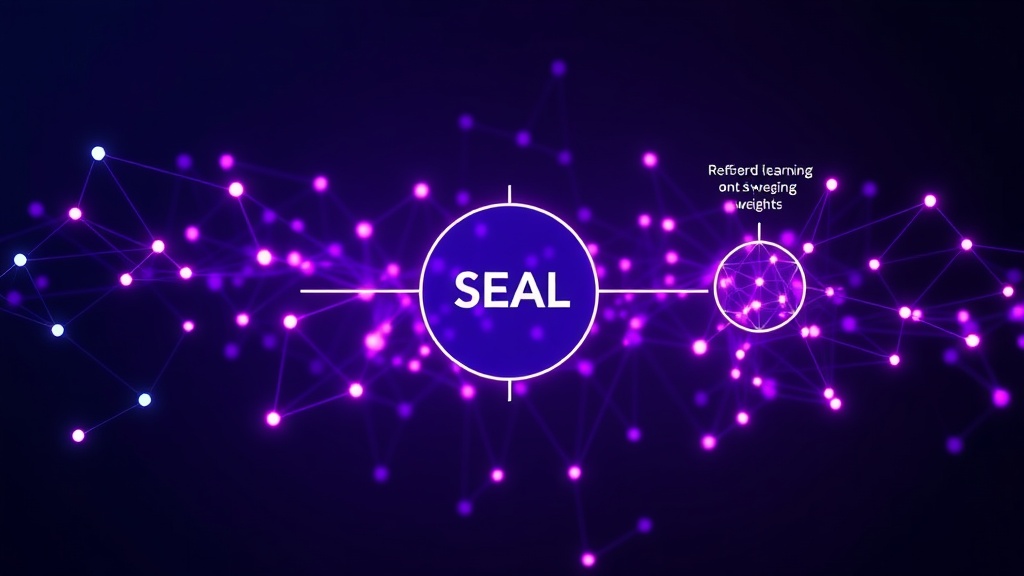
Diagram illustrating the SEAL framework's self-editing and reinforcement learning loop for LLMs

The Mechanics of Self-Editing

The SEAL framework breaks down the self-improvement process into several key stages. First, the LLM generates an output, such as a text response or a piece of code. This output is then subjected to an evaluation phase. This evaluation can be performed by a separate, specialized reward model, or potentially by the LLM itself through a meta-cognitive process. The evaluation assesses the accuracy, relevance, and overall quality of the generated output against predefined criteria or a learned objective. If the output is deemed suboptimal, the framework initiates a self-correction mechanism. This involves the LLM identifying the specific aspect of its output that led to the negative evaluation. It then formulates a correction, which is essentially a modification to its internal weights. This weight update is guided by the reinforcement learning algorithm, which aims to maximize the cumulative reward over time. Essentially, the LLM learns which internal configurations lead to better outcomes and adjusts itself accordingly. One of the significant challenges in this process is ensuring that the self-edits are beneficial and do not degrade the model's performance on other tasks. Catastrophic forgetting, where a model loses previously learned information while acquiring new skills, is a known issue in machine learning. SEAL attempts to mitigate this by carefully designing the reward function and the update mechanism to encourage stable and progressive learning. The goal is not just to fix individual errors but to foster a robust, continuous improvement trajectory.

Implications for AI Development

The development of SEAL has profound implications for the future of AI. For developers, it promises more agile and adaptable AI systems. Instead of lengthy and costly retraining cycles, models could potentially maintain and improve themselves in near real-time, adapting to evolving data landscapes and user feedback. This could significantly reduce the operational overhead associated with deploying and maintaining large AI models. For founders, SEAL could unlock new product categories and enhance existing ones. Imagine AI assistants that learn from user interactions to become more personalized and effective over time, or code generation tools that improve their output based on developer feedback without requiring a full model update. This continuous improvement capability could provide a significant competitive advantage, allowing products to become smarter and more valuable as they are used. From a research perspective, SEAL contributes to the ongoing quest for artificial general intelligence (AGI). The ability for an AI to critically evaluate its own performance and autonomously refine its capabilities is a crucial step towards more generalized intelligence. It moves AI closer to systems that can learn and adapt like humans, rather than relying solely on pre-programmed knowledge or external human guidance. However, the framework also raises important questions. How do we ensure the safety and alignment of self-improving AIs? If a model can change its own weights, how do we guarantee it remains aligned with human values and objectives? The potential for unintended consequences or emergent behaviors in autonomous self-improvement systems is a significant area for future research and careful consideration. The surprising detail here is not the framework itself, but the potential for these models to outpace human oversight if not carefully managed. What nobody has addressed yet is the long-term economic impact of AI systems that can self-improve. If AI development costs decrease dramatically due to SEAL-like technologies, what does this mean for the pace of innovation, market competition, and the demand for human AI engineers?