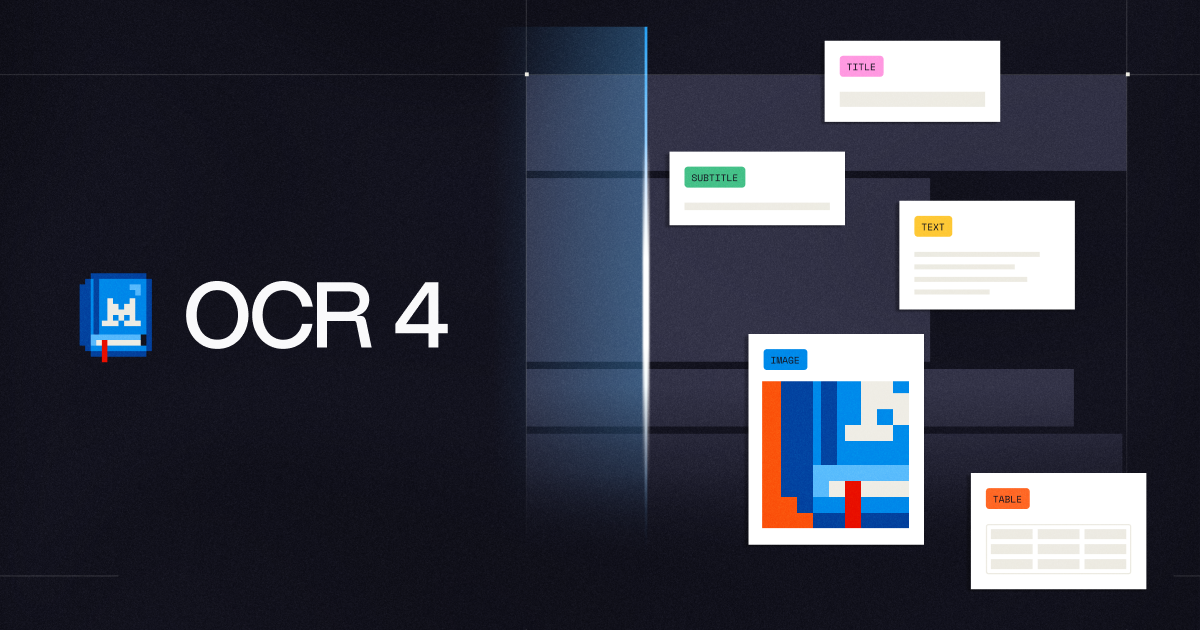
Mistral OCR 4: A Leap in Document Intelligence
Mistral AI has released OCR 4, its fourth generation Optical Character Recognition model, promising substantial improvements in speed and accuracy for document processing. This release targets developers and enterprises grappling with the increasing volume and complexity of digital and scanned documents. The new model aims to streamline workflows, reduce manual data entry, and unlock deeper insights from unstructured text. OCR 4 builds upon its predecessors with architectural refinements and expanded training datasets. Early benchmarks indicate a significant reduction in processing time, making real-time document analysis more feasible. Accuracy has also seen a marked increase, particularly for documents with varied layouts, low-quality scans, and non-standard fonts. This enhanced performance is crucial for applications ranging from financial document analysis and legal discovery to medical record processing and intelligent automation.
Key Advancements in OCR 4
The core of OCR 4's performance boost lies in its novel neural network architecture. Mistral AI has moved towards a more transformer-based approach, allowing the model to better understand context and relationships between words and characters within a document. This is a departure from more traditional convolutional approaches that often struggled with long-range dependencies. The model now treats document elements more holistically, akin to how a human reads and interprets a page, rather than processing text in isolated chunks. One of the most notable improvements is in handling tables and forms. OCR 4 demonstrates a superior ability to identify table structures, extract cell data accurately, and maintain row/column integrity. This has been a persistent challenge for many OCR solutions, often requiring complex post-processing steps. The new model integrates table detection and data extraction more seamlessly, reducing the need for specialized pre-processing pipelines. Similarly, form field recognition and data extraction have been refined, making it easier to populate databases from scanned forms. Another critical area of advancement is multilingual support. While previous versions offered multilingual capabilities, OCR 4 has been trained on a significantly larger and more diverse set of languages and scripts. This includes better handling of languages with complex character sets and right-to-left writing systems. The model's ability to accurately detect and process text across multiple languages within a single document has also been enhanced, a common requirement for global enterprises.Performance Benchmarks and Accuracy Gains
Mistral AI has published preliminary benchmarks showing OCR 4 achieving up to a 30% increase in processing speed compared to OCR 3 on equivalent hardware. This acceleration is attributed to optimized inference engines and more efficient model weights. For developers integrating OCR into high-throughput systems, this speed increase translates directly into lower operational costs and greater scalability. Accuracy improvements are equally impressive. On standard benchmark datasets like ICDAR and custom enterprise datasets, OCR 4 has shown an average error rate reduction of 15-20%. This gain is particularly pronounced on challenging documents, such as those with handwritten annotations, faded print, or significant noise. The model's confidence scores for extracted text have also become more reliable, providing users with a clearer indication of data trustworthiness.