
Miora: An AI-Powered Canvas for Creative Professionals
Miora has launched, introducing a novel approach to creative work by combining an editable canvas with advanced agent memory capabilities. The platform aims to empower creators by allowing them to scale their creative output with intelligent assistance.
At its core, Miora functions as an interactive workspace where users can generate and manipulate creative assets. Unlike traditional design tools that rely solely on manual input, Miora integrates AI agents that possess 'memory.' This memory allows the agents to recall previous interactions, understand context, and build upon prior work, leading to more coherent and iterative creative processes. Think of it less like a static design tool and more like a collaborative partner who remembers your project's history and preferences, offering suggestions that are consistently relevant.
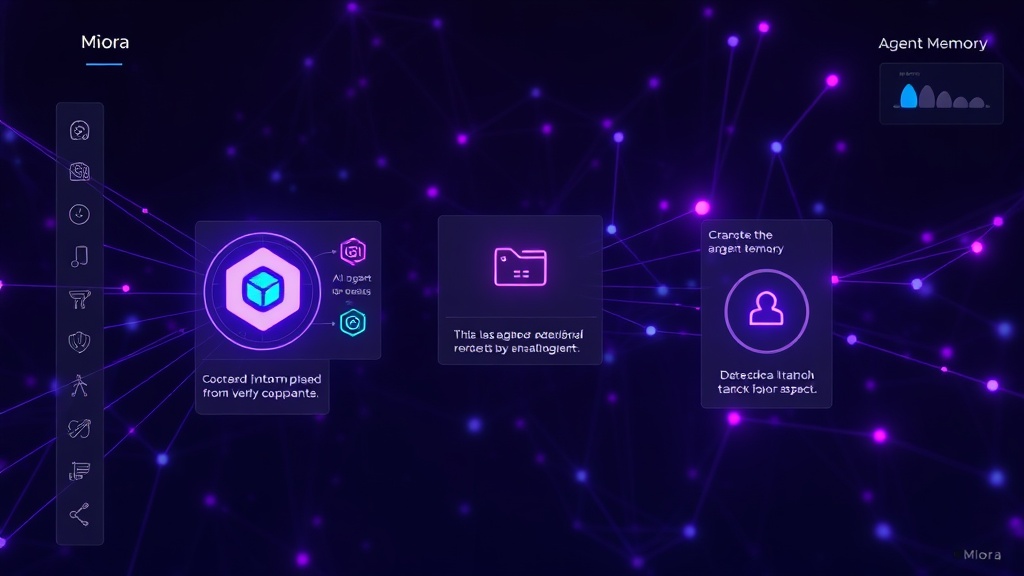
The Power of Agent Memory
The key differentiator for Miora is its implementation of agent memory. In AI systems, memory typically refers to the ability to store and retrieve information from past interactions. For creative applications, this translates into agents that can:
- Maintain Context: Agents remember the project's theme, style, and specific user requests across sessions.
- Iterative Refinement: Users can ask for modifications to generated content, and the AI will understand the request in relation to what has already been created.
- Personalized Assistance: Over time, the agents learn the user's unique aesthetic preferences and working style, providing more tailored suggestions.
- Complex Task Handling: By remembering sequences of operations, agents can assist with more complex, multi-step creative tasks that would typically require significant manual effort.
This persistent memory is crucial for projects that evolve over time. A designer working on a brand identity, for instance, can rely on Miora's agents to recall logo variations, color palettes, and typography choices previously approved or rejected, ensuring consistency and accelerating the design iteration cycle. This is a significant departure from stateless AI models that treat each prompt in isolation.
Scaling Creativity and Workflow Efficiency
Miora's stated goal is to help creators scale their output without sacrificing quality or control. The editable canvas aspect ensures that users are not merely generating one-off images but are working within a flexible environment where elements can be precisely positioned, resized, and modified. The AI agents act as intelligent assistants, generating initial concepts, suggesting variations, or even performing repetitive editing tasks based on user direction and their stored memory.
For solo creators, this could mean the ability to produce a higher volume of high-quality assets for marketing, social media, or personal projects. For teams, Miora offers a potential platform for collaborative creativity, where shared agent memory can ensure everyone is working with the same project context and brand guidelines. The platform aims to reduce the friction typically associated with translating abstract ideas into tangible creative outputs.
Potential Applications and Future Implications
The implications for various creative fields are substantial. Graphic designers can leverage Miora for rapid prototyping of logos, social media graphics, and ad creatives. Illustrators might use it to generate base elements or explore different stylistic directions. Content creators could find it invaluable for producing visual assets for blogs, videos, and presentations. The editable canvas ensures that the output is not a black box but a set of components that can be integrated into existing design workflows.
The success of Miora will likely hinge on the robustness of its agent memory implementation and the intuitive nature of its editable canvas. If the agents can reliably recall and apply context, and if the canvas provides the fine-grained control designers expect, Miora could carve out a significant niche. The platform raises an interesting question: as AI agents become more context-aware and capable of long-term memory, how will this fundamentally change the definition of creative authorship and the tools we use to express ourselves?