Markdown as the Foundation, Not an Afterthought
Most mind-mapping applications treat Markdown as a final output. You build your visual map, then export it to Markdown. Prasad Patil, the creator of MindSpark, envisioned the opposite. He wanted the mind map to be the Markdown outline. This core constraint drove the design of MindSpark, offering a unique approach to knowledge organization and visualization.
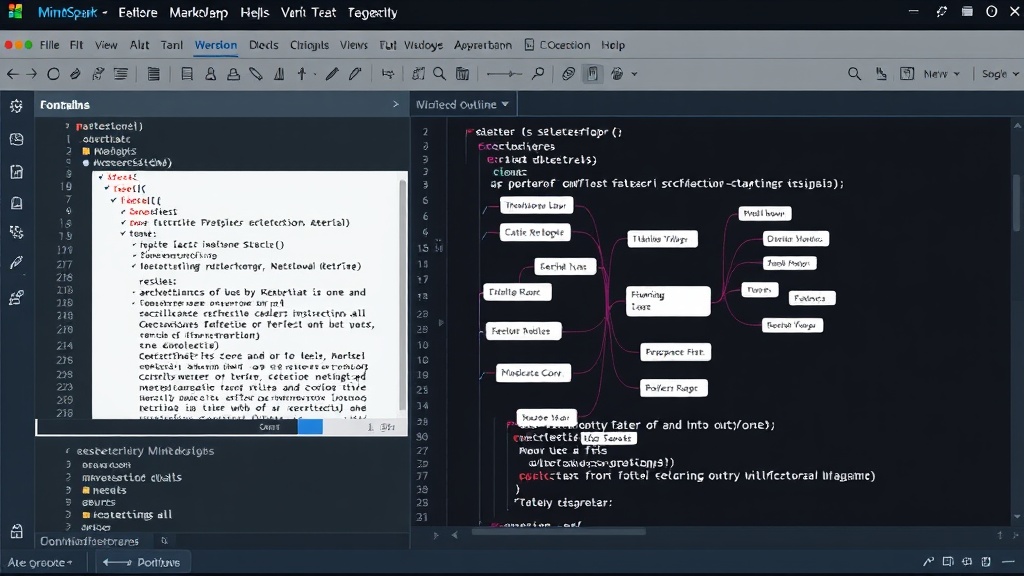
The traditional mind map is a visual hierarchy. Markdown, at its heart, is a plain text format for structuring documents, often used for outlines and notes. Patil’s insight was to bridge these two worlds directly. Instead of a one-way street from visual map to text, MindSpark allows users to work directly in Markdown, with the visual map dynamically reflecting the outline. This means bulk edits in a familiar text editor translate directly into changes in the mind map diagram, and vice-versa.
This fundamental shift addresses a common pain point: the disconnect between ephemeral notes and structured visual aids. Developers, writers, and researchers often start with outlines or raw thoughts in text files. Converting these into a visual mind map can be cumbersome, and updating the visual map after the initial creation often requires manual intervention in specialized software. MindSpark aims to eliminate this friction by treating the Markdown file as the single source of truth.
Solving the Sync Problem
The most significant technical challenge in this approach is maintaining perfect synchronization between the text-based Markdown outline and the live, visual canvas. When a user edits the Markdown text, the diagram must update instantly. Conversely, manipulating the diagram (e.g., rearranging nodes, collapsing branches) needs to be reflected accurately in the Markdown.
Several issues arise in this two-way sync process. Folding nodes in the Markdown outline, for instance, must correspond to collapsing branches on the visual map. Word wrap in the text editor needs to be handled gracefully without breaking the visual structure. Syntax highlighting, a standard feature in Markdown editors, must also be managed to ensure it doesn't interfere with the diagramming logic.
Patil’s solution involves a robust synchronization engine. This engine listens for changes in both the text input and the canvas manipulation. When a change occurs, it parses the updated state and redraws the corresponding element. For folding, the system tracks which branches are collapsed in the visual representation and applies corresponding indentation or comment markers in the Markdown. Word wrap is handled by ensuring the visual renderer respects text boundaries without altering the underlying Markdown structure. Syntax highlighting is applied to the raw Markdown text, separate from the visual rendering engine, ensuring clarity in both views.
The Formula Engine: Beyond Simple Hierarchies
MindSpark introduces an unusual feature for a mind-mapping tool: a formula engine. This allows users to embed calculations within their mind maps, similar to spreadsheet functionality. For example, a node could display the SUM of its children’s values. This capability moves mind mapping beyond purely hierarchical organization into data aggregation and analysis.
Consider a project management mind map. Each task could have an estimated effort value. A parent task could then automatically display the total effort required for all its sub-tasks using a formula like SUM(children). This provides immediate, dynamic insights into project scope and resource allocation without manual recalculation.
This formula engine is not merely a gimmick; it extends the utility of mind maps for quantitative tasks. It allows for rollups, aggregations, and conditional logic directly within the knowledge structure. This makes MindSpark suitable for use cases that require not just outlining ideas but also performing basic data analysis on those ideas.
Ownership Philosophy: Self-Hosting and GitHub Integration
Patil emphasizes an ownership philosophy for MindSpark, centering on self-hosting and direct integration with Git repositories. The tool offers both a hosted version and a self-hostable option. The static mode, which leverages a GitHub repository as its storage, is particularly noteworthy.
In this mode, your mind map lives entirely within a Git repository. The Markdown files are the primary artifacts. This offers several advantages:
- Version Control: Every change is tracked by Git, providing a complete history and the ability to revert to previous states.
- Collaboration: Teams can collaborate on mind maps using standard Git workflows (pull requests, branching, merging).
- Data Portability: Your data is always in plain text Markdown files, ensuring long-term accessibility and freedom from vendor lock-in.
- Offline Access: The Markdown files can be edited offline using any text editor, with changes syncing back when online.
This approach aligns with the ethos of developer tools that prioritize open standards, data ownership, and seamless integration into existing workflows. By treating a GitHub repo as the storage backend, MindSpark positions itself as a tool that respects user control over their data and integrates naturally with development pipelines.
What's Next for MindSpark
The roadmap for MindSpark includes further enhancements to the synchronization engine, expanding the formula capabilities, and improving the user interface. Patil has also made the project open source, inviting contributions and issue filings from the community. The goal is to build a flexible, user-centric tool that redefines how people structure and visualize their thoughts and projects.
The underlying principle remains: Markdown should be the core, not an export. This philosophy promises a more integrated and powerful experience for anyone who relies on both text-based notes and visual diagrams to organize their work.