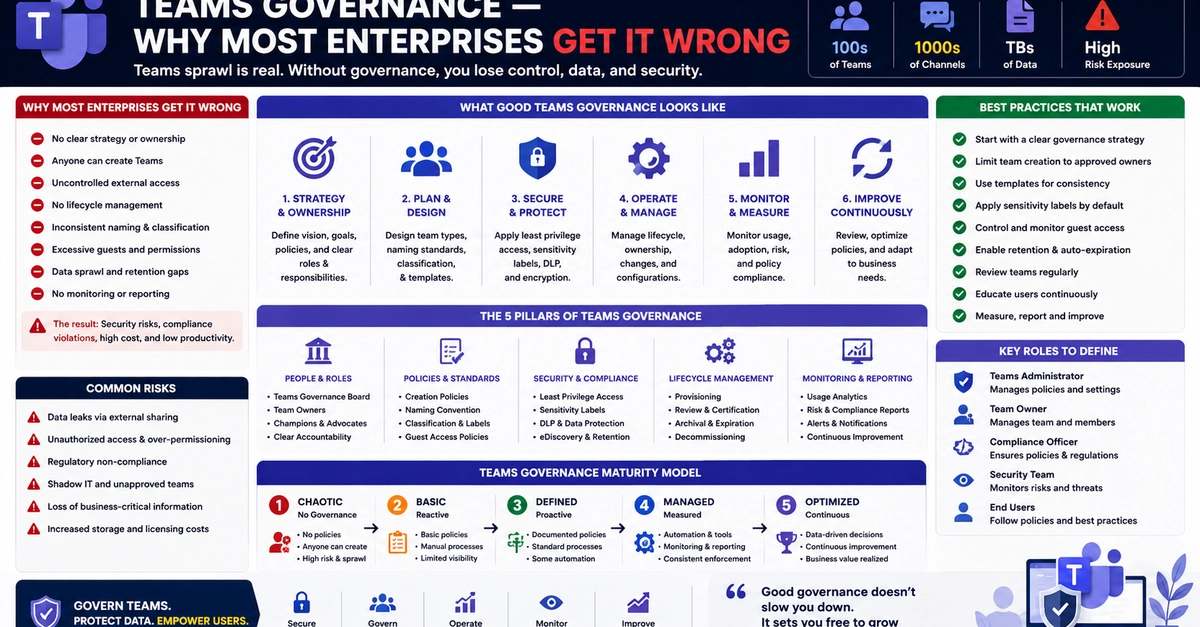
The Collaboration Platform That Became a Governance Nightmare
Microsoft Teams was deployed at extraordinary speed across the enterprise world. In most organizations, the timeline was stark: March 2020, global pandemic, remote work mandate, Teams switched on, everyone told to use it, and governance deferred because there was no time. Five years later, the governance that was deferred has still not been implemented in most of those environments. The result is predictable and consistent across industries: Teams sprawl at industrial scale. Hundreds of Teams that nobody owns. Channels for projects that ended three years ago. Guest users from partnerships that dissolved. Sensitive conversations in channels that include contractors who should not have visibility. Files shared in Teams, unmanaged, unmonitored, and uncataloged.
This situation is not a minor inconvenience; it's a ticking time bomb for security, compliance, and operational efficiency. The very tool designed to enhance collaboration has become a significant burden, creating a chaotic digital environment that is difficult to manage, audit, and secure.
The Root Cause: Deferred Governance
The primary culprit is the deferral of governance. When Teams was rapidly adopted, the focus was on enabling remote work and ensuring business continuity. IT departments and leadership teams made a pragmatic decision: get the tool out to users, and figure out the rules later. This "figure it out later" approach, while understandable in a crisis, has proven disastrous in the long run. Governance policies, access controls, lifecycle management, and data retention strategies were all sacrificed for expediency. Now, organizations are left to untangle a massive mess.
Consider the sheer volume of data. Every channel, every chat, every file shared within Teams represents a piece of an organization's digital footprint. Without proper governance, this data becomes a black hole. Sensitive documents might reside in a team owned by an employee who has since left the company, with no one else having the necessary permissions to access or manage them. Compliance officers struggle to conduct audits when they can't even identify who owns a particular Team or what data it contains. This lack of ownership and oversight creates significant risks.
Consequences of Unmanaged Teams Sprawl
The consequences of this deferred governance are manifold and severe:
- Security Risks: Unmanaged guest access is a gaping security hole. Former partners, contractors, or even external malicious actors could retain access to sensitive information long after their legitimate need has expired. Sensitive data, including intellectual property, customer information, or financial reports, can be exposed to unauthorized individuals. The absence of clear access policies means that permissions are often overly broad, granting more access than necessary to internal users as well.
- Compliance Nightmares: Regulatory bodies demand clear data management and retention policies. With Teams sprawl, it's nearly impossible to enforce these. Identifying and retrieving data for legal discovery or compliance audits becomes a Herculean task. Data retention policies are bypassed if Teams and their associated data are not properly cataloged and managed. This can lead to hefty fines and legal repercussions.
- Operational Inefficiency: Users waste time searching for information across countless, often redundant, Teams and channels. Duplicate files proliferate, leading to version control issues and confusion. Onboarding new employees becomes more challenging as they navigate a complex, unorganized environment. IT support teams are overwhelmed with requests related to access issues, team creation, and data recovery from orphaned Teams.
- Loss of Control: The uncontrolled creation of Teams means that IT loses visibility and control over the collaboration landscape. Shadow IT can flourish, with departments creating their own Teams without adhering to organizational standards or security protocols. This undermines any attempts at a unified digital workplace strategy.
What Does Good Governance Look Like?
Implementing effective Teams governance is not a one-time project; it's an ongoing process. It requires a strategic approach that balances collaboration needs with security and compliance requirements. Key components include:
- Clear Ownership: Every Team must have a designated owner responsible for its content, membership, and lifecycle. This owner should be a living, breathing individual within the organization, not a generic mailbox.
- Lifecycle Management: Establish policies for Team creation, review, archiving, and deletion. Teams for projects that have concluded should be archived or deleted after a defined period. Regular reviews of Team membership and purpose are essential.
- Access Control Policies: Define clear rules for internal and external access. Implement mechanisms to manage guest access, ensuring it is time-bound and regularly reviewed. Principle of least privilege should be applied rigorously.
- Data Retention and Archiving: Integrate Teams governance with organizational data retention policies. Define how long data in Teams should be kept and how it should be archived. This is critical for compliance and eDiscovery.
- Naming Conventions and Descriptions: Enforce consistent naming conventions for Teams and channels to improve discoverability and organization. Require clear descriptions for each Team, outlining its purpose and content.
- Training and Awareness: Educate users on governance policies, their responsibilities as Team owners or members, and the importance of adhering to these rules.
The Path Forward: Reclaiming Control
The challenge of Teams governance is significant, but not insurmountable. Organizations must move beyond the reactive approach and adopt a proactive strategy. This often requires a cultural shift, emphasizing the shared responsibility for maintaining a secure and organized digital workspace. Tools and automation can play a crucial role, helping to identify orphaned Teams, enforce policies, and streamline the governance process. However, technology alone is not a panacea; it must be coupled with clear policies, executive buy-in, and ongoing user education.
For many enterprises, the journey will involve an audit of existing Teams to identify rogue or unmanaged environments, followed by the implementation of new policies and potentially the use of third-party governance tools. The goal is to transform Teams from a source of chaos into a truly productive, secure, and compliant collaboration platform. The time to address this deferred governance is long overdue.