Microsoft Scales AI Infrastructure with AMD Partnership
Microsoft is set to significantly bolster its artificial intelligence capabilities on Azure by deploying AMD's Helios rack-scale AI accelerator solution at scale. This strategic move will integrate AMD's latest Radeon Instinct MI455X GPUs and Epyc Venice processors into Microsoft's cloud infrastructure, aiming to provide enhanced performance and capacity for AI workloads. The partnership signifies a growing trend of major cloud providers diversifying their hardware suppliers to meet the voracious demand for AI compute power, moving beyond the dominance of a single vendor.
The deployment of AMD's Helios platform is designed to offer a cohesive, high-density solution for AI training and inference. Rack-scale systems, unlike individual server deployments, are engineered from the ground up to optimize for the specific demands of large-scale AI computations. This includes high-speed interconnects between GPUs, efficient power and cooling, and streamlined management, all crucial for handling the massive datasets and complex models that characterize modern AI development. For Microsoft, this partnership represents a direct effort to broaden its AI hardware ecosystem, offering customers more choice and potentially more competitive pricing for AI services.
Helios: A Rack-Scale AI Solution
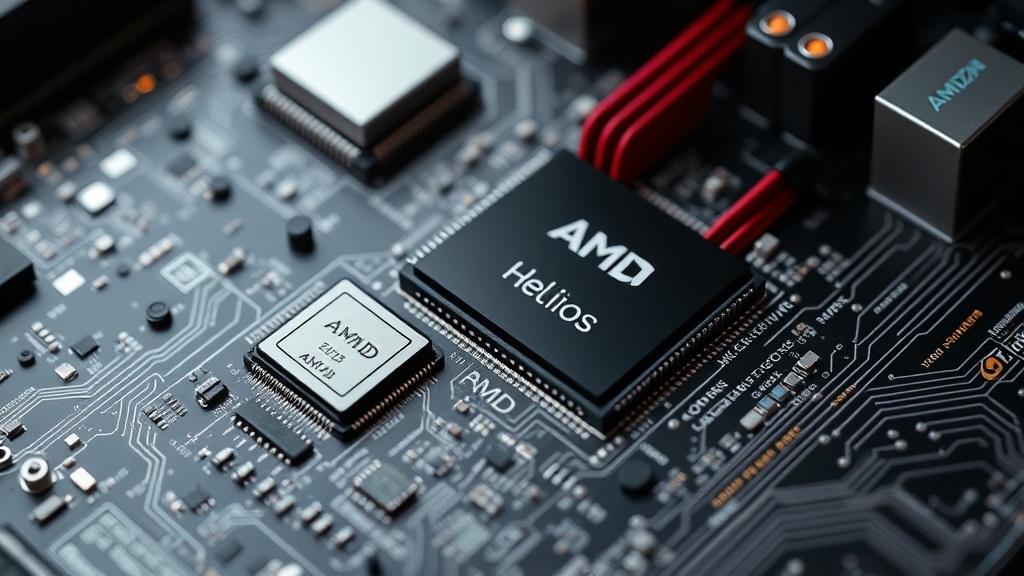
AMD's Helios is not just a collection of individual components; it's a designed system. It aims to provide a turnkey solution for data centers looking to deploy AI infrastructure rapidly and efficiently. The MI455X GPU, based on AMD's CDNA architecture, is engineered for high-performance computing and AI tasks, focusing on delivering substantial FLOPS and memory bandwidth. When combined with AMD's Epyc Venice server processors, which offer high core counts and robust I/O capabilities, Helios creates a powerful foundation for demanding AI workloads. The 'rack-scale' aspect is critical here. Think of it less like buying individual computer parts and more like ordering a fully assembled, high-performance supercomputer module designed for a specific, intense task – in this case, AI.
The MI455X GPU is expected to offer competitive performance in AI training and inference. While NVIDIA has long held a dominant position in this market, AMD has been steadily improving its offerings. The MI455X is likely to feature advanced memory technologies and high-speed interconnects, such as Infinity Fabric, to ensure that GPUs can communicate with each other and with the CPU with minimal latency. This is paramount for distributed training, where a single AI model is trained across hundreds or thousands of accelerators simultaneously. The Epyc Venice processors, on the other hand, will serve as the computational backbone, handling data preprocessing, model orchestration, and other essential CPU-bound tasks.
Strategic Implications for Azure and the Cloud Market
Microsoft's decision to adopt AMD's Helios at scale on Azure is a significant move in the intensifying cloud AI race. For years, the AI hardware landscape has been heavily dominated by NVIDIA's GPUs. While Microsoft has undoubtedly been a major consumer of NVIDIA's offerings, diversifying its hardware portfolio is a strategic imperative. This diversification can lead to several benefits: reduced reliance on a single supplier, improved cost-efficiency through competitive bidding, and the ability to tailor hardware configurations to specific customer needs or emerging AI workloads. It also signals a maturation of AMD's AI hardware capabilities, moving from individual component sales to integrated, system-level solutions that enterprise customers like Microsoft are increasingly seeking.
The availability of AMD hardware on Azure provides developers and businesses with more options when building and deploying AI applications. This increased competition in the AI hardware-as-a-service market could drive innovation and lead to better pricing structures for AI compute. For enterprises already invested in AMD's CPU ecosystem, the introduction of their GPUs and AI accelerators on Azure might offer a more seamless integration path. Furthermore, this move could encourage other cloud providers to consider or expand their offerings of AMD-based AI infrastructure, fostering a more balanced market.
What remains to be seen is the specific performance uplift and cost savings that this deployment will translate into for Azure customers. While the technical specifications of the MI455X and Epyc Venice processors are promising, real-world performance in diverse AI workloads will be the ultimate determinant of success. Microsoft will need to demonstrate clear advantages, whether in raw speed, energy efficiency, or total cost of ownership, to encourage widespread adoption of these new AMD-powered instances on Azure.
Broader Industry Trends
The deepening partnership between Microsoft and AMD reflects a broader industry trend: the commoditization of AI hardware. As the demand for AI compute continues to skyrocket, driven by generative AI, large language models, and advanced analytics, cloud providers are under immense pressure to scale their infrastructure rapidly and cost-effectively. This pressure is forcing them to look beyond traditional suppliers and explore a wider range of hardware solutions. We are seeing a parallel trend in the development of custom silicon by hyperscalers, but the integration of established third-party AI accelerators like AMD's Helios at scale is a more immediate and pragmatic approach for many.
This move also positions AMD as a more formidable competitor in the AI accelerator market, directly challenging NVIDIA's long-standing dominance. By securing a large-scale deployment with a major cloud provider like Microsoft, AMD gains critical validation and a significant revenue stream. It signals that their AI hardware is maturing to a point where it can meet the stringent requirements of hyperscale cloud environments. For the AI community, this increased hardware diversity is a net positive, promising more choice, potentially lower costs, and accelerated innovation in the field.