Beyond Framework Preference: A Control Model Shift
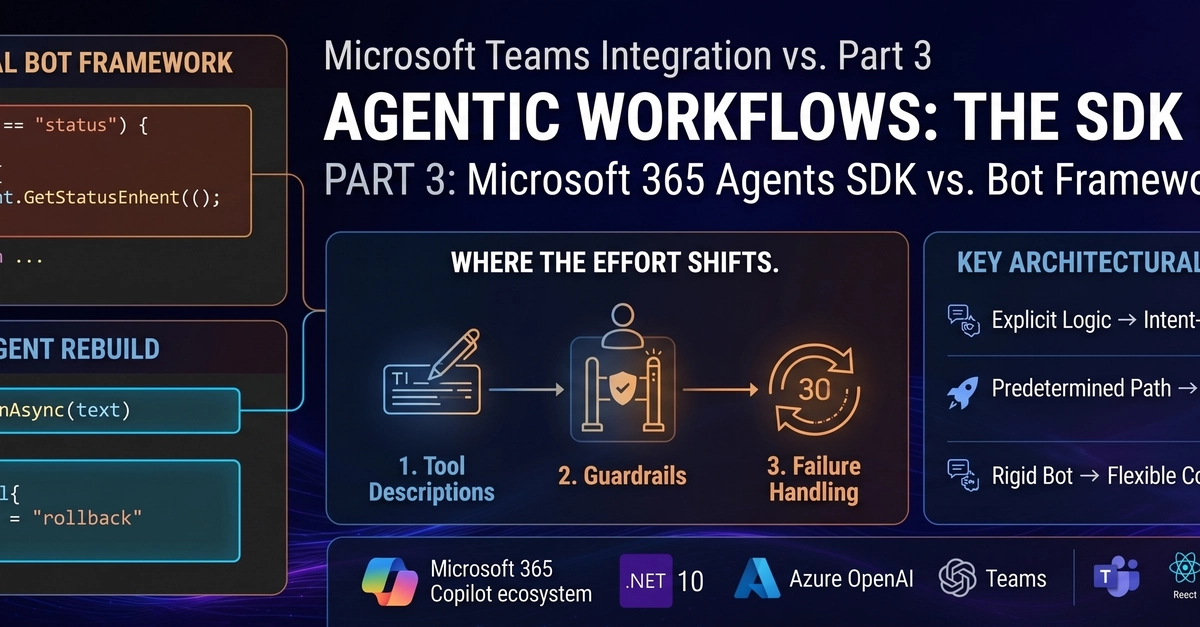
The conversation around Microsoft's Agent SDK and the traditional Bot Framework often centers on framework preference. This framing misses the core distinction: a fundamental shift in control models. While both enable conversational AI experiences, the M365 Agents SDK moves the locus of control from the developer's explicit code to a more declarative, orchestrator-driven approach, deeply integrated with Microsoft 365 data and capabilities. This isn't merely an evolution of the Bot Framework; it represents a different philosophy for building intelligent agents.
Part one of this discussion laid out the high-level differences. Now, let's ground these concepts in tangible code and engineering effort. Understanding where the development work shifts is crucial for any team considering this transition.
The Engineering Effort: Where the Work Shifts
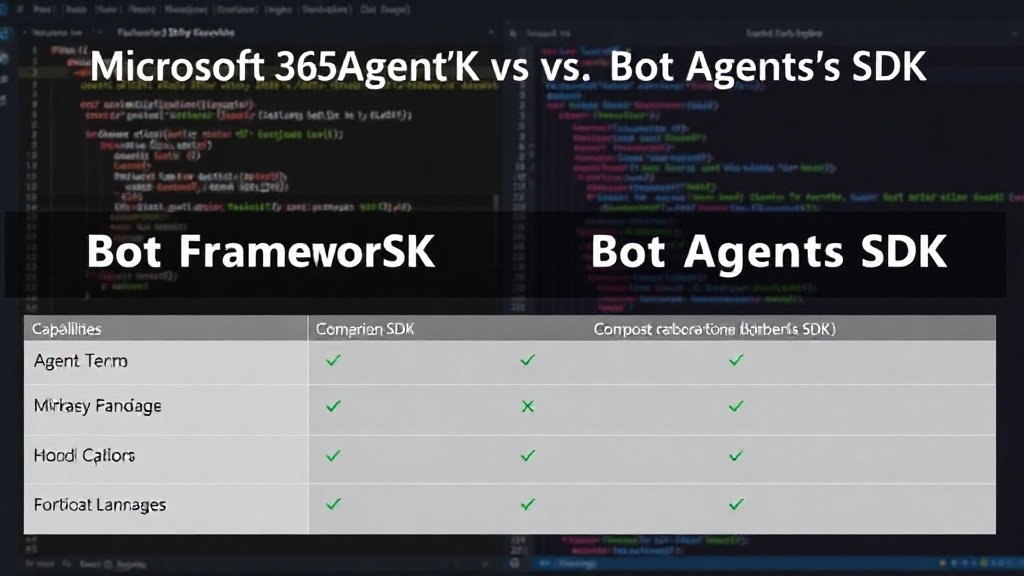
The table above, often skimmed, reveals the heart of the matter. With the Bot Framework SDK, developers are in the driver's seat. They meticulously define conversation flows, manage state, integrate with various services, and explicitly code the logic for every user turn. This offers granular control but demands significant upfront and ongoing engineering. Every piece of logic, every data fetch, every conditional branch is a line of code written and maintained by the developer.
Consider a simple task: retrieving a user's latest email and summarizing it. In the Bot Framework, this involves:
- Setting up authentication for Microsoft Graph.
- Writing code to call the Graph API for emails.
- Implementing logic to identify the latest email.
- Potentially integrating a separate NLP service for summarization, or writing custom summarization logic.
- Crafting the response to present the summary to the user.
Each of these steps requires explicit coding, error handling, and state management within the bot's core logic. The developer is responsible for the entire orchestration.
The Agent SDK Approach: Declarative Orchestration
The Microsoft 365 Agents SDK flips this script. Instead of dictating every step, developers define the agent's capabilities, its access to data (e.g., emails, calendar, files), and its goals. The underlying Microsoft 365 platform, empowered by AI, takes on the role of orchestrator. The developer declares *what* the agent should be able to do and *what* data it can access, rather than *how* to do it step-by-step.
Revisiting the email summarization task with the Agents SDK looks fundamentally different:
- The developer declares the agent can access the user's email and has a summarization capability (likely leveraging a pre-trained or fine-tuned model).
- The agent's definition specifies the data sources (emails) and the desired action (summarize).
- The M365 platform, using its understanding of user intent and available tools, orchestrates the call to Microsoft Graph, retrieves the email, invokes the summarization capability, and formats the output.
The engineering effort shifts from writing procedural logic for data retrieval and processing to defining the agent's persona, its toolset, its access permissions, and its high-level objectives. The complex, often repetitive, task of state management and API interaction is largely abstracted away and handled by the platform.
The Surprising Trade-off: Control vs. Productivity
The surprising detail here is not the abstraction itself, but the profound shift in the developer's role. It moves from being a meticulous architect of conversational flows to a strategic director of an AI-powered assistant. This grants immense productivity gains, especially for complex M365-integrated scenarios, but it comes at the cost of the granular, turn-by-turn control developers have grown accustomed to with the Bot Framework. If a specific, non-standard interaction sequence is required, or if deep customization of the core orchestration logic is paramount, the M365 Agents SDK might present a steeper learning curve or require a different architectural pattern than a traditional bot.
What This Means for Development Workflows
For developers accustomed to the Bot Framework, rebuilding a bot as an agent involves a mental model reset. The focus shifts from state machines and explicit dialog management to defining capabilities, permissions, and orchestrator prompts. Debugging also changes; instead of stepping through lines of code, developers might analyze execution traces of the agent's decision-making process and its interactions with M365 services.
This shift is analogous to moving from manual car manufacturing to using advanced robotics and AI in a factory. The individual worker's role changes from assembling each part to programming, overseeing, and optimizing the automated systems. The potential for scale and complexity is vastly increased, but the intimate, hands-on control over every single component is reduced.
The Future: Agents as the New Standard?
The M365 Agents SDK represents Microsoft's vision for intelligent, data-aware applications deeply embedded within the productivity suite. While the Bot Framework will undoubtedly remain relevant for custom, standalone conversational experiences, agents built with the new SDK are poised to become the de facto standard for applications that need to leverage M365 data and functionalities contextually. If you're building an application that needs to interact with user emails, calendars, or documents in a sophisticated, AI-driven manner, understanding and adopting the Agents SDK paradigm is no longer optional—it's a prerequisite for building the next generation of M365-integrated tools.