The Cascading Failure That Took Down Everything
Imagine this: your payment service experiences a brief, 3-minute outage. To you, it seems like a minor blip. But for every other service that relies on payments, the situation quickly escalates. These services, programmed to retry failed requests, launch into a 'retry storm.' Each retry consumes valuable network connections and system resources. Within 10 minutes, what started as a 3-minute failure in one service has cascaded, taking down all 12 interconnected services for 45 minutes. This is the costly reality of unmanaged microservice dependencies, and it's precisely why circuit breakers are not a luxury, but a necessity.
Circuit breakers act as a critical safety mechanism, preventing a single point of failure from crippling your entire distributed system. They introduce a controlled way to handle downstream service unavailability, ensuring that a temporary problem doesn't become a system-wide catastrophe.
How Circuit Breakers Work: A State Machine Approach
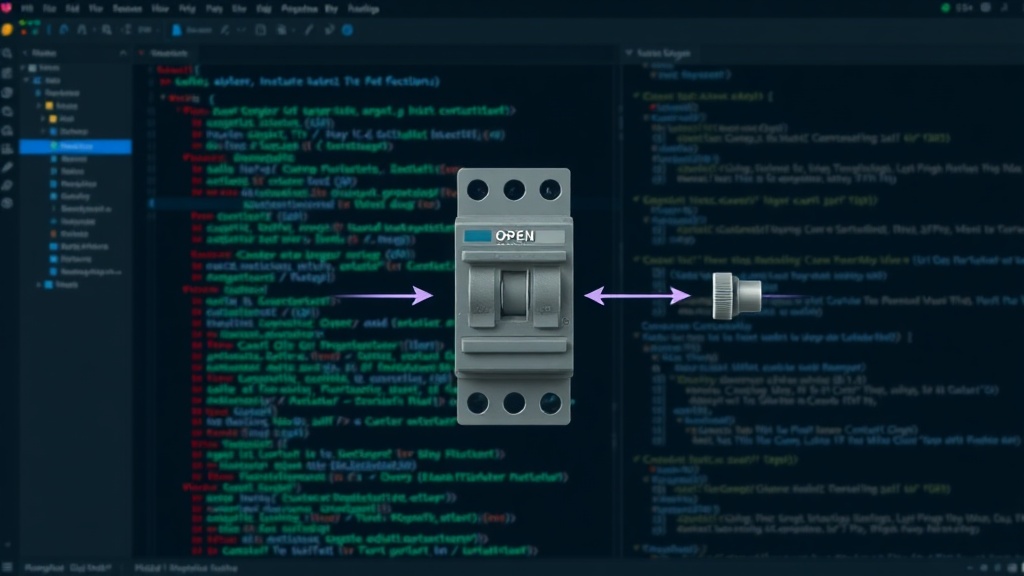
At its core, a circuit breaker operates like a state machine, managing the flow of requests to a potentially failing service. The three primary states are CLOSED, OPEN, and HALF-OPEN.
CLOSED State
In the CLOSED state, the circuit breaker functions normally. All requests from the client application are allowed to pass through to the downstream service. The circuit breaker continuously monitors the number of failures (e.g., timeouts, network errors, specific error codes) occurring within a defined window or a set number of requests. If the failure rate exceeds a predetermined threshold, the circuit breaker transitions to the OPEN state.
OPEN State
Once in the OPEN state, the circuit breaker immediately fails any incoming requests to the downstream service. It does not even attempt to send the request. This 'fast failure' is crucial; it prevents the client application from wasting resources on requests that are almost certain to fail and, importantly, stops the retry storms that can overwhelm the struggling service. After a configured timeout period elapses, the circuit breaker transitions to the HALF-OPEN state.
HALF-OPEN State
The HALF-OPEN state is a probationary period. The circuit breaker allows a single test request (or a small, controlled batch of requests) to pass through to the downstream service. If this test request succeeds, it indicates that the downstream service may have recovered. The circuit breaker then transitions back to the CLOSED state, resuming normal operation. However, if the test request fails, the circuit breaker immediately returns to the OPEN state, and the timeout period restarts. This ensures that the system doesn't prematurely resume sending traffic to a service that is still unstable.
Implementing Circuit Breakers
Adding circuit breakers to your microservices architecture involves selecting an appropriate library or implementing the logic yourself. Many popular frameworks and libraries offer built-in circuit breaker patterns.
Choosing the Right Library
For Java, libraries like Resilience4j and Hystrix (though Hystrix is in maintenance mode) are popular choices. Python developers might look at libraries like `pybreaker` or `tenacity`. In .NET, Polly is a widely adopted resilience library that includes circuit breaker functionality. Node.js has options like `opossum`. The choice often depends on your technology stack and specific requirements for configuration and monitoring.
Configuration Best Practices
Effective circuit breaker implementation requires careful configuration:
- Failure Threshold: Define what constitutes a failure (e.g., HTTP 5xx errors, connection timeouts) and set a sensible threshold. This could be a percentage of requests (e.g., 50% failures) or a fixed number of errors within a rolling window.
- Timeout Period: Configure the time the breaker stays in the OPEN state. This should be long enough for the downstream service to recover but not so long that it significantly impacts user experience.
- Test Request Count: In the HALF-OPEN state, decide how many requests to allow through for testing. A single request is common, but a small batch can provide more confidence.
- Metrics and Monitoring: Crucially, circuit breakers should emit metrics. You need to know when a breaker trips, when it resets, and the failure rates it's observing. This visibility is essential for debugging and understanding system health.
Beyond Basic Implementation: Advanced Considerations
While the basic state machine is the foundation, real-world implementations often include advanced features:
- Bulkheads: These isolate elements of an application into pools so that if one element fails, the others will continue to function. Think of them like watertight compartments on a ship; a breach in one compartment doesn't sink the whole vessel.
- Rate Limiting: While not strictly a circuit breaker function, rate limiting often complements it by controlling the number of requests sent to a service, preventing overload even before the circuit breaker needs to trip.
- Fallback Mechanisms: When a circuit breaker trips (is OPEN), you can define fallback logic. This could involve returning cached data, a default response, or a simplified version of the service's functionality. This ensures that the client application can still provide some level of service to the user, even if a dependency is unavailable.
The Unanswered Question: Proactive vs. Reactive Tripping
The standard circuit breaker pattern is reactive; it trips open only after a service has already started failing. What nobody has addressed yet is the potential for a more proactive approach. Could systems learn to predict impending failures based on subtle network latency increases or unusual request patterns, tripping the breaker *before* the first actual error occurs? This could prevent even the briefest moments of degraded performance.
Conclusion: Resilience Through Controlled Failure
Microservices architectures offer flexibility and scalability, but they introduce complexity in managing inter-service dependencies. Uncontrolled retries in the face of failures are a primary cause of cascading outages. Implementing circuit breakers is a fundamental step towards building resilient systems. They allow your services to gracefully degrade, prevent retry storms, and provide essential visibility into the health of your distributed applications. If your microservices communicate over a network, circuit breakers are not optional; they are a core component of robust system design.