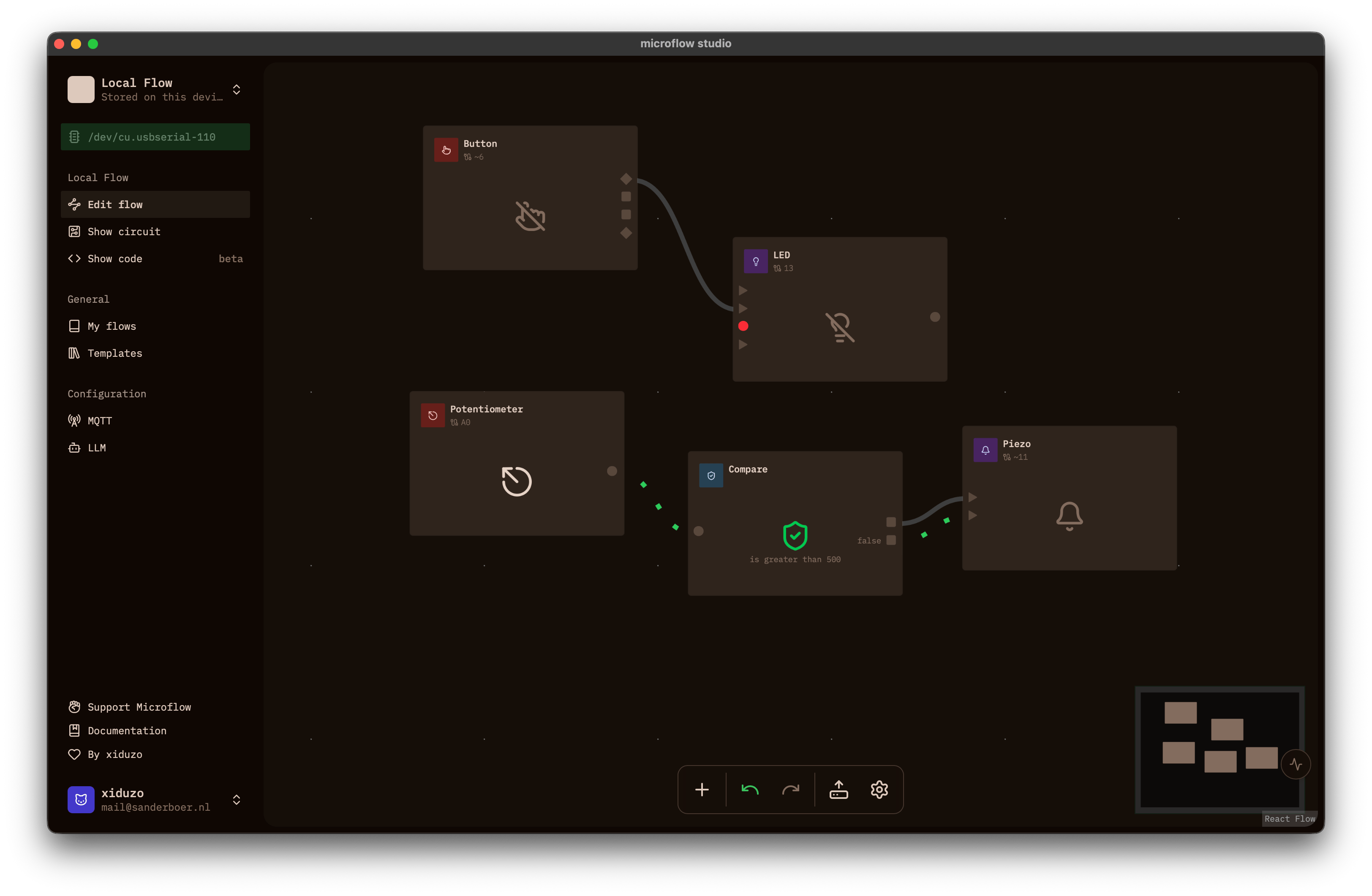
Microcontrollers Made Simple
Microcontrollers are the unsung heroes of modern technology. They power everything from smart thermostats and digital watches to complex industrial machinery and advanced robotics. Yet, for many aspiring developers and creators, the barrier to entry for microcontroller programming remains surprisingly high. Traditional development often requires deep knowledge of low-level languages like C/C++, intricate hardware understanding, and complex toolchains. This steep learning curve can deter individuals with great ideas but limited embedded systems expertise.
Enter Microflow, a new platform aiming to democratize microcontroller development. The core premise is elegantly simple: abstract away the complexities of hardware and low-level programming, allowing users to focus on the logic and functionality of their projects. This approach is designed to significantly lower the barrier to entry, making embedded systems development accessible to a much broader audience, including hobbyists, students, and even those from non-traditional tech backgrounds.
The Microflow Approach
Microflow tackles the complexity of microcontroller programming through a visual, flow-based interface. Instead of writing lines of code, users assemble functional blocks that represent common operations. These blocks are interconnected to define the program's logic. Think of it less like writing a novel and more like building with LEGOs – each block has a specific purpose, and snapping them together creates a functional whole. This visual paradigm offers several key advantages:
- Intuitive Logic Representation: Flowcharts and visual programming paradigms are inherently easier to grasp than abstract code for many. Users can see the data flow and control flow of their program laid out before them, making it easier to understand, debug, and modify.
- Reduced Syntax Errors: By using pre-defined blocks, the risk of syntax errors, a common frustration for beginners in traditional coding, is dramatically reduced. The platform handles the translation of these visual blocks into executable code.
- Faster Prototyping: The ability to quickly assemble and rearrange functional blocks allows for rapid prototyping. Developers can iterate on ideas much faster, testing different approaches without extensive re-coding.
The platform aims to support a range of popular microcontrollers, ensuring that projects built with Microflow can be deployed on real-world hardware. While specific microcontroller compatibility details are still emerging, the goal is to provide a versatile tool that bridges the gap between simple hobbyist boards and more professional embedded applications.
Target Audience and Potential Impact
Microflow is positioned to appeal to several key demographics. For educators and students, it offers a powerful tool for teaching fundamental programming concepts and introducing embedded systems without getting bogged down in low-level details. This could foster a new generation of technically inclined individuals who might otherwise shy away from hardware projects.
Hobbyists and makers will find Microflow a compelling way to bring their ideas to life. Whether it's building a custom home automation system, a unique wearable gadget, or an interactive art installation, the platform can accelerate the development process. Instead of spending weeks wrestling with datasheets and C code, they can focus on the creative aspects of their projects.
For startups and small businesses, Microflow could potentially lower the cost and time-to-market for hardware-enabled products. By simplifying the development process, it might enable smaller teams to build functional prototypes and even initial product runs more efficiently. This could be particularly impactful in sectors where embedded systems are crucial but specialized engineering talent is scarce or expensive.
The Unanswered Question: Scalability and Advanced Features
While Microflow's promise of simplicity is attractive, a critical question remains: how well does it scale for more complex projects? Visual programming tools often face challenges when projects grow beyond a certain size. Managing intricate dependencies, optimizing performance, and integrating with specialized hardware or external libraries can become cumbersome in a purely block-based environment. What happens when a user needs to implement a highly optimized algorithm or interface with a niche sensor that doesn't have a pre-built block? The platform's ability to offer advanced features or extensibility, perhaps through custom block creation or a hybrid code/visual approach, will be key to its long-term viability beyond introductory projects.
Looking Ahead
Microflow enters a landscape where the demand for embedded systems continues to surge. As the Internet of Things (IoT) expands and more devices become connected and intelligent, the need for accessible development tools will only grow. If Microflow can successfully deliver on its promise of simplifying microcontroller programming without sacrificing essential functionality or scalability, it could indeed make microcontrollers significantly more accessible, fostering innovation across a wide range of fields.