
The Synchronous Bottleneck
Many developers operate under a default mental model: a request arrives, the server processes it, and a response is sent back. This synchronous, start-to-finish chain works well for simple operations. However, this model quickly breaks down when any part of the processing is slow, prone to failure, or simply doesn't require immediate user feedback. Tasks like sending a confirmation email, resizing an uploaded image, generating a complex report, or notifying a third-party service are prime candidates for asynchronous handling. Blocking the user's experience while these operations complete is inefficient and can lead to poor user satisfaction.
Consider the user uploading a profile picture. In a purely synchronous system, the user might wait until the image is not only uploaded but also resized, perhaps watermarked, and stored before they see a confirmation. This could take several seconds, during which the UI is unresponsive. If the resizing service fails halfway through, the entire operation fails, and the user might receive an error without their original image being saved. This is where message queues offer a significant architectural improvement.
What a Message Queue Does
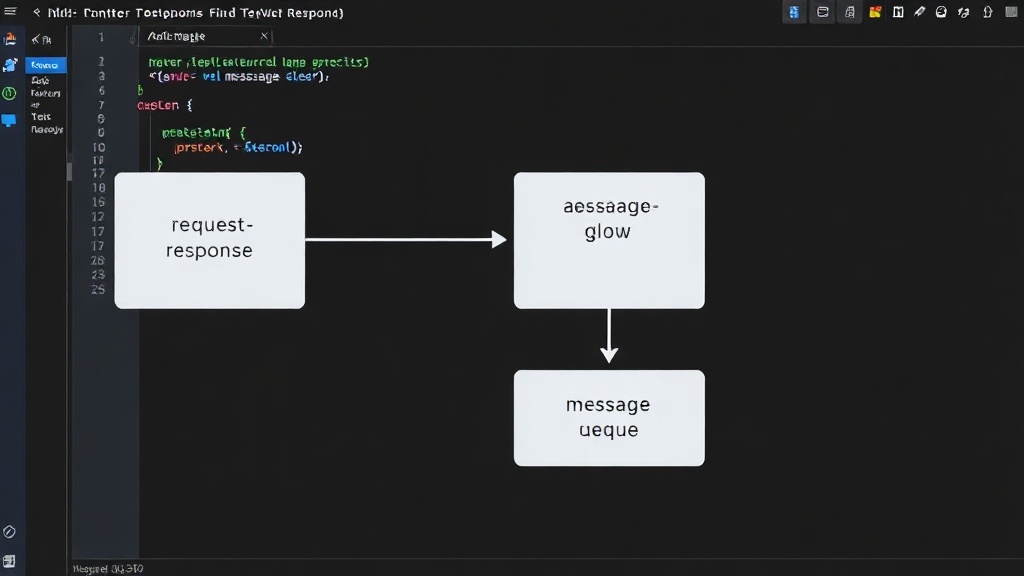
A message queue acts as an intermediary between different parts of a system, specifically between a producer and a consumer. The producer is the component that initiates a task and sends a message describing that task to the queue. The consumer is the component that retrieves messages from the queue and performs the actual work. This decoupling is the core benefit.
When a user uploads a profile picture, the web server (the producer) doesn't perform the resizing itself. Instead, it creates a message like: "resize_image, user_id=123, image_url=http://..., target_size=medium" and places this message onto a queue. The web server then immediately returns a response to the user, perhaps saying, "Your profile picture is being processed." This is a near-instantaneous response, freeing up the web server to handle other incoming requests.
Meanwhile, a separate service (the consumer), dedicated to image processing, constantly monitors the message queue. When it picks up the "resize_image" message, it downloads the image, performs the resizing, saves the new versions, and then acknowledges that the message has been processed. If the image processing service crashes, the message remains on the queue (or is returned to the queue after a timeout), and another instance of the service can pick it up later. The original request is not failed; it's merely delayed in its background processing. This makes the system far more resilient to temporary service outages or performance hiccups.
Benefits of Asynchronous Processing
The advantages of employing message queues and asynchronous processing are manifold:
- Improved Responsiveness: User-facing services can return responses much faster, as they offload long-running or non-critical tasks. This leads to a snappier user experience.
- Enhanced Reliability and Resilience: If a background worker service fails, messages remain in the queue and can be processed later by another available worker. This prevents cascading failures and ensures tasks are eventually completed.
- Scalability: Producers and consumers can be scaled independently. If image processing becomes a bottleneck, you can add more image processing workers without affecting the web servers. Conversely, if your web servers are overloaded, you can scale them up without needing to scale the image processing at the same rate.
- Decoupling: Services become less dependent on each other. The producer doesn't need to know the intricate details of the consumer, only how to format a message for the queue. This simplifies development and maintenance.
- Load Leveling: Queues naturally smooth out traffic spikes. A sudden surge of uploads won't overwhelm the image processing system all at once; it will be processed at a rate the consumers can handle.
When to Use Message Queues
Message queues are not a silver bullet for every problem. They introduce complexity and introduce their own potential failure points (e.g., the queue service itself). However, they are invaluable for scenarios involving:
- Background Jobs: Any task that doesn't need to be completed within the user's immediate interaction.
- Inter-service Communication: Particularly in microservices architectures, where services need to communicate without direct, synchronous dependencies.
- Event-Driven Architectures: Where events trigger actions in other parts of the system.
- Batch Processing: Processing large volumes of data that can be handled in chunks.
- Tasks Requiring Retries: Operations that might fail transiently and need to be retried without user intervention.
Popular message queue technologies include RabbitMQ, Apache Kafka, Amazon SQS, Google Cloud Pub/Sub, and Azure Service Bus. Each offers different trade-offs in terms of durability, throughput, ordering guarantees, and complexity. Choosing the right one depends on the specific requirements of your system.
The Unanswered Question: Managing Queue Complexity
While the benefits of message queues are clear, a significant challenge emerges as systems grow: managing the complexity of the queues themselves. How do you monitor thousands of queues, track message processing rates across numerous consumers, diagnose why a specific message is stuck, or ensure exactly-once processing semantics when needed? The infrastructure to manage this asynchronous world can quickly become as complex as the applications it serves. What nobody has fully addressed yet is a standardized, developer-friendly framework for observing and managing distributed message queue systems at scale, beyond the tooling provided by individual cloud providers or open-source projects.
In essence, message queues transform the perception of handling a request. Instead of a single, brittle chain, you build a resilient, distributed system where tasks are processed reliably and efficiently, even when parts of the system are temporarily unavailable or overloaded. This shift from immediate response to asynchronous processing is fundamental to building modern, scalable applications.