Scope and Definitions
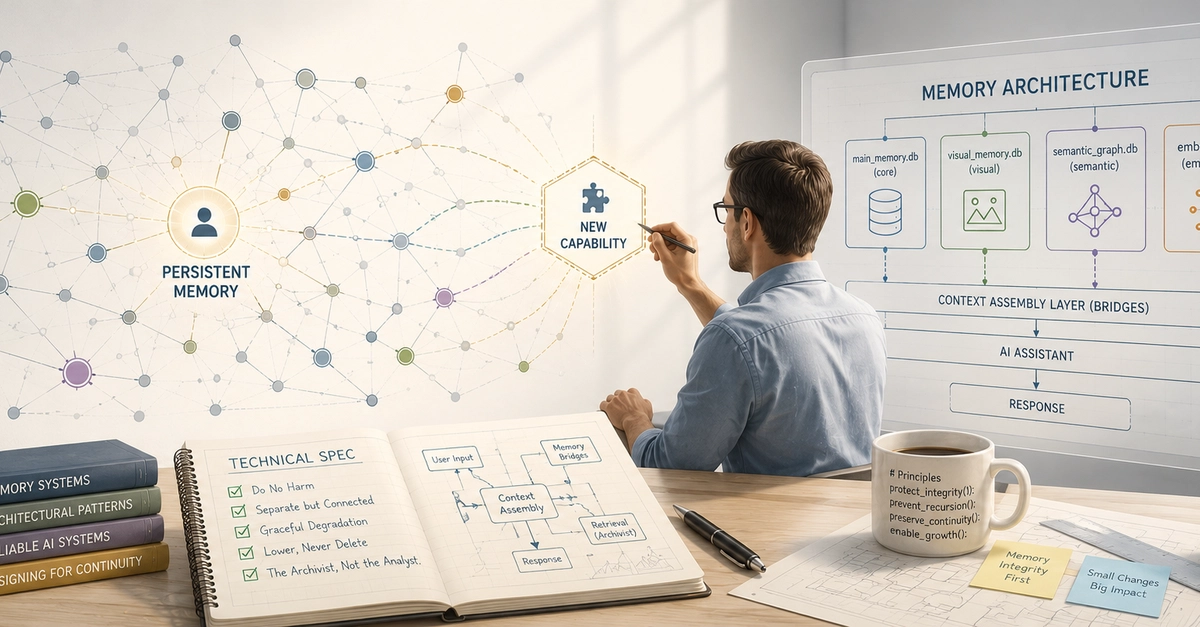
This guide addresses developers using coding agents like Claude Code, Cursor, or Devin to modify AI systems that possess persistent memory. These are systems where behavior evolves based on accumulated experience across sessions. The core principle is that when you alter such a system, you are not merely refactoring code; you are fundamentally changing the system's accumulated behavioral state. This framework distills lessons from 11 deployed AI assistants and over 15 specifications developed through months of iteration.
This guidance is not for stateless chatbots, traditional Retrieval-Augmented Generation (RAG) systems, or short-lived coding agents that do not retain state between interactions. The focus is exclusively on the complex challenge of managing stateful AI systems.
The Memory Integrity Problem
AI systems with persistent memory learn and adapt. This learning is stored as a form of 'memory'—a state that influences future decisions and actions. When a coding agent modifies the codebase of such a system, it can inadvertently corrupt this memory. This corruption can manifest in several ways:
- Behavioral Drift: The AI starts behaving in ways inconsistent with its past experiences or intended function.
- Loss of Learned Skills: Previously acquired capabilities or knowledge become inaccessible or degraded.
- Recursive Errors: The agent's modifications might trigger a feedback loop, causing the AI to repeatedly perform an incorrect action or enter an unstable state.
- Unpredictable Outcomes: The system's responses become erratic and unexplainable, making debugging and maintenance extremely difficult.
Think of it like trying to update a personal diary by randomly rewriting entries from years ago without understanding the context of those entries. The diary's narrative coherence would be destroyed. Similarly, modifying the code of a stateful AI without considering its accumulated memory can lead to a loss of its functional narrative.
Framework for Memory-Safe Specifications
To mitigate these risks, technical specifications for coding agents must be designed with memory integrity as a primary concern. The following framework provides a structured approach:
1. Define the State Boundary
Clearly delineate what constitutes the AI's persistent memory. This includes:
- Data Structures: Identify the specific data formats and locations where the AI stores its learned state (e.g., vector databases, serialized objects, internal knowledge graphs).
- State Transitions: Document how the AI's state is expected to evolve over time and through interactions.
- Access Control: Specify which parts of the system can read from and write to the persistent memory. Coding agents should generally have read-only access or highly controlled write access.
2. Specify Agent Actions with State Awareness
When defining tasks for the coding agent, explicitly consider the impact on memory:
- Read-Only Operations: Prioritize specifications that require the agent to only read from memory to inform its code changes.
- Controlled Writes: If writes are necessary, define precise validation and sanitization procedures. The specification must detail how the agent should verify that its intended modification does not conflict with existing, valuable learned states.
- State Backups and Rollbacks: Include procedures for creating backups of the persistent memory before agent execution and define rollback mechanisms in case of unintended state corruption.
3. Prevent Recursion and Feedback Loops
Specifications must include safeguards against self-perpetuating errors:
- Depth Limits: For recursive code generation or modification, impose strict limits on recursion depth.
- Action Dampening: If the agent's actions can influence its own future inputs or decision-making processes, implement mechanisms to dampen or limit the feedback loop's intensity.
- Sanity Checks: Introduce periodic checks to ensure the AI's behavior remains within acceptable parameters after modifications. If deviations are detected, the agent should halt or revert changes.
4. Ensure Behavioral Continuity
Preserving the AI's learned behavior is crucial:
- Behavioral Benchmarking: Define a set of benchmark tests that verify key learned behaviors. These tests must run *before* and *after* agent modifications.
- Gradual Rollouts: For significant changes, consider phased deployments where the agent's modifications are applied to a subset of the AI's memory or deployed to a staging environment first.
- Human Oversight: Specify points where human review is mandatory, especially for modifications that deeply affect the AI's core decision-making logic or knowledge base.
The "So What?" Perspective
Developers modifying stateful AI systems must update their spec writing practices. Treat code modifications as state changes, not just refactoring. Implement explicit definitions of memory boundaries, controlled write access for agents, and behavioral benchmarks to prevent corruption and ensure continuity.
While not a direct security vulnerability, memory corruption in stateful AI can lead to unpredictable behavior that attackers could exploit. Specifications must include mechanisms to prevent recursive modification loops and ensure state integrity, acting as a crucial defense against emergent instability.
The ability to safely evolve AI systems with persistent memory is critical for long-term product development. Investing in robust specification frameworks for coding agents reduces development risk, prevents costly regressions, and ensures the AI's accumulated value isn't lost, preserving the product's evolving moat.
For creators building with AI assistants, understanding the memory-safe spec framework means more reliable and predictable AI companions. It allows for safer experimentation with AI systems that learn and adapt, ensuring your AI assistant's evolving capabilities remain coherent and useful over time.
This framework implies that the 'data' for stateful AIs is not just static training sets but dynamic, evolving memory states. Specifications must account for how agents interact with and modify this dynamic data, ensuring its integrity and preventing drift that could invalidate downstream data analysis or model retraining.
Sources synthesised
- 16% Match