On-Device Dictation for Mac Users
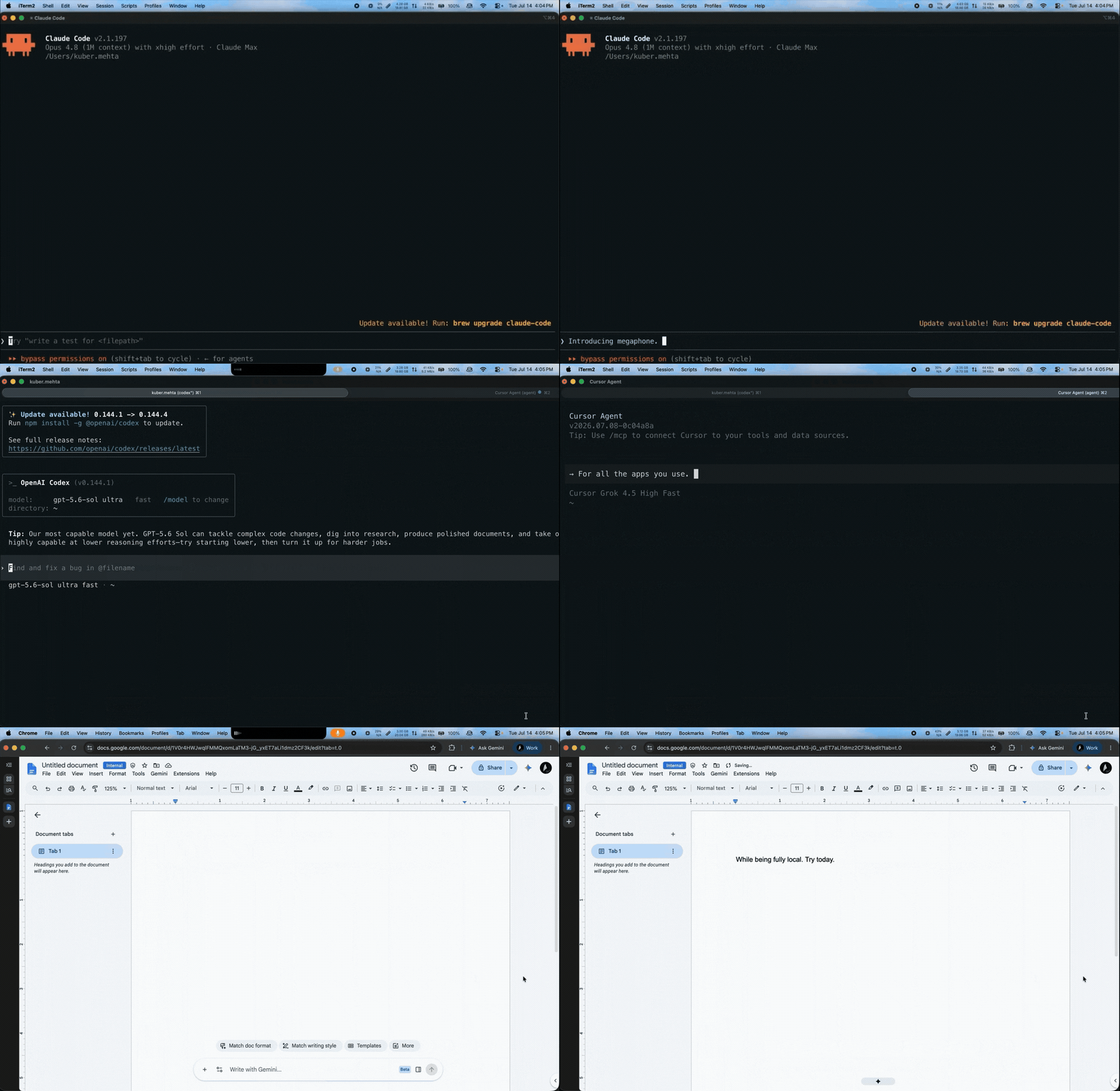
Megaphone, a newly launched open-source application for macOS, addresses a critical need for privacy-conscious users: on-device dictation. In an era where data privacy is paramount, many existing speech-to-text solutions rely on cloud-based processing, raising concerns about sensitive information being transmitted and stored externally. Megaphone distinguishes itself by performing all speech-to-text conversions locally on the user's machine, ensuring that personal conversations, notes, and commands remain private.
The application is designed to be a straightforward yet powerful tool for anyone who frequently uses dictation on their Mac. This includes writers, developers, students, and professionals who want to convert spoken words into text without the inherent risks associated with cloud services. By keeping data processing entirely on the device, Megaphone offers a secure alternative that respects user privacy.
Core Functionality and Technical Approach
Megaphone leverages the built-in speech recognition capabilities of macOS, allowing it to integrate seamlessly with the operating system. The open-source nature of the project means that its code is publicly available for review, fostering transparency and allowing the community to contribute to its development and security. This approach is particularly important for a tool handling potentially sensitive audio input.
The primary benefit of Megaphone is its commitment to privacy. Unlike cloud-based dictation services that send audio data to remote servers for processing, Megaphone processes everything locally. This eliminates the risk of data breaches on remote servers and ensures that users maintain full control over their spoken content. For individuals or organizations with strict data handling policies, this on-device processing is a non-negotiable feature.
The application aims to provide a user experience that is both simple and efficient. Users can activate dictation, speak naturally, and see their words appear in their chosen application. The open-source model also allows for rapid iteration and customization, as developers can adapt the tool to specific workflows or integrate it with other local applications.
Why On-Device Dictation Matters
The trend towards cloud-centric computing has brought immense convenience and power, but it has also introduced new vulnerabilities and privacy challenges. For sensitive tasks, such as dictating personal notes, confidential business communications, or medical information, relying on cloud services can be a significant risk. Data transmitted to the cloud can be intercepted, stored indefinitely, or accessed by third parties, even with strong encryption.
On-device processing, as implemented by Megaphone, mitigates these risks by keeping all data within the user's control. This approach is akin to using a local file editor instead of a cloud-based one for highly sensitive documents. The processing happens within the secure confines of the user's machine, protected by their existing security measures. This is especially relevant given the increasing sophistication of AI models that can analyze and interpret speech data for various purposes, some of which may not align with user privacy goals.
The open-source aspect further bolsters trust. With the code accessible to anyone, security researchers and developers can audit it for vulnerabilities or backdoors. This community-driven scrutiny is often more robust than proprietary solutions, where users must simply trust the vendor's claims about security and privacy. The ability to inspect the source code provides a level of assurance that is difficult to achieve otherwise.
Potential Use Cases and User Benefits
Megaphone's utility spans a wide range of users and scenarios. For writers and journalists, it offers a way to quickly capture thoughts and draft content without typing, all while knowing their draft is not being uploaded anywhere. Developers can use it to dictate code comments, documentation, or even simple scripts, benefiting from hands-free input during coding sessions.
Students can dictate lecture notes or essay outlines, ensuring that their academic work remains private. Professionals in fields with strict confidentiality requirements, such as legal or healthcare, can use Megaphone to dictate notes or reports, confident that sensitive client or patient information is not being exposed to external servers. The application also serves as an accessibility tool, enabling users with physical limitations to interact with their Mac more effectively through voice commands and dictation.
The simplicity of the application means it requires minimal setup. Users can download, install, and begin using it without complex configuration. This low barrier to entry makes powerful, private dictation accessible to a broad audience, not just tech-savvy individuals. The 100% on-device processing is the core value proposition, making it a compelling choice for anyone prioritizing privacy in their digital tools.
The Future of Private Dictation
Megaphone's emergence highlights a growing demand for privacy-focused tools in the AI and machine learning landscape. As more powerful AI capabilities are integrated into everyday software, the question of where that processing occurs becomes critical. Solutions that can deliver advanced functionality while respecting user privacy are likely to gain significant traction.
The open-source model is a strategic advantage for Megaphone. It allows the community to identify bugs, suggest features, and contribute to its ongoing development. This collaborative approach can lead to a more robust and feature-rich application over time, potentially rivaling or even surpassing proprietary solutions in terms of performance and security. The project's success will depend on community adoption and contributions, but its foundational commitment to on-device, private processing positions it well in a market increasingly concerned with data security.
What remains to be seen is how Megaphone will evolve to incorporate new advancements in on-device speech recognition models. As these models become more efficient and accurate, Megaphone could potentially offer even higher levels of performance while maintaining its privacy-first stance. The challenge will be to balance cutting-edge AI capabilities with the resource constraints and security requirements of local processing.