The MCP Cost Debate Ignites
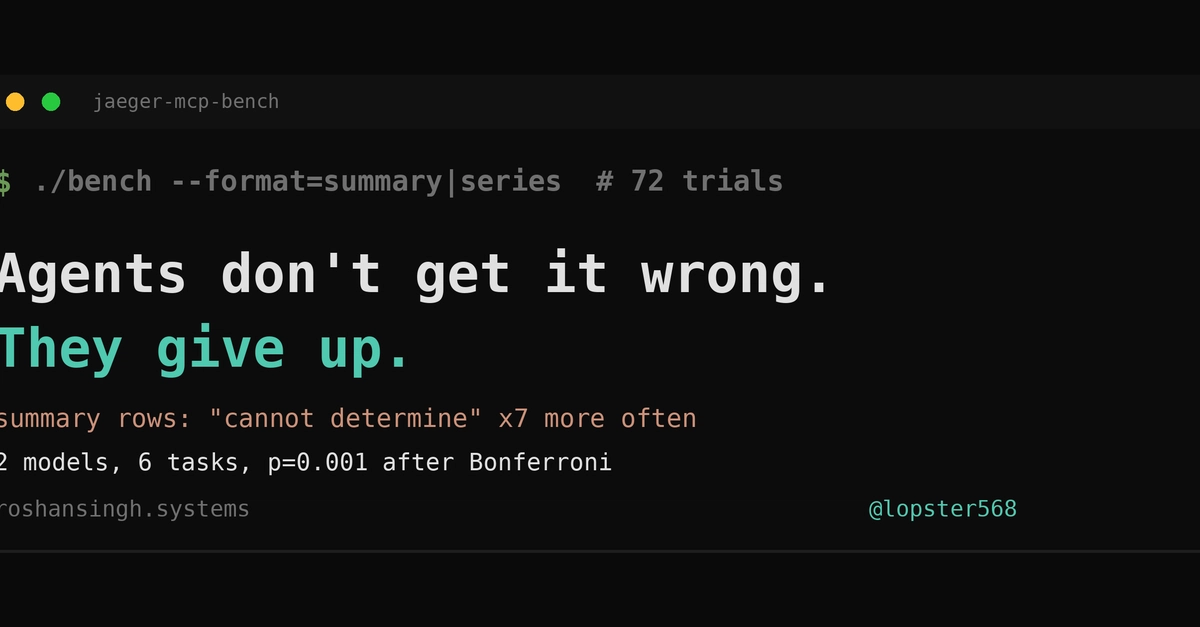
A heated debate rages around the cost of Multi-Cluster Protocol (MCP) tools, particularly concerning their large context window usage. Online discussions, often featuring detailed token counts and server statistics, highlight the financial implications. However, a critical aspect frequently overlooked is how agents actually utilize the data these tools provide. One maintainer, faced with a design fork on what an MCP tool should return, opted for empirical measurement over conjecture, running 72 trials to resolve the design question.
The core of the disagreement centered on the output format for service performance metrics – specifically latencies, call rates, and error rates – proposed as an MCP tool for CNCF Jaeger. The two primary design options presented were: pre-aggregated summary rows, which are compact and cost-efficient, versus per-bucket time series data, which offers raw, granular points but is significantly more expensive to process. The latter, at default resolution, could generate approximately 720 data points per service.
Empirical Measurement Over Opinion
The decision to run trials stemmed from a practical necessity. When proposing the inclusion of service performance metrics as an MCP tool within CNCF Jaeger, a design fork emerged. The question was stark: what shape should the output take? Should it be a concise summary, or a detailed, granular dataset?
The first option, summary rows, offered pre-aggregated statistics per service. This approach is inherently compact and computationally cheaper, making it attractive from a cost perspective. It would present a high-level overview, sufficient for many quick checks.
The second option, per-bucket time series, proposed returning the raw data points. At the default resolution, this could amount to roughly 720 data points for each service. While significantly more expensive in terms of processing and storage, this option provides complete, unadulterated information. The debate pitted the cost-effectiveness of aggregation against the completeness of raw data.
The 72-Trial Experiment
To resolve this design dilemma definitively, a series of 72 trials were conducted. The objective was to understand, through empirical data, how agents interact with and benefit from different output formats. This approach moved the discussion from theoretical cost-benefit analysis to practical utility, directly addressing what agents *do* with the data.
The trials likely involved setting up agent simulations or actual agent deployments that consumed data from the MCP tool under both output configurations. By observing agent behavior, resource consumption, and the quality of their outputs or decisions based on the received data, the experiment aimed to provide a clear, data-driven answer.
The results of these trials, though not fully detailed in the provided excerpt, are implied to favor the more complete, per-bucket time series data. This suggests that the granularity offered by raw data points provides essential context or functionality that is lost in pre-aggregated summaries. For agents that need to perform detailed analysis, anomaly detection, or fine-grained performance tuning, the raw data is indispensable.
Implications for MCP Tool Design
The outcome of this empirical approach has significant implications for the design of MCP tools and similar observability systems. It underscores the importance of understanding the downstream consumers of the data. If agents require detailed, historical performance data to function effectively, then providing summarized data is a disservice, potentially leading to suboptimal performance or incorrect conclusions.
This also has a direct impact on the ongoing debate about MCP costs. While raw data is more expensive to transmit and process, its utility might justify the cost. The true cost of an MCP tool isn't just the tokens consumed by the tool itself, but the value and functionality it unlocks for the agents that rely on it. If granular data enables agents to perform tasks that aggregated data cannot, then the 'cheaper' option is, in fact, less valuable.
The experiment serves as a powerful example for the wider development community. Instead of engaging in protracted, opinion-based arguments about system design and cost, a pragmatic, data-driven approach can yield clear answers. Running controlled trials, even if they seem resource-intensive initially, can prevent design stagnation and lead to more effective, utility-focused tools. The surprise here is not the cost of tokens, but the resistance to empirical testing in favor of abstract arguments.
What's Next for MCP Tools?
The findings suggest a direction for future MCP tool development: prioritize data completeness where agent utility demands it. This means architects and maintainers must move beyond surface-level cost discussions and delve into the functional requirements of the agents consuming the data. The question for tool designers should shift from 'What is the cheapest way to present this data?' to 'What is the most effective way to provide data that enables agents to perform their tasks optimally?'
This empirical approach is not unique to MCP tools. It's a fundamental principle in building effective software: understand your users (or in this case, your agents) and measure their needs. The 72 trials, while specific to Jaeger's MCP server, offer a blueprint for resolving similar design debates across the technology landscape. The argument about MCP being 'dead' might be premature; perhaps the tools simply need to be designed to return what agents truly need, not just what's cheapest to send.