The Production Bottleneck for AI Agents
AI agents often falter not due to flawed logic or poor demonstrations, but when scaling successful workflows to handle multiple users, diverse tools, and production-level demands. A small, single-server MCP setup that performs well in a development environment can quickly become an insurmountable bottleneck under real-world load. This is particularly true when managing complex integrations involving multiple tools, APIs, databases, and internal systems, all while needing to track logs, implement retries, handle authentication, and enforce cost limits. The transition from a developer's laptop to a production-ready, load-balanced environment exposes the fragility of architectures that rely on remembering state between individual client and server interactions.
The core issue lies in the traditional approach to agent session management. Many existing MCP implementations operate on a model where a single client communicates with a specific, long-lived server instance. This “sticky server” approach, while simple for initial development, breaks down under scale. When that server instance restarts, crashes, or becomes unavailable due to load balancing, any in-memory state for active agent workflows is lost. This leads to failed tool calls, interrupted processes, and a poor user experience. Developers building agent integrations must therefore move beyond this pattern to achieve true production readiness.
A Web-Native Shift for Scalable Agent Integrations
The critical shift in MCP session design is moving from a stateful, client-to-server relationship towards a more stateless, web-native paradigm. This means treating agent sessions less like a persistent connection to a specific machine and more like how modern web applications handle user interactions. The goal is to build agent workflows that can scale horizontally, meaning you can add more server instances without breaking existing sessions or losing critical data. This architecture avoids the pitfalls of fragile in-memory state and unreliable tool calls that vanish when a container restarts.
This new approach leverages patterns common in web development, such as stateless APIs and distributed state management. Instead of a server instance holding all the context for a given agent session, that context is externalized. This allows any available server instance to pick up a session where it left off, provided the necessary state is accessible. This fundamental change is key to building agent integrations that are not only functional but also robust, reliable, and scalable to meet the demands of production environments.
Designing for Statelessness and Externalized State
The practical implementation of a scalable MCP session architecture involves several key components and design decisions. The primary objective is to decouple the agent's execution logic from the server instance running that logic. This is achieved by externalizing session state and ensuring that tool calls are idempotent or can be reliably retried.
Externalizing Session State
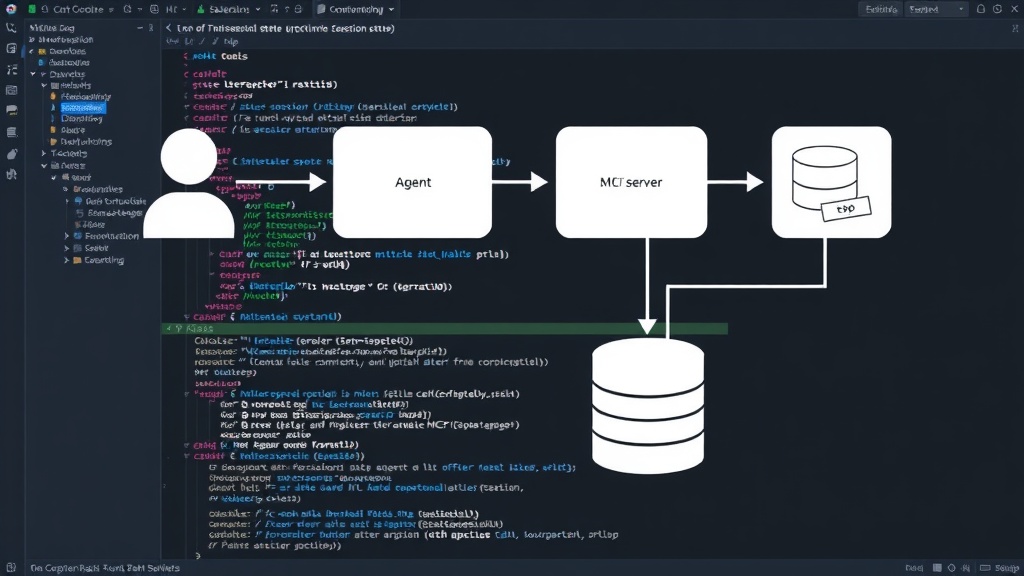
Instead of storing session data (like conversation history, tool call history, or intermediate results) directly in the memory of the MCP server process, this data must be stored in a persistent, accessible location. This could be a distributed cache like Redis, a managed database, or even a dedicated state management service. When an agent needs to access or update its state, it queries this external store. This ensures that if a server instance fails or is replaced, another instance can immediately retrieve the required state and continue the workflow seamlessly. Think of it less like a single, forgetful assistant holding your notes, and more like a shared, always-on digital filing cabinet that any assistant can access.
Stateless Server Instances
With state externalized, the MCP server instances themselves can become largely stateless. Their primary role shifts to receiving requests, retrieving necessary state from the external store, executing the agent's logic (including making tool calls), updating the state in the external store, and returning the result. This statelessness is what enables horizontal scaling. Load balancers can distribute incoming requests across any available server instance, and if one instance goes down, traffic is simply rerouted to another healthy instance without disrupting ongoing sessions.
Idempotent Tool Calls and Retries
A critical aspect of building robust agent workflows is ensuring that tool calls are either idempotent (meaning making the same call multiple times has the same effect as making it once) or that the system can gracefully handle retries. In a distributed system, network issues or temporary service unavailability can cause tool calls to fail. By designing tools to be idempotent or by implementing robust retry mechanisms at the MCP layer (potentially with exponential backoff), agents can ensure that workflows progress even in the face of transient errors. This externalized state also helps in managing retry logic, as the system knows precisely which step failed and what parameters were used.
Benefits of the New Architecture
Adopting this web-native, stateless architecture for MCP session management brings significant advantages:
- Scalability: Easily scale by adding more stateless server instances behind a load balancer.
- Reliability: Workflows are resilient to individual server failures; state is preserved externally.
- Maintainability: Decoupled components are easier to update, debug, and manage.
- Cost-Effectiveness: Efficient resource utilization and avoidance of over-provisioning for peak sticky-session needs.
- Flexibility: Agents can integrate with a wider range of tools and services without being constrained by server-specific state.
This architectural shift is not merely an optimization; it's a fundamental requirement for any AI agent integration aiming for production-grade performance and reliability. By embracing statelessness and externalized state, developers can build agent systems that scale gracefully, manage complexity, and deliver consistent user experiences, moving beyond the limitations of single-server architectures.