Bridging the AI Gap: From Chatbot to Task Master
Artificial intelligence assistants, while powerful conversationalists, often remain confined within their digital chat windows. They can process information and generate text, but interacting with your external digital environment—reviewing code on GitHub, querying a database, or drafting a document in your preferred productivity suite—has remained largely out of reach. The Model Context Protocol (MCP) and its associated MCP Servers aim to change this, acting as a universal translator that bridges the gap between AI clients and the real world. MCP transforms your AI from an isolated chatbot into a genuine assistant capable of executing tasks within your established working environment.
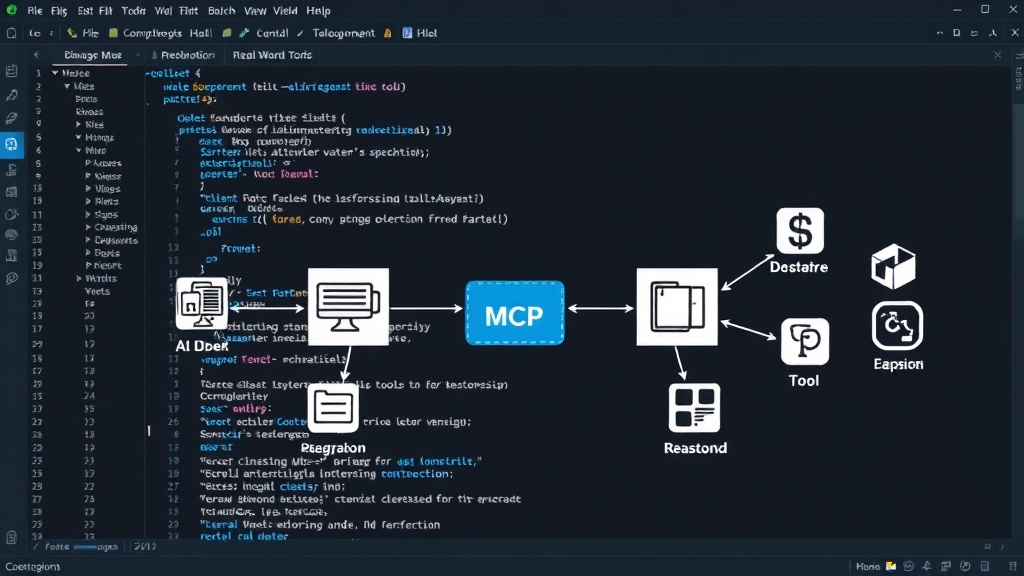
The core innovation of MCP lies in its server architecture. An MCP Server functions as a middleware layer. It standardizes the communication protocol, allowing diverse AI clients to interact with a wide array of external data sources and tools without needing custom integrations for each. This means you can configure your server once and then leverage it across multiple AI platforms and applications. The official documentation highlights the flexibility, noting that a single MCP server can connect to multiple clients simultaneously. This architecture is key to unlocking the potential of AI assistants as active participants in complex workflows.
The Client-Server Ecosystem
MCP's design emphasizes an extensible ecosystem of clients and servers. Popular AI clients are being adapted to support the MCP standard. For instance, Claude Desktop and Claude Code are among the first to integrate with MCP, enabling users to have conversational AI that can directly interact with their codebase and development tools. This integration means developers can ask their AI to analyze code, suggest refactors, or even generate documentation, all within the context of their active development session.
Beyond code, the potential applications are vast. Imagine an AI assistant that can access your company's internal knowledge base to answer complex queries, pull sales data from a CRM to draft a quarterly report, or even schedule meetings by interacting with your calendar application. The MCP Server acts as the secure gateway and translator, ensuring that the AI's requests are understood by the external systems and that the responses are relayed back in a format the AI can process. This bidirectional communication is crucial for creating AI assistants that are not just informative but also actionable.
Standardization and Interoperability
Historically, integrating AI into existing software ecosystems has been a fragmented and labor-intensive process. Each AI model might have its own API, and each external tool or data source requires a specific integration. This creates a significant barrier to entry for developers and businesses looking to leverage AI effectively. MCP addresses this by providing a standardized protocol. By adhering to MCP, developers can create tools and data connectors that work with any MCP-compliant client, and AI developers can build clients that can interface with any MCP-compliant server.
This standardization is akin to the development of USB for peripherals. Before USB, connecting devices required a multitude of different ports and drivers. USB standardized this connection, making it plug-and-play across a vast range of hardware. Similarly, MCP aims to be the universal connector for AI, abstracting away the complexities of individual APIs and protocols. The result is a more fluid and integrated user experience, where AI capabilities can be seamlessly embedded into existing workflows and applications.
Security and Control
A primary concern when granting AI access to external systems is security. MCP Servers are designed with this in mind. They act as a controlled interface, allowing fine-grained permissions to be set for what data and tools the AI can access. This means users can explicitly grant or deny access to specific resources, ensuring that sensitive information remains protected. The server acts as an intermediary, logging interactions and enforcing security policies, providing a level of oversight that is essential for enterprise adoption.
The protocol itself is being developed with security best practices. While specific details on encryption and authentication mechanisms would be found in its technical specifications, the principle of a mediated connection inherently offers a more secure model than direct, ad-hoc integrations. By centralizing access through an MCP Server, organizations can implement consistent security policies and audit trails, which are critical for compliance and risk management. This controlled access is what allows an AI to review code on a private GitHub repository or query sensitive customer data within a CRM, without exposing the entire system.
The Future of AI Assistants
The advent of MCP Servers signals a significant evolution in how we interact with and utilize AI. It moves beyond the paradigm of AI as a passive information provider to AI as an active agent within our digital lives. For developers, this means tools that can automate tedious tasks, provide real-time code analysis within their IDE, and streamline debugging processes. For businesses, it promises more efficient operations, better data utilization, and enhanced productivity across various departments.
The Model Context Protocol is building the infrastructure for a future where AI assistants are deeply integrated into every aspect of our digital work. This interconnectivity is not just about convenience; it's about unlocking new levels of efficiency and innovation. As more clients and servers adopt the MCP standard, we can expect to see a proliferation of AI-powered tools and workflows that were previously only theoretical. The ability for an AI to understand context and act upon it across disparate systems is the next logical step in AI's journey from a novel technology to an indispensable utility.
What remains to be seen is the pace at which different AI providers and tool developers embrace MCP. While Claude is an early adopter, widespread adoption across major platforms like OpenAI's ChatGPT, Google's Gemini, and a broader range of IDEs and productivity software will determine the ultimate reach and impact of this protocol. The success of MCP hinges on its ability to become the de facto standard for AI-system interoperability.