Matten's Ecosystem: Companion Crates
The matten workspace extends its utility through three focused companion crates. These libraries operate with narrow, self-contained scopes and crucially, they do not introduce any new dependencies to the core matten crate. This design ensures that users can selectively adopt functionality without bloating their project's dependency graph. Each companion crate serves a specific integration purpose, bridging matten's tensor capabilities with other popular Rust ecosystems.
matten-ndarray: Bridging to Ndarray
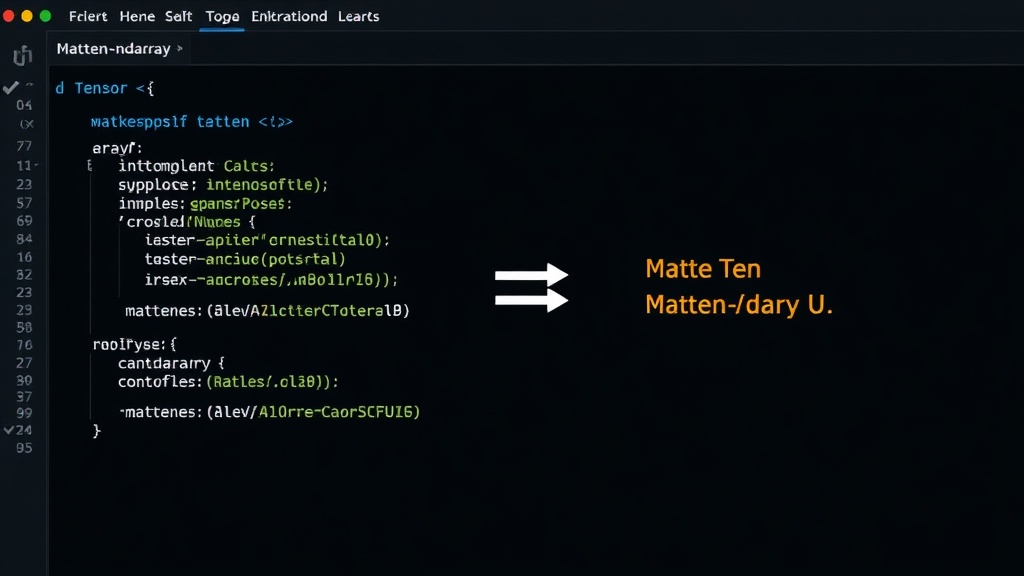
The matten-ndarray crate provides a direct conduit between matten::Tensor and ndarray::ArrayD<f64>. Its sole responsibility is to facilitate seamless conversion between these two powerful data structures. This is particularly valuable for developers already invested in the ndarray ecosystem, allowing them to leverage matten's numerical core while retaining compatibility with their existing tools and workflows. The conversion is straightforward, enabling users to move data efficiently between the two representations.
For instance, converting a matten::Tensor to an ndarray::ArrayD<f64> involves creating a new ArrayD instance and populating it with the tensor's data. The shape of the tensor directly maps to the shape of the ndarray. Similarly, converting an ndarray::ArrayD<f64> back to a matten::Tensor reconstructs the tensor using the array's data and dimensions. This bi-directional conversion is essential for scenarios where data must pass between different computational or analytical libraries.
matten-linalg: Linear Algebra Operations
matten-linalg offers a set of linear algebra routines that operate on matten::Tensor objects. This crate abstracts away complex mathematical operations, providing developers with easy-to-use functions for common linear algebra tasks. These include operations such as matrix multiplication, vector addition, and decomposition methods. By integrating these capabilities, matten-linalg empowers users to perform sophisticated numerical computations directly within the matten framework, without needing to rely on external, potentially heavier, linear algebra libraries.
The design of matten-linalg prioritizes performance and ease of integration. It aims to provide a performant set of tools that feel natural to use for anyone familiar with numerical computing. The underlying implementations are optimized to take advantage of matten's core numerical capabilities, ensuring that these operations are both efficient and accurate. Developers can integrate these functions into their existing matten-based pipelines, accelerating development and reducing the cognitive load associated with implementing complex mathematical algorithms from scratch.
matten-plot: Visualization Capabilities
For data visualization needs, matten-plot serves as the bridge. This companion crate allows users to generate plots and visualizations directly from their matten::Tensor data. It integrates with popular plotting libraries, transforming tensor data into visual representations that aid in understanding and analysis. This capability is critical for exploratory data analysis, debugging, and presenting results. Instead of manually exporting data and using separate visualization tools, developers can create charts and graphs within their matten workflow, streamlining the entire process.
The crate aims to make visualization accessible and efficient. It supports various plot types, from simple scatter plots to more complex multi-dimensional representations, depending on the underlying plotting library it interfaces with. The goal is to provide a convenient way to inspect tensor data, identify patterns, and communicate insights effectively. This integration is a significant step towards making matten a more comprehensive solution for data-intensive applications.
When to Move On From Matten
While matten and its companion crates offer valuable functionality, understanding when to transition away is equally important for robust software development. The decision to move on typically arises when a project's requirements outgrow the scope or performance characteristics of matten. This can happen in several scenarios. Firstly, if a project's computational demands become exceptionally high, requiring highly specialized optimizations or hardware acceleration that matten does not provide, it may be time to consider alternatives.
Secondly, as projects mature, they might integrate with larger, more established ecosystems. If a project increasingly relies on specific features or abstractions offered by a dominant library within a particular domain (e.g., a comprehensive deep learning framework or a specialized scientific computing suite), migrating to that library directly can simplify the architecture and leverage a broader set of community-vetted tools. The companion crates, while useful for bridging, are not a substitute for native integration within these larger ecosystems.
Consider, for example, a machine learning project that starts with matten for tensor manipulation. As the project evolves to include complex neural network architectures, distributed training, and extensive hyperparameter tuning, it might become more efficient to migrate to a framework like TensorFlow or PyTorch (or their Rust equivalents if available and suitable). The decision is not a reflection of matten's quality, but rather an acknowledgment of evolving project needs and the benefits of aligning with dominant tools in specific domains. The key is to continuously evaluate whether matten remains the most effective tool for the task at hand, or if a more specialized or broader solution offers greater long-term advantages.