%22%20%2F%3E%0A%20%20%3C%2Fsvg%3E)
Mathup's Tensor Notation System Explained
Mathup, a platform known for its advanced mathematical expression capabilities, has introduced a new system for tensor notation. This feature is designed to streamline the definition, manipulation, and visualization of tensors, which are fundamental in fields like physics, machine learning, and advanced engineering. Tensors, often described as multi-dimensional arrays, can become incredibly complex to represent and work with using traditional notation. Mathup's approach aims to make these operations more intuitive and less error-prone.
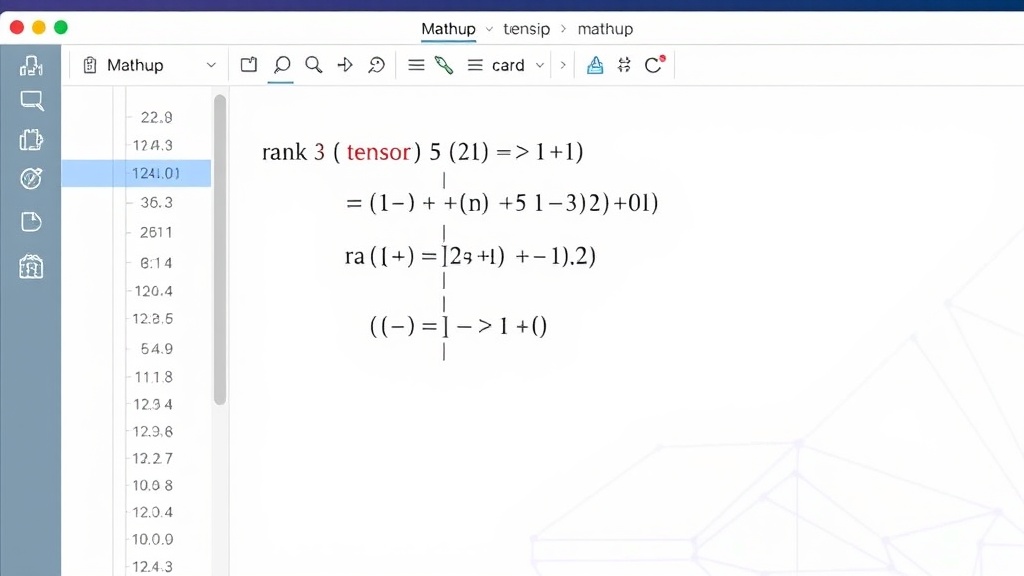
The core of Mathup's tensor notation lies in its ability to handle indices, both covariant and contravariant, with clear visual distinction. Users can define tensors by specifying their rank and the nature of their indices. For instance, a rank-2 tensor in 3D space could be represented as a matrix, but Mathup's system extends this to arbitrary ranks and dimensions. This is crucial for researchers working with differential geometry, general relativity, or quantum field theory, where tensor calculus is a daily tool. The system supports Einstein summation convention automatically, reducing the need for explicit summation symbols and making equations more compact and readable. This feature alone can significantly cut down on the cognitive load when dealing with lengthy tensor equations.
Consider the representation of a metric tensor, $g_{\mu\nu}$. In Mathup, defining this tensor would involve specifying its rank (2) and its indices (two covariant Greek indices). The platform then handles the underlying data structure, allowing for operations such as raising or lowering indices using an inverse metric tensor, or calculating the Ricci tensor and scalar curvature. This is analogous to how a high-level programming language abstracts away memory management; Mathup abstracts away the low-level details of tensor manipulation, allowing users to focus on the mathematical concepts. The system is designed to be extensible, with plans to integrate with popular numerical libraries for high-performance computation.
Key Features and Benefits
Mathup's tensor notation system offers several key advantages. Firstly, it provides a unified environment for defining tensors, performing operations, and visualizing results. This eliminates the need to switch between different tools or libraries for symbolic manipulation and numerical computation. The visual clarity of the notation is paramount; Mathup renders tensor equations in a human-readable format that closely resembles standard mathematical typesetting, but with added interactivity. Users can click on indices to see their associated transformations or to perform operations like contraction.
Another significant benefit is the built-in support for various tensor operations. These include tensor products, contractions, outer products, and transformations under coordinate changes. For example, performing a tensor contraction between two tensors, say $A^{\mu}_{\nu}$ and $B^{\nu}_{\rho}$, resulting in $C^{\mu}_{\rho} = A^{\mu}_{\nu} B^{\nu}_{\rho}$, is handled automatically by Mathup's engine once the tensors and the operation are specified. The platform can also detect and flag potential errors, such as incompatible index types or ranks during operations, acting as an intelligent assistant for mathematicians and physicists.
The integration with symbolic computation engines means that users can not only define and manipulate tensors but also derive complex tensor identities and solve differential equations involving tensors. This capability is particularly valuable for researchers in theoretical physics and applied mathematics who need to perform extensive symbolic calculations that would be prohibitively time-consuming and error-prone by hand. The ability to export these expressions in various formats, including LaTeX and Python code, further enhances its utility in academic and industrial workflows.
Implications for Research and Development
The introduction of robust tensor notation support in Mathup has significant implications for several domains. In machine learning, particularly in areas like tensor networks and deep learning models that inherently use multi-dimensional arrays, this could lead to more efficient model design and analysis. Researchers can now express complex tensor operations directly, potentially leading to new algorithms or optimizations that were previously difficult to articulate and implement. The platform's ability to visualize these operations can also aid in understanding the behavior of complex neural network architectures.
For theoretical physicists, Mathup's tensor notation could accelerate research by simplifying the often-arduous process of manipulating complex tensor expressions. This might free up researchers to focus more on the conceptual breakthroughs rather than getting bogged down in algebraic manipulation. Imagine researchers working on quantum gravity or string theory being able to explore new tensor formulations with greater ease and confidence. The system's support for covariant and contravariant indices, along with automatic summation, directly addresses pain points that have long existed in these fields.
The broader impact lies in democratizing access to powerful tensor manipulation tools. While specialized libraries exist, they often require significant programming expertise. Mathup's user-friendly interface and intuitive notation lower the barrier to entry, enabling students and researchers who may not be expert programmers to leverage advanced mathematical tools. This could foster innovation across a wider range of disciplines that utilize tensor mathematics, from fluid dynamics and cosmology to materials science and bioinformatics. The platform is effectively building a bridge between abstract mathematical concepts and their practical application.
Future Directions and User Feedback
Mathup has indicated that this is just the first step in their tensor capabilities. Future plans include enhanced support for differential operators acting on tensors, integration with more advanced visualization tools for higher-rank tensors, and potentially automated theorem proving for tensor identities. The team is actively soliciting user feedback to refine the notation and expand the library of supported operations.
The Hacker News discussion surrounding this announcement highlights a strong interest from the community. Many users expressed enthusiasm for the potential to simplify their work, while others offered constructive suggestions for improving usability and expanding functionality. One recurring theme in the comments is the desire for seamless integration with existing numerical computation frameworks like NumPy and TensorFlow, allowing users to transition smoothly from symbolic definition in Mathup to numerical execution.
What remains to be seen is how well Mathup's system scales to extremely high-rank tensors or extremely large datasets. While symbolic manipulation is powerful, the computational cost of operations on very large tensors can be prohibitive. Mathup's success will depend not only on the elegance of its notation but also on its ability to provide performant solutions, perhaps through clever optimizations or hybrid symbolic-numerical approaches. The tight integration with symbolic engines is a good start, but true utility for data-intensive fields will hinge on computational efficiency.