
The Foundational Pillars of Data Science
Data science, at its core, is a discipline built upon a robust understanding of mathematics. While the field has seen explosive growth fueled by computational power and vast datasets, its theoretical underpinnings remain firmly rooted in established mathematical concepts. A new paper, "Mathematics of Data Science," delves into these essential areas, arguing that a solid grasp of mathematical principles is not merely academic but critical for developing effective, reliable, and interpretable data-driven solutions.
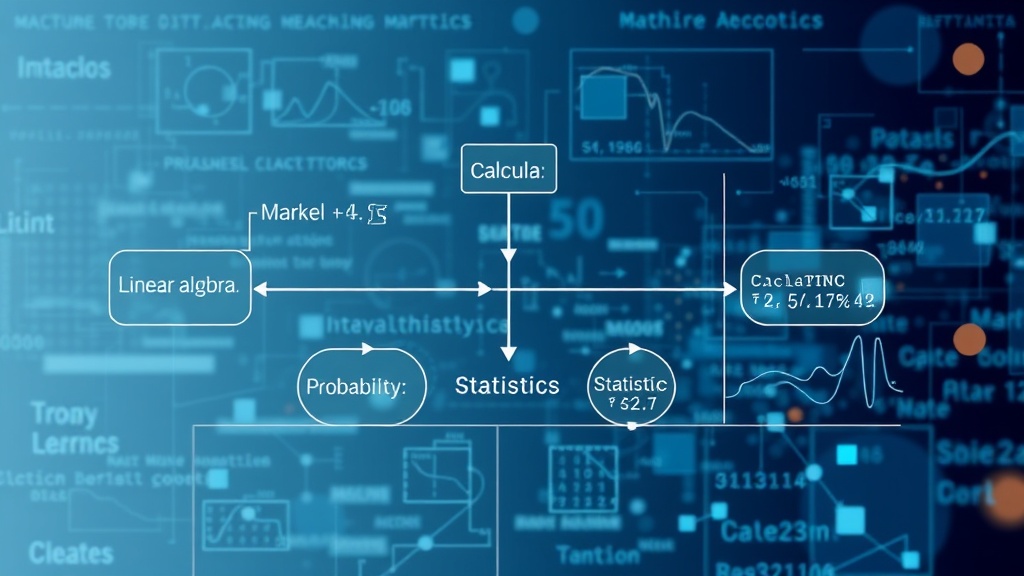
The authors highlight several key mathematical domains that form the bedrock of data science practices. These include linear algebra, calculus, probability theory, and statistics. Linear algebra, for instance, is indispensable for understanding how data is represented and manipulated, particularly in high-dimensional spaces. Techniques like matrix decomposition (e.g., Singular Value Decomposition - SVD) are fundamental to dimensionality reduction methods such as Principal Component Analysis (PCA), which are ubiquitous in machine learning for feature extraction and noise reduction.
Calculus, specifically differential calculus, is crucial for optimization algorithms that underpin model training. Gradient descent, a cornerstone of deep learning and many other machine learning algorithms, relies heavily on calculating gradients to iteratively find the minimum of a loss function. Understanding partial derivatives and the chain rule is therefore essential for anyone seeking to optimize complex models.
Probability theory and statistics provide the framework for understanding uncertainty, making inferences, and evaluating model performance. Concepts like probability distributions, Bayes' theorem, hypothesis testing, and confidence intervals are vital for data analysis, experimental design, and model validation. Without these tools, it is impossible to rigorously assess the significance of findings or the reliability of predictions.
Bridging Theory to Practical Applications
The paper emphasizes that the connection between these mathematical concepts and practical data science tasks is not always immediately obvious, especially to those entering the field with a programming-first mindset. For example, understanding the geometric interpretations of linear algebra can provide intuition for how algorithms like Support Vector Machines (SVMs) find optimal hyperplanes, moving beyond a mere algorithmic description to a deeper comprehension of their behavior and limitations.
Similarly, grasping the probabilistic underpinnings of generative models, such as Variational Autoencoders (VAEs) or Generative Adversarial Networks (GANs), allows practitioners to better control their output, diagnose failure modes, and develop novel applications. The paper posits that a superficial understanding, often gained from high-level libraries, can lead to misapplication of algorithms, over-reliance on default parameters, and an inability to debug or improve models when they fail.
The authors also touch upon the increasing relevance of discrete mathematics and graph theory in areas like network analysis, recommender systems, and certain types of algorithmic fairness research. Understanding graph traversal algorithms, spectral graph theory, and combinatorial optimization can unlock new approaches to complex relational data problems that are not well-suited to traditional Euclidean space representations.
The Future Landscape and Educational Imperatives
As data science continues to evolve, the paper suggests that the mathematical requirements will only deepen. Emerging fields like causal inference, differential privacy, and advanced reinforcement learning demand a sophisticated mathematical toolkit. Causal inference, for instance, draws heavily on probability, statistics, and even elements of causal calculus to move beyond correlation to causation. Differential privacy, crucial for protecting sensitive data in analysis, relies on advanced concepts from measure theory and probability.
The authors pose a question for educators and curriculum designers: How can we better integrate rigorous mathematical training into data science programs without alienating students who may not have a traditional mathematics background? They advocate for teaching mathematical concepts in context, demonstrating their direct application to real-world data science problems rather than as abstract theoretical exercises. This approach, they argue, can foster deeper understanding and greater confidence in applying these powerful tools.
The Hacker News discussion surrounding this paper reveals a community grappling with this very issue. Many commenters shared anecdotes of struggling with the mathematical underpinnings of tools they use daily, while others championed the necessity of such knowledge for true mastery and innovation in the field. The consensus appears to be that while computational tools abstract away much of the low-level implementation, a deep understanding of the mathematics enables practitioners to be more effective problem-solvers, critical thinkers, and ultimately, better data scientists.
This paper serves as a timely reminder that data science is not just about wielding powerful software packages; it is about understanding the principles that govern data, algorithms, and inference. For developers, founders, and researchers alike, revisiting and strengthening these mathematical foundations is an investment that pays dividends in the form of more robust, insightful, and impactful data science work.