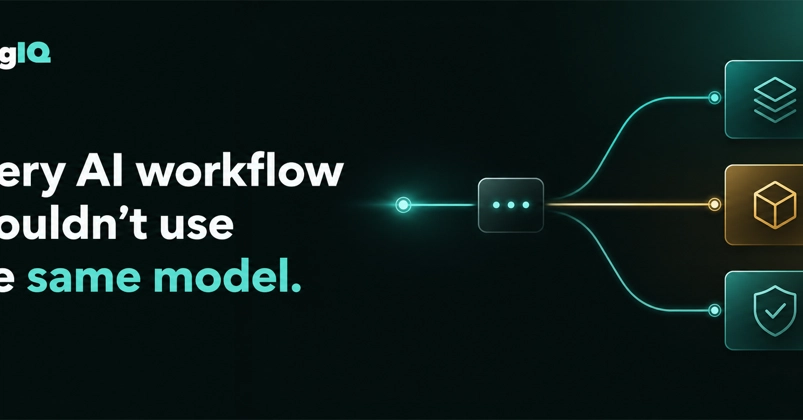
The Problem with Universal AI Models
Most AI applications today make a single, uniform model decision for their entire product. Whether it's classifying a support ticket, extracting data from an invoice, determining refund eligibility, or responding to a security alert, all these diverse tasks are often funneled through the same powerful, and expensive, AI model. This approach, while seemingly safe, creates a dual problem: routine, less complex tasks become unnecessarily costly, while a blanket switch to cheaper models risks degrading quality in areas where accuracy is critical.
The fundamental question developers and businesses should be asking is not 'Which model is the cheapest?' but rather 'Which model is the most appropriate for this specific workflow, considering its inherent complexity, associated risks, and observed performance?' This nuanced approach is crucial for both economic efficiency and maintaining high-quality AI outputs where it matters most.
The current paradigm treats all AI tasks as if they have the same requirements for computational power and data processing. This is akin to using a sledgehammer to crack a nut – it's overkill and inefficient. Support ticket classification, for instance, might be solvable with a smaller, faster, and cheaper model, while a critical security response demands the precision and robustness of a top-tier, albeit more expensive, model. Failing to differentiate leads to wasted resources on simple tasks and potential errors on critical ones.
Introducing MargIQ: Workflow-Specific AI Optimization
To address this, I built MargIQ. MargIQ is designed to help businesses answer the critical question of model appropriateness for each specific AI workflow. It provides the tools and insights needed to move beyond a one-size-fits-all strategy and adopt a more granular, cost-effective, and quality-conscious approach to AI model deployment.
The platform works by analyzing the unique characteristics of different AI workflows within an application. Instead of assuming all tasks require the same level of AI sophistication, MargIQ helps identify which tasks can be handled by less powerful, more economical models, and which truly necessitate the high-fidelity performance of advanced models. This allows for a strategic allocation of resources, ensuring that budget is spent wisely without compromising the integrity of AI-driven processes.
Think of it less like a single, monolithic AI brain and more like a team of specialized AI assistants, each with their own skill set and cost profile. MargIQ helps you assemble and manage that team, assigning tasks to the most suitable assistant.

How MargIQ Identifies Appropriate Models
MargIQ's methodology involves observing and analyzing the behavior of different AI models across various workflows. By feeding representative data through a spectrum of models – from highly performant, expensive ones to more basic, cost-effective options – the platform can benchmark their effectiveness. This isn't just about raw accuracy metrics; it's about understanding the trade-offs between cost, latency, and the specific business impact of errors for each task.
For example, when evaluating an invoice extraction workflow, MargIQ might compare a state-of-the-art large language model (LLM) against a fine-tuned, smaller model. It would measure how accurately the smaller model extracts key fields like invoice number, date, and total amount. If the smaller model achieves 98% accuracy and the larger model achieves 99%, the cost savings of using the smaller model for this high-volume task often become immediately apparent. The 1% difference might be negligible in terms of business impact, making the cheaper option the clear winner.
Conversely, for a fraud detection workflow, even a 0.5% improvement in accuracy from a more powerful model could translate into significant financial savings or risk mitigation, justifying the higher cost. MargIQ quantifies these trade-offs, providing data-driven recommendations that align with specific business objectives and risk tolerances.
The platform facilitates this analysis through a configurable environment where users can define their workflows, select candidate models, and set evaluation criteria. MargIQ then automates the process of data routing, model execution, and result aggregation, presenting clear reports that highlight the optimal model choices for each segment of their AI operations.
The Future of AI Cost Management
The implications of this workflow-specific optimization are significant. For startups and smaller businesses, it democratizes access to sophisticated AI capabilities by making them more affordable. They can leverage AI without the prohibitive costs associated with using only the most powerful models for every task. For larger enterprises, it presents an opportunity for substantial cost reduction and improved operational efficiency, freeing up budget for innovation or other strategic initiatives.
Moreover, this approach fosters a more dynamic and adaptive AI infrastructure. As new, more efficient models emerge, MargIQ can be used to re-evaluate existing workflows and seamlessly integrate better-performing, cost-effective alternatives. It encourages a mindset of continuous improvement and optimization, rather than static deployment.
The real question for any business deploying AI is how to maximize value. MargIQ provides a concrete path to achieving that by ensuring that every dollar spent on AI models delivers the most appropriate level of performance for the task at hand, preventing both unnecessary expense and critical quality compromises.
This granular control over AI model selection is not just about saving money; it's about building more resilient, efficient, and intelligent applications. It’s about making smarter, data-driven decisions that directly impact the bottom line and the user experience.