The Genesis of Mantiq: A Freshman's Struggle
The journey of Mantiq, now a free digital logic workbench, began not with a grand business plan, but with the relatable exhaustion of a freshman programmer. Muhammad bin Shahzad, a student at SEECS, NUST, faced the all-too-common confusion of Digital Logic Design courses. Staring at Boolean expressions at 4 AM, grappling with Karnaugh maps, and questioning the correctness of answer keys – this all-too-human experience fueled the initial spark. This wasn't a startup idea; it was a personal pain point seeking a solution.
The first iteration, named Logic++, emerged in 2025 as a first-semester project. Its scope was intentionally simple, built under the typical academic deadline pressure. Yet, Logic++ demonstrated a crucial insight: Boolean expressions could be programmatically typed and simplified, offering a tangible way to overcome the abstract challenges of digital logic. This initial success, though modest, planted the seed for something much larger.
From Logic++ to Mantiq: Evolution and Expansion
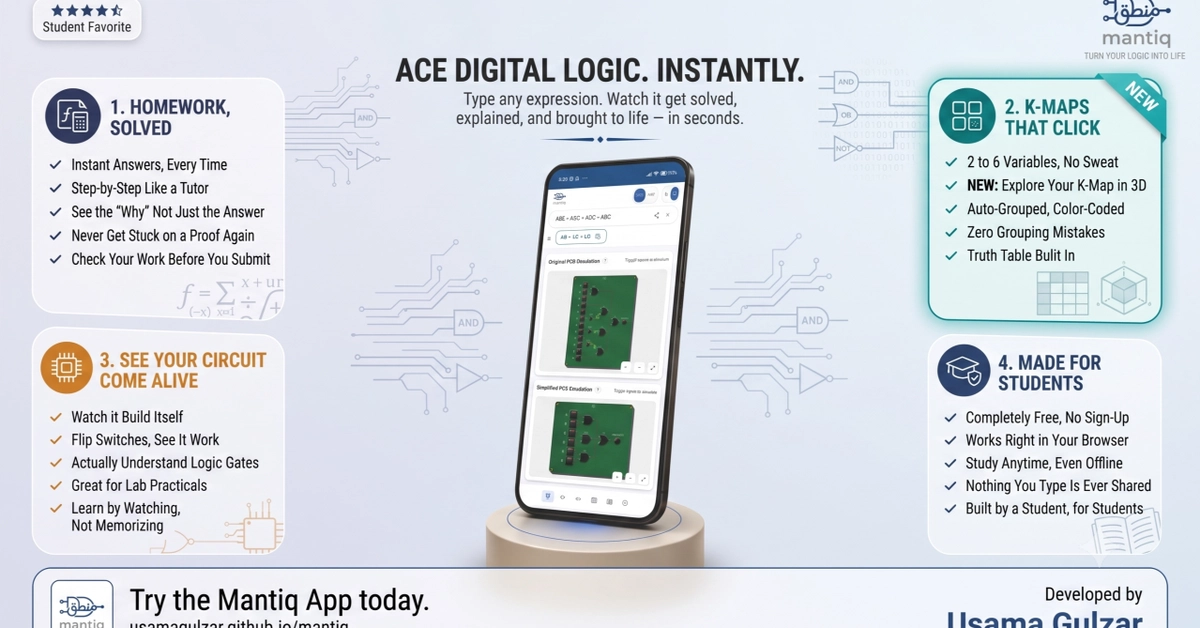
The foundational work of Logic++ proved valuable, but its limited scope didn't fully address the breadth of digital logic education. The realization dawned that a more comprehensive tool was needed – one that could not only simplify expressions but also simulate circuits and provide a richer learning environment. This broader vision led to the development of Mantiq. The name itself, Mantiq, is derived from the Arabic word for logic, underscoring its core purpose.
Unlike Logic++, Mantiq was designed with scalability and educational utility in mind. It aimed to be more than just a solver; it aspired to be a workbench. This meant incorporating features that allowed students to visualize the behavior of digital circuits, experiment with different logic gates, and understand the practical implementation of theoretical concepts. The goal was to transform the abstract world of Boolean algebra and circuit diagrams into an interactive, accessible experience.
The development process involved several key stages. Initially, the focus remained on robust Boolean expression simplification, ensuring accuracy and efficiency. This core functionality was then expanded to include circuit design capabilities. Users could graphically assemble circuits using standard logic gates (AND, OR, NOT, XOR, NAND, NOR) and then test their functionality. This hands-on approach is critical for solidifying understanding in digital logic design.
A significant challenge in digital logic education is the disconnect between theoretical knowledge and practical application. Mantiq seeks to bridge this gap by providing a virtual environment where students can build and test circuits without the need for expensive physical hardware. This democratizes access to digital logic experimentation, making it available to anyone with a computer and an internet connection.
The project also benefited from the collaborative spirit of its creators. While Muhammad bin Shahzad was the driving force behind Logic++ and a key contributor to Mantiq, the project evolved with input and contributions from peers and mentors. This iterative development, informed by the direct experiences of students learning digital logic, ensured that Mantiq remained relevant and practical.
The Power of a Free, Accessible Workbench
The decision to make Mantiq a free, open-source digital logic workbench is a critical aspect of its mission. In educational settings, particularly in resource-constrained environments, access to sophisticated simulation tools can be a significant barrier. By offering Mantiq at no cost, the creators aim to level the playing field and empower students worldwide. This move directly addresses the frustration of students who might otherwise be unable to afford or access necessary learning resources.
Mantiq's feature set is designed to support various learning objectives:
- Boolean Expression Simplification: Takes complex Boolean expressions and simplifies them using established algorithms, helping students verify their manual calculations.
- Circuit Design and Simulation: Allows users to draw digital circuits using a drag-and-drop interface with standard logic gates. The simulator then shows the output based on input values.
- Truth Table Generation: Automatically generates truth tables for given Boolean expressions or designed circuits, providing a clear mapping of inputs to outputs.
- Educational Focus: The interface and features are geared towards learning, making complex concepts more digestible for beginners in digital logic.
This comprehensive approach means Mantiq isn't just a calculator; it's a complete digital logic learning environment. Students can explore the relationship between algebraic expressions and their physical circuit implementations, observing firsthand how logical operations translate into electronic behavior. The immediate feedback provided by the simulator helps reinforce learning and correct misconceptions quickly.
The Feynman quote, "What I cannot create, I do not understand," serves as a guiding principle. Mantiq embodies this philosophy by enabling users to create, simulate, and thus understand digital logic in a practical, hands-on manner. It transforms passive learning into active exploration.
Looking Ahead: The Future of Mantiq
The journey from Logic++ to Mantiq highlights the power of addressing real-world problems with practical solutions. The project's success hinges on its ability to continuously evolve and meet the needs of students and educators. Future development could include more advanced circuit components, support for larger-scale digital systems, integration with hardware description languages (HDLs) like Verilog or VHDL, and enhanced visualization tools for signal propagation.
What remains to be seen is how widely Mantiq will be adopted by academic institutions and whether it can foster a community of educators and students who contribute to its development and share learning resources. Its potential impact is significant: making the foundational concepts of digital electronics more accessible and engaging for a new generation of engineers and computer scientists.
The transition from a freshman assignment to a free, comprehensive digital logic workbench demonstrates a commitment to education and a deep understanding of the challenges faced by students. Mantiq offers a powerful, accessible platform for anyone looking to master the fundamentals of digital systems.