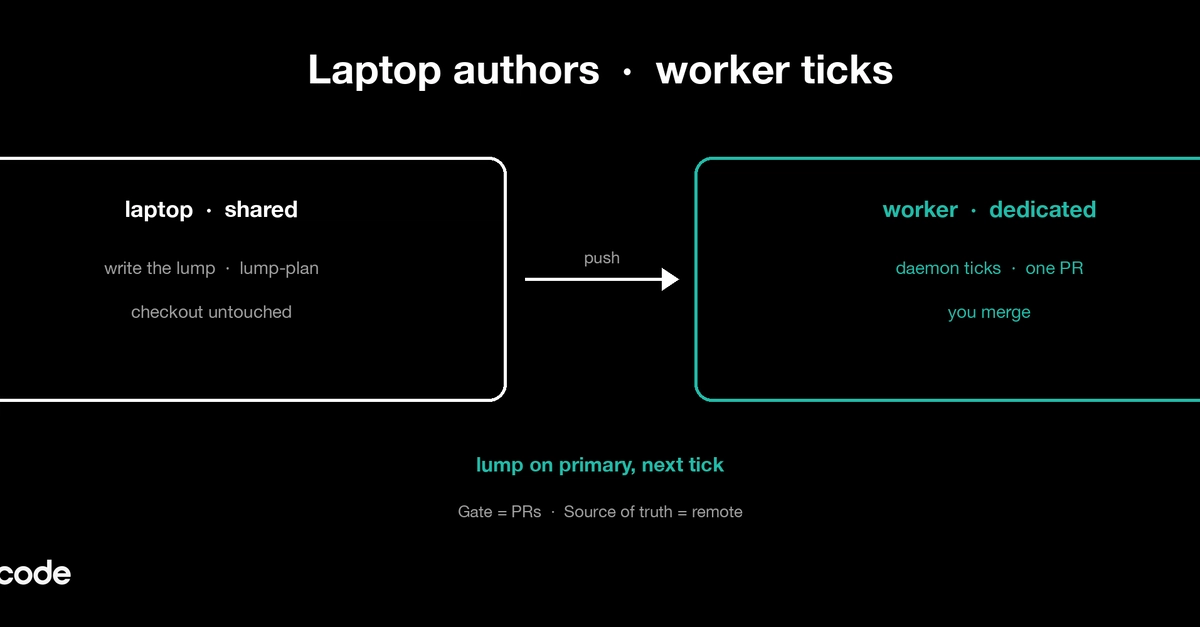
Introducing the Dedicated Lumpcode Daemon
Lumpcode, a Git-first loop manager, has introduced a dedicated daemon to automate its agent campaigns. This CLI tool orchestrates long-running agent campaigns directly within your Git repository, ensuring that each step is reviewable and that the repository itself serves as the single source of truth. Unlike traditional workflows that might rely on separate databases for state management, Lumpcode leverages Git's history. A campaign is defined once, and approved changes are merged. The system then intelligently picks up the remaining work based on the repository's remote history, not an external state store.
The core concept of Lumpcode revolves around 'lumps' – campaign definitions residing in .lumpcode/lumps/<name>/. Within each lump, a 'context' represents an isolated unit of work, typically tied to a specific branch or a Pull Request (PR). While users can manually trigger these campaigns, the new dedicated daemon offers a hands-off approach. This daemon runs on a separate machine, continuously monitoring the primary branch for new lumps. When a lump is merged into the primary branch, the daemon automatically picks it up and begins processing the defined tasks.
The architectural choice to integrate loops directly with Git is significant. It stems from the idea that codemods and similar automation tools can evolve beyond simple scripts to become more intelligent agents. By using Git as the arbiter and history keeper, Lumpcode ensures transparency and auditability. Every action taken by an agent campaign is a commit, a PR, or a merge, all traceable within the repository's lifecycle. This approach contrasts with systems that might store campaign state in proprietary databases, which can become opaque and difficult to manage over time.
The dedicated daemon streamlines this Git-first workflow. Imagine authoring your campaign logic on your primary development machine. A second, dedicated clone of your repository then runs the scheduler. This setup prevents your development environment from being bogged down by campaign processing and ensures that the scheduler is always available. When a specific lump, representing a defined set of tasks or code modifications, is approved and merged into the primary branch (e.g., main or master), the scheduler detects this change. It then initiates the processing of that lump's context, typically by creating new branches or executing automated code transformations based on the merged changes.
How the Daemon Operates
The daemon's operation is straightforward yet powerful. It essentially acts as an always-on observer of the primary branch. When a new campaign or a stage of an existing campaign is merged, the daemon identifies it. Its primary function is to ensure that the work defined by the lump is executed without manual intervention. This is particularly useful for repetitive or complex multi-step processes that are best managed through version control. For instance, consider a scenario where you are refactoring a large codebase. You might define a Lumpcode campaign to systematically apply changes across various modules. Each approved step, represented by a PR, signals to the daemon that the next stage of the refactoring can commence. The daemon then takes over, potentially creating new branches for further modifications, running automated tests, or applying further code transformations as defined in the lump's configuration.
This dedicated daemon approach offers several key benefits. Firstly, it decouples the campaign execution from the developer's local machine, preventing performance degradation and interruptions. Secondly, it ensures consistency and reliability, as the daemon is designed to run continuously. Thirdly, it enhances the auditability of automated processes. Since all actions are tied to Git commits and PRs, there's a clear, immutable record of what happened, when, and why. This is crucial for compliance, debugging, and understanding the evolution of codebases managed by automated agents.
The setup involves maintaining two clones of the repository: one for active development and another dedicated clone running the Lumpcode daemon. The daemon monitors the primary branch of the primary clone. When a lump is merged into this primary branch, the daemon detects the change. It then operates on its own clone, ensuring that the development environment remains clean and unaffected by the campaign execution. This separation is akin to having a dedicated build server or CI/CD agent that operates independently of a developer's workstation, but with the added benefit of deep Git integration.
The practical implications are substantial for teams engaged in large-scale code transformations, automated refactoring, or managing complex agent-driven development workflows. By offloading the execution to a persistent daemon, developers can focus on authoring and reviewing code, while the system handles the iterative application and verification of changes. The Git-first nature ensures that all changes are subject to the same review processes as manual code contributions, maintaining code quality and collaboration standards.
This daemon effectively transforms Lumpcode from a powerful CLI tool into a continuous, automated agent execution system. It allows for complex, multi-step agent campaigns to run reliably in the background, driven entirely by Git merges. The system reads what's left from remote history, meaning it doesn't require a separate, stateful database to track progress. This reliance on Git as the source of truth simplifies setup and maintenance while providing a robust audit trail for all automated actions.
Referenced Sources
- verified