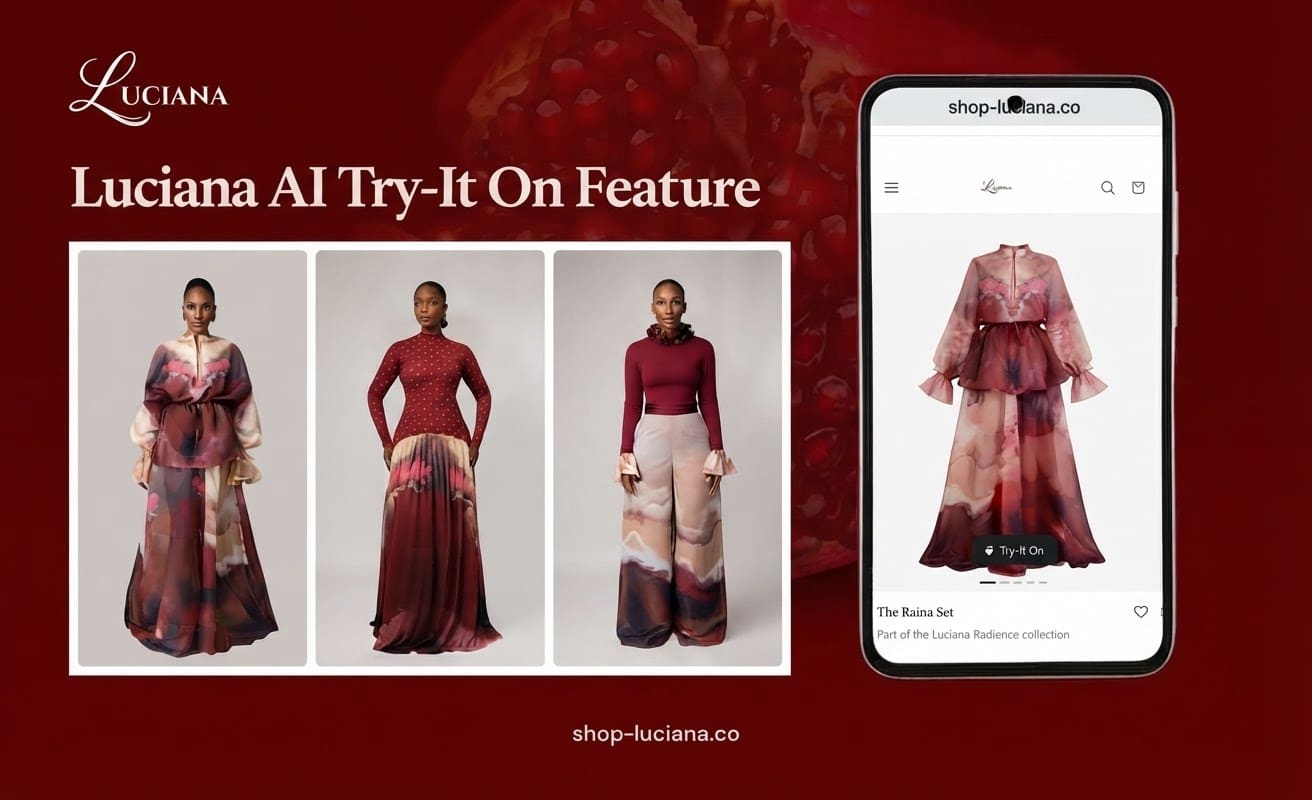
Revolutionizing Online Fashion in Nigeria
Luciana Womenswear, a prominent name in Nigeria's premium fashion scene, has just launched what it claims is the country's first artificial intelligence-powered virtual try-on feature for online shoppers. This move signals a significant leap forward for e-commerce in the Nigerian fashion industry, aiming to bridge the gap between online browsing and the tangible experience of in-store shopping.
The new AI virtual try-on technology allows customers to upload a photo of themselves and see how Luciana's garments would look on their specific body type and silhouette. This addresses a common pain point for online fashion consumers: the uncertainty of fit and style. By providing a personalized visualization, Luciana aims to reduce hesitation, boost customer confidence, and ultimately decrease return rates, which are often high in online apparel sales due to sizing and appearance discrepancies.
The implementation of this technology is more than just a novel feature; it represents a strategic investment in enhancing the customer journey. In a market where online retail is rapidly growing but often lacks the tactile feedback of physical stores, tools like this become crucial for building trust and fostering loyalty. Luciana's initiative positions them as an innovator, setting a new benchmark for how fashion brands can leverage technology to improve the online shopping experience.

How the AI Virtual Try-On Works
The underlying technology analyzes the user's uploaded photo, identifying key body landmarks and measurements. Once a garment is selected, the AI algorithm digitally overlays the clothing item onto the user's image, adjusting for drape, fit, and proportion. This process is designed to be intuitive and quick, enabling shoppers to experiment with multiple outfits in a matter of minutes without leaving their homes.
While the specifics of the AI model and its training data are proprietary to Luciana and its technology partners, the general principle involves sophisticated computer vision and machine learning techniques. These models are trained on vast datasets of clothing items and human body shapes to accurately predict how fabric will behave and how garments will appear on different individuals. The goal is to create a realistic rendering that closely approximates how the actual garment would fit and look.
The system likely incorporates several layers of AI processing. First, it requires robust image segmentation to isolate the user's body from the background. Then, advanced pose estimation helps understand the user's posture. Finally, generative AI or advanced rendering techniques are employed to place the virtual garment onto the user's form, simulating how it would hang, stretch, or fold. This is a complex undertaking, especially when dealing with the varied textures, patterns, and cuts of high-fashion apparel.
Impact on the Online Fashion Retail Landscape
Luciana's introduction of AI virtual try-on technology is a significant development for the Nigerian e-commerce sector. Traditionally, online fashion retailers have relied on detailed size charts, customer reviews, and high-quality product photography to convey product information. However, these methods can still leave customers with a sense of uncertainty, leading to cart abandonment or increased return rates.
By offering a personalized virtual fitting experience, Luciana is directly tackling these challenges. This not only enhances customer satisfaction but also has the potential to significantly improve operational efficiency for the brand. Reduced returns mean lower logistical costs, less inventory handling, and a more sustainable business model. For customers, it means a more engaging, informed, and ultimately satisfying shopping experience.
The move could also spur further innovation within the Nigerian fashion tech space. As consumers become accustomed to advanced digital experiences, other brands may feel pressure to adopt similar technologies to remain competitive. This could lead to a broader adoption of AI and other emerging technologies in online retail, not just in fashion but across various sectors.
The surprising detail here is not just the introduction of AI, but its deployment by a local premium brand in Nigeria. This suggests a maturing market that is ready for and capable of adopting cutting-edge consumer technologies, moving beyond basic e-commerce functionalities to offer sophisticated, value-added services. It demonstrates a commitment to customer experience that rivals global online fashion giants.
The Future of Fashion Retail with AI
The integration of AI in fashion retail is not entirely new globally, but its adoption in emerging markets like Nigeria is a strong indicator of technological democratization. Virtual try-on technologies are evolving rapidly, with advancements in augmented reality (AR) and 3D body scanning promising even more immersive and accurate experiences in the future.
For developers in Nigeria and beyond, this presents an opportunity to build and refine such AI-driven solutions. The demand for personalized online shopping experiences is only set to grow, and companies that can deliver these innovations will likely lead the market. This technology can be extended to virtual styling consultations, personalized recommendations based on body shape and style preferences, and even virtual fashion shows.
Luciana's initiative is a testament to how technology can be harnessed to overcome geographical limitations and enhance the digital shopping experience. As more brands explore similar integrations, the line between online and offline shopping will continue to blur, offering consumers unprecedented convenience and customization. The question remains: how quickly will other Nigerian fashion retailers embrace this technological shift, and what new innovations will follow in its wake?