
The Bottleneck in Typesetting Large Documents
For decades, producing professional-quality documents with complex layouts, extensive cross-referencing, and intricate typography has been a time-consuming process. The compilation of large TeX-based documents, particularly those using advanced engines like LuaTeX, often involves significant delays. Even minor edits could trigger recompilations that take minutes, or even hours, for massive projects. This friction directly impacts productivity, especially for authors, academics, and publishers working with extensive manuscripts, technical manuals, or books. The delay forces a context switch, breaking the flow of writing and editing. It makes iterative refinement a chore rather than an efficient part of the creative process.
LuaTeX, known for its flexibility and extensibility through the Lua scripting language, offers powerful features for document creation. However, its internal architecture, while robust, historically presented challenges for achieving rapid incremental compilation. Traditional TeX engines often re-process large portions of the document, even for small changes, leading to lengthy build times. This problem is compounded in large documents where the sheer volume of content and interdependencies increases the computational overhead for each compilation pass.
The core issue lies in how changes are propagated and processed. When a change is made, the typesetting engine must re-evaluate page breaks, hyphenation, font metrics, cross-references, and potentially update the table of contents, index, and bibliography. In a large document, this can involve traversing vast amounts of internal data structures and performing complex calculations. The goal of real-time compilation is to bypass this full re-evaluation for most changes, only processing what is strictly necessary.
Introducing Real-Time LuaTeX: A New Compilation Paradigm
A recent development, detailed in a paper by Reunanen (2026), introduces a fundamentally new approach to LuaTeX that enables recompilation of large documents in as little as 1 millisecond. This isn't an incremental optimization; it's a redesign of the internal compilation pipeline aimed at achieving near-instantaneous feedback. The research focuses on making the typesetting process reactive, allowing the engine to respond to changes with unprecedented speed.
The key innovation lies in a novel internal data structure and a change-detection mechanism. Instead of re-parsing and re-processing the entire document structure on every change, the new system meticulously tracks dependencies. When an edit is made, the engine can precisely identify which parts of the document are affected. It then re-executes only the Lua code and TeX commands relevant to those specific affected areas. This selective re-execution is the cornerstone of the speedup.
Think of it less like re-reading an entire book to find a typo on page 200, and more like having a hyper-aware editor who instantly highlights only the sentences that were changed and asks you to rephrase them. The editor doesn't re-read the whole book; they focus precisely on the affected text and its immediate context.
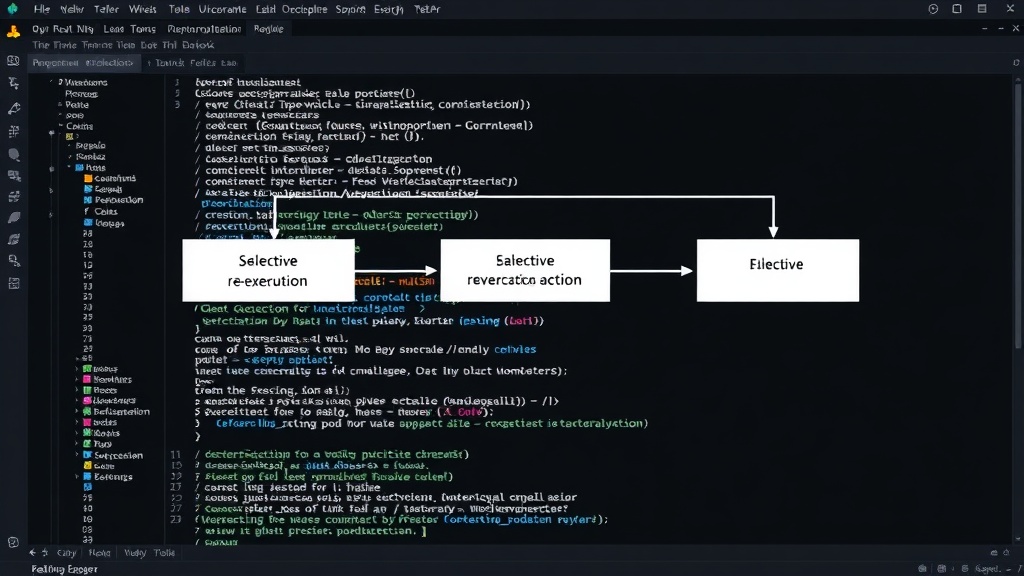
This mechanism allows the engine to bypass extensive computations, such as re-calculating entire chapter layouts or re-generating large sections of the table of contents, unless those specific elements were directly modified or their dependencies were altered. The result is a compilation process that, for many common edits, completes in the blink of an eye, effectively bringing document compilation into the real-time interaction domain.
Technical Underpinnings and Performance Gains
The research paper outlines several critical components that enable this performance leap. Firstly, a fine-grained dependency tracking system is implemented. This system records which elements of the document (e.g., a paragraph, a cross-reference, a macro definition) depend on which underlying data or code. When an element is modified, the system can efficiently query this dependency graph to find all other elements that need to be re-evaluated.
Secondly, the LuaTeX engine's internal state management has been refactored. Instead of discarding and rebuilding large parts of the state, the system now aims to update the state in place. This includes data structures for page layout, font metrics, hyphenation patterns, and macro definitions. By modifying these structures incrementally, the overhead associated with state initialization during compilation is drastically reduced.
The performance gains are substantial. The paper reports that for large, complex documents (e.g., several hundred pages with extensive cross-referencing), recompilation times have been reduced from minutes to mere milliseconds. This represents a speedup factor of thousands, transforming the user experience from one of waiting to one of immediate feedback. The reported 1ms figure is achieved under specific conditions, likely for minimal changes, but even for more significant edits, the compilation times are orders of magnitude faster than previous LuaTeX versions.
Implications for Document Creation and Publishing
The implications of Real-Time LuaTeX are far-reaching. For authors and researchers, it means an end to the frustrating waiting times associated with editing. Imagine writing a thesis or a book where every minor correction, every added sentence, or every adjusted cross-reference appears on screen almost instantly. This immediacy can significantly boost creative flow and reduce the cognitive load associated with document production.
For developers building custom typesetting solutions or complex document templates, the ability to iterate rapidly on their code and see results in real-time is invaluable. Debugging complex macro packages or fine-tuning intricate layout algorithms becomes a much more interactive and efficient process. This could lead to more sophisticated and polished document designs becoming more accessible.
The publishing industry could also benefit. While traditional publishing workflows might not immediately adopt such rapid compilation, the technology opens doors for new tools. Interactive document editors that leverage this engine could offer a WYSIWYG-like experience for TeX users, bridging the gap between simple editors and the power of TeX. Furthermore, for publishers dealing with rapidly changing content, such as technical documentation or legal documents, the speed of updates could streamline their workflows.
Future Directions and Open Questions
While the reported 1ms compilation time is a remarkable achievement, the research also opens up new avenues for exploration. One key question is the scalability of this approach to even larger and more complex documents, such as those involving complex graphical elements or external data integration that might require more extensive processing. The paper suggests that the core mechanism is robust, but real-world performance across a wider spectrum of document types will need further validation.
Another area for future work involves integrating this real-time compilation capability into existing TeX editors and IDEs. Developing user interfaces that fully exploit this speed, perhaps through live preview features that update as you type, will be crucial for widespread adoption. The research team is actively working on such integrations, aiming to make this powerful capability accessible to a broad user base.
The success of Real-Time LuaTeX also raises broader questions about the future of typesetting engines. As computation becomes cheaper and user expectations for responsiveness increase, other document preparation systems might explore similar reactive compilation paradigms. This development signals a potential shift in how we think about and interact with the tools used to create complex written content, moving from batch processing to fluid, real-time interaction.