
Exhaustive Search Unlocks GIF Compression Potential
A novel approach to GIF recompression is demonstrating significant file size reductions, achieving up to 50% smaller files without any perceptible loss of image quality. This method, detailed in a recent blog post, moves beyond traditional optimization techniques by employing an exhaustive search algorithm to find the absolute best compression settings for each individual GIF. The core problem with existing GIF compressors is their reliance on heuristics that often miss optimal configurations, leaving potential savings on the table.
The limitations of the GIF format are well-known. Its 256-color palette, frame-based animation, and lack of modern compression standards mean that GIFs can quickly become bloated, impacting load times and bandwidth usage. While tools like Gfycat and Imgur have offered solutions, they often involve re-encoding to different formats or applying lossy compression, which is precisely what this new method aims to avoid.
This new technique, developed by Aleksander Skjoelsvik, focuses on the parameters within the GIF specification itself. Instead of making assumptions about which settings are best, it systematically explores every possible combination of these settings for a given GIF. This brute-force method, while computationally intensive, guarantees that the most efficient representation of the animation, within the GIF format's constraints, is found.
How Exhaustive Search Optimizes GIFs
The GIF format allows for several optimization points that are often overlooked or simplified by standard compressors. These include:
- Global vs. Local Color Tables: GIFs can use a global color table for all frames or a local color table for each individual frame. Choosing the right approach, or a combination, can save bytes.
- Frame Disposal Methods: How each frame replaces the previous one (e.g., clear to background, restore to previous) has a direct impact on file size.
- Color Palette Reduction: While GIFs are limited to 256 colors, the exact 256 colors chosen can be optimized. This involves finding the smallest subset of colors that accurately represents the image content, often by analyzing the actual pixels used in each frame.
- Dithering: The use of dithering to simulate more colors can be applied selectively or omitted where it doesn't significantly impact perceived quality.
Skjoelsvik's algorithm works by iterating through these parameters. For a given GIF, it might first try using a global color table, then systematically test different palette sizes and color compositions. For each palette, it evaluates the best disposal methods and dithering settings. This process continues until all meaningful combinations have been tested. The algorithm then selects the combination that results in the smallest file size while ensuring the output remains a valid, lossless GIF.
The effectiveness of this approach is highlighted by the results. In testing, the algorithm was able to recompress GIFs that had already been optimized by standard tools, achieving further reductions. This suggests that many GIFs circulating online are not as efficiently encoded as they could be, even when using existing optimization software.
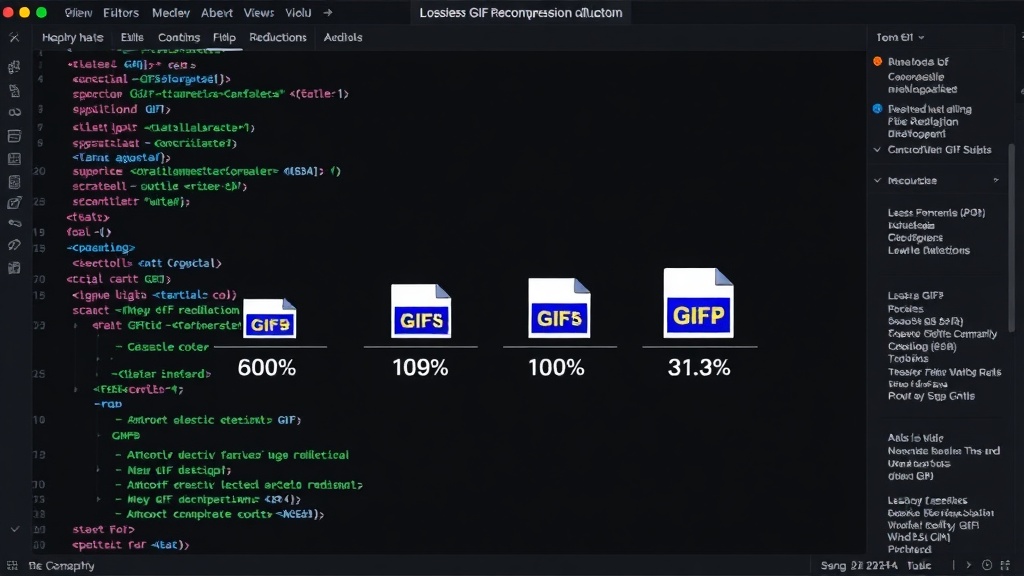
The Trade-off: Computation Time vs. File Size
The primary drawback of an exhaustive search is the computational cost. Finding the absolute best configuration requires significant processing power and time. For a single, small GIF, the process might take seconds or minutes. However, for larger or more complex animations, the time required could extend considerably, potentially making it impractical for real-time compression scenarios or for processing vast libraries of GIFs on limited hardware.
This is where the trade-off becomes apparent. Users must decide if the bandwidth savings and faster load times justify the increased time spent on compression. For web developers preparing assets for high-traffic websites, or for creators distributing animated content, the investment in compression time could yield substantial long-term benefits. The algorithm's author acknowledges this, noting that the current implementation is a proof of concept and that further optimizations to the search process itself are possible.
The question remains: can this exhaustive search be made practical for everyday use? Current implementations might be best suited for batch processing where time is less of a constraint. Future work could involve developing more intelligent pruning strategies within the search algorithm, or leveraging parallel processing to speed up the computation. Without such advancements, its adoption might be limited to scenarios where maximum compression is paramount, and processing time is secondary.
Still, the demonstration is powerful. It proves that the GIF format, despite its age, still holds significant unexploited compression potential. By systematically exploring the parameter space, developers can achieve lossless savings that were previously thought unattainable with simple tools.