The Challenge of Fine-Tuning Speed
Fine-tuning large language models (LLMs) and diffusion models is a critical step for adapting them to specific tasks and datasets. Techniques like Low-Rank Adaptation (LoRA) have made this process significantly more efficient by reducing the number of trainable parameters. However, measuring and comparing the actual speed of these fine-tuning processes across different hardware, software configurations, and parameter settings has remained a challenge. Developers often rely on anecdotal evidence or isolated benchmarks, making it difficult to objectively assess which methods offer the best wall-clock time performance for their specific needs.
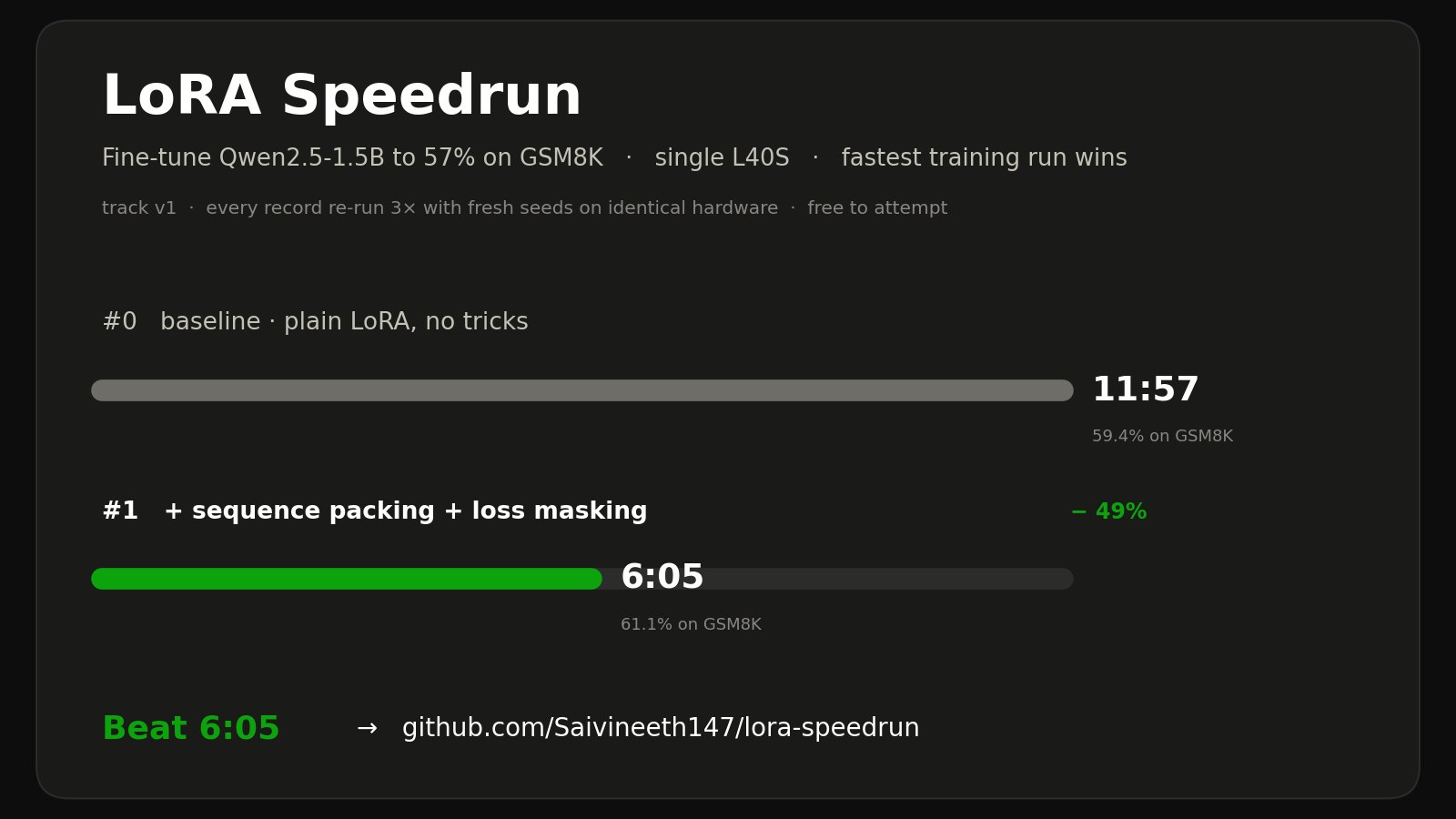
Enter LoRA Speedrun, a new open-source project aiming to bring transparency and comparability to the fine-tuning speed landscape. It establishes a public, wall-clock leaderboard that tracks the performance of various LoRA fine-tuning techniques. The project provides a standardized framework for running benchmarks and a central repository for results, allowing the community to see which configurations deliver the fastest results.
How LoRA Speedrun Works
The core of LoRA Speedrun is a set of standardized scripts designed to run consistent fine-tuning experiments. These scripts abstract away much of the setup complexity, allowing users to easily execute benchmarks on their own hardware. The project focuses on measuring the total time taken from the start of the training process to its completion (wall-clock time), which is a crucial metric for practical deployment and iteration speed. This approach differs from solely focusing on metrics like throughput (samples per second) or training loss, providing a more holistic view of efficiency.
Users can contribute to the leaderboard by running these scripts and submitting their results. The project is built on a foundation of open collaboration, encouraging developers and researchers to share their findings. This collective effort aims to build a comprehensive database of fine-tuning performance that reflects real-world conditions. The underlying methodology emphasizes reproducibility, ensuring that results are comparable across different submissions. This includes specifying the exact hardware used (GPU model, VRAM, CPU, RAM), the software environment (PyTorch version, CUDA version, drivers), and the specific LoRA parameters (rank, alpha, target modules, optimizer, learning rate).
Key Metrics and Contributing Factors
LoRA Speedrun tracks several key metrics, with wall-clock time being paramount. However, the project also captures data points that influence this time, such as:
- Hardware Specifications: The type and amount of GPU memory (VRAM), GPU compute capability, CPU, and system RAM all play a significant role. Higher-end GPUs with more VRAM generally lead to faster training, especially when dealing with larger models or batch sizes.
- Software Stack: The versions of deep learning frameworks like PyTorch, CUDA, and associated libraries can introduce performance variations. Optimizations within these libraries can lead to substantial speedups.
- LoRA Configuration: Parameters such as the LoRA rank (dimension of the low-rank matrices), alpha (scaling factor), and the specific layers targeted for adaptation (e.g., query, key, value, output projections) influence both the memory footprint and the computational load.
- Dataset Size and Batch Size: Larger datasets naturally require more training steps. The batch size, conversely, affects how many samples are processed in parallel. A larger batch size can improve GPU utilization but may also increase memory requirements and potentially affect convergence.
- Optimizer and Learning Rate Scheduler: Different optimizers (e.g., AdamW, SGD) and learning rate schedules can impact convergence speed and the total number of training steps required.
By collecting these granular details alongside the final time, LoRA Speedrun allows users to identify not just which configurations are fastest, but also *why* they are fastest. This insight is invaluable for optimizing fine-tuning workflows.
The Community Aspect and Future Implications
The open-source nature of LoRA Speedrun is its greatest strength. It fosters a collaborative environment where the community can collectively identify the most efficient ways to fine-tune models. For developers working with LLMs and diffusion models, this leaderboard serves as a practical guide. It can inform hardware purchasing decisions, help select optimal LoRA settings for rapid prototyping, and provide a benchmark against which new optimization techniques can be measured. The surprising detail here is not the existence of a leaderboard, but its specific focus on wall-clock time for LoRA, a technique that has become a de facto standard for efficient fine-tuning.
What nobody has addressed yet is the long-term impact of such a standardized benchmarking effort on the development of new fine-tuning techniques. Will the focus on raw speed, as measured by wall-clock time, lead to trade-offs in model performance or generalization? Or will it spur innovation in hardware-software co-design for AI training? As the project matures, it could evolve to incorporate more nuanced metrics or even automated submissions directly from popular training frameworks.
For founders, this project offers a clear signal about the practical performance characteristics of AI model adaptation. It can help in budgeting for compute resources and setting realistic timelines for product development cycles that rely on customized AI models. Creators can leverage the insights to iterate faster on their AI-generated content, experimenting with different model adaptations without waiting days for results.
Conclusion
LoRA Speedrun addresses a critical gap in the AI fine-tuning ecosystem. By providing a public, community-driven leaderboard focused on wall-clock performance, it empowers developers, researchers, and businesses to make more informed decisions about their AI development workflows. The project's emphasis on standardization and transparency promises to accelerate the pace of innovation in efficient model adaptation.