
The Challenge of Long Document Comprehension
Large language models (LLMs) struggle with extensive documents. A 492-page report, for instance, might have a table of contents (TOC) with hundreds of entries. Standard retrieval methods, like top-k sampling across every page, can dilute relevant information with noise from adjacent sections. This approach is akin to asking a librarian for information about a specific historical event, and they respond by reading aloud every book in the entire history section, hoping the answer is somewhere within the cacophony. For enterprise applications requiring precise answers from lengthy internal documents, this inefficiency is a significant bottleneck.
The core problem lies in the scale and structure of information. Traditional retrieval mechanisms treat documents as flat collections of text. When a query is issued, they retrieve chunks of text based on semantic similarity, irrespective of their structural position. In a long document, this means an answer to a specific question might be buried pages away from related context, or worse, the retrieval system pulls similar-sounding but irrelevant passages from different sections, overwhelming the LLM's context window and degrading answer quality. This is particularly problematic for structured documents like legal contracts, technical manuals, or research papers, where hierarchical organization is key to understanding.
Introducing Loop Engineering for Hierarchical Retrieval
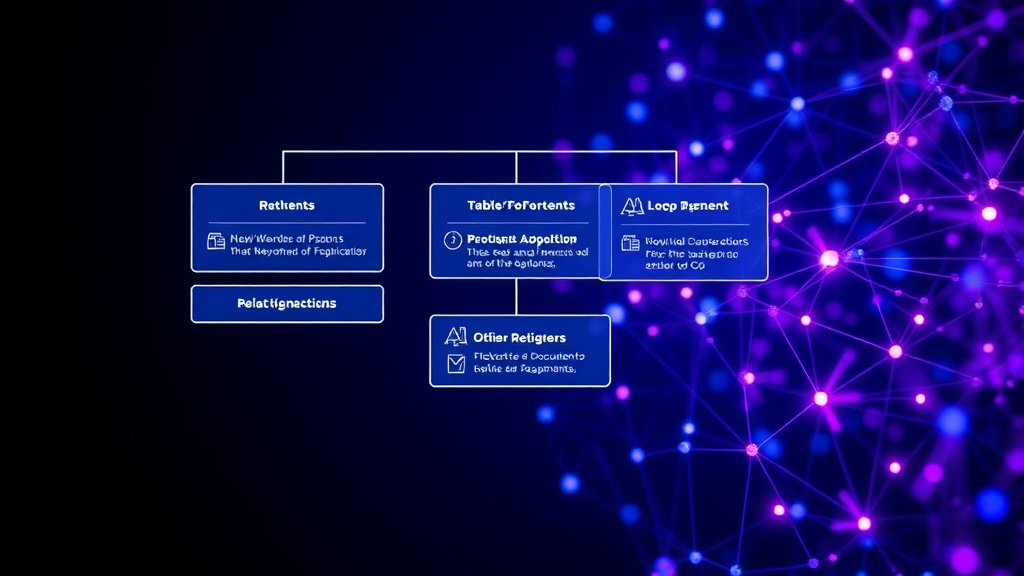
Loop Engineering offers a novel solution by leveraging the inherent structure of documents, specifically their tables of contents. Instead of a brute-force page-by-page retrieval, this method treats the TOC as a navigable map. The system first identifies relevant sections in the TOC that likely contain the answer to a given query. These selected TOC entries then guide the retrieval process, focusing the search on specific chapters or sub-sections. This hierarchical approach ensures that the retrieved information is not only semantically relevant but also contextually appropriate within the document's structure.
The process can be visualized as a guided tour rather than a free-for-all exploration. Imagine a tour guide (the LLM) with a detailed itinerary (the TOC). When a tourist asks a question, the guide doesn't randomly point to exhibits in the museum. Instead, they consult the itinerary to find the specific wing or exhibit related to the query, then guide the tourist directly there. This significantly reduces the time spent searching and increases the likelihood of finding accurate information. The system effectively creates a bounded loop within the retrieval process, iterating through relevant TOC entries until the answer is found or the search space is exhausted.
How Loop Engineering Works
The mechanism involves several key steps. First, the system processes the document to extract both its content and its TOC. The TOC is parsed into a structured format, often a tree or list, representing the document's hierarchy. When a user query arrives, an initial retrieval step identifies a set of potentially relevant TOC entries. This might involve a lightweight semantic search against TOC titles and descriptions, or even keyword matching.
Once a candidate set of TOC entries is identified, the system enters a refined retrieval phase. Instead of fetching text chunks from the entire document, it focuses on the content within the sections indicated by the selected TOC entries. This can involve multiple stages. For example, the system might first retrieve the most relevant chapter, then within that chapter, identify the most relevant sub-section using the TOC's deeper levels. This iterative refinement process continues, guided by the TOC's structure, until sufficient context is gathered to answer the query accurately. This approach inherently saves tokens, as the LLM only receives highly relevant, contextually organized information, rather than a broad, potentially noisy selection of text chunks.
Benefits and Implications
The primary benefits of Loop Engineering are improved precision and efficiency. By directing retrieval through the TOC, the system avoids retrieving irrelevant information that might surround the target content in a flat retrieval model. This leads to higher quality answers, as the LLM is less likely to be confused by extraneous details. Furthermore, the reduced amount of text processed per query directly translates to lower token consumption. For enterprises that rely on LLMs for document analysis, this can lead to significant cost savings, especially when dealing with high volumes of queries against large document repositories.
The technique is particularly valuable for enterprise AI applications. Many businesses operate with vast internal knowledge bases, legal archives, financial reports, and technical documentation. The ability to reliably extract specific information from these long, structured documents is critical for informed decision-making, compliance, and operational efficiency. Loop Engineering provides a more robust and scalable method for accessing this information compared to generic retrieval techniques. It transforms how AI systems interact with complex, hierarchical data, moving from a brute-force search to an intelligent, structured navigation.
Unanswered Questions and Future Directions
While Loop Engineering offers a compelling solution, several questions remain. What is the optimal strategy for mapping queries to TOC entries when a document's TOC is sparse or poorly structured? How does the system perform with documents that have deeply nested or highly irregular hierarchical structures? The current approach assumes a well-defined TOC. Exploring methods to automatically infer or reconstruct hierarchical structure from unstructured documents could further broaden the applicability of this technique. Additionally, the computational overhead of parsing and navigating the TOC needs to be balanced against the gains in retrieval efficiency and precision. Benchmarking this against other advanced retrieval techniques, like graph-based retrieval or hybrid approaches, will be crucial for understanding its competitive edge in various enterprise scenarios.