The Core Problem: Resolving Business References
In the intricate world of business applications, a persistent challenge is how to reliably resolve references. These references aren't merely pointers in code; they represent real-world business entities, relationships, and actions. Think of a customer order: it needs to be linked to a specific customer, a particular product, and a delivery address. How do we ensure these links are robust, discoverable, and maintainable, especially as the underlying technology stack evolves?
The previous discussion established that a Locator is not a UI control nor a search mechanism. Instead, it is an architectural concept. Its primary role is to resolve business references within a defined business context and then translate these references into canonical business identities. This means that when an application needs to find a specific customer, the Locator doesn't just search a database table; it understands the business context (e.g., 'the customer who placed the order yesterday') and provides a definitive, unambiguous identity for that customer.
This distinction is crucial. If a Locator were just a search function, its behavior would be tied directly to the implementation details of the search engine or database. But by framing it as an architectural concept, we elevate it to a level where it can be discussed and understood independently of how it's built.
Defining the Locator: Abstraction Over Implementation
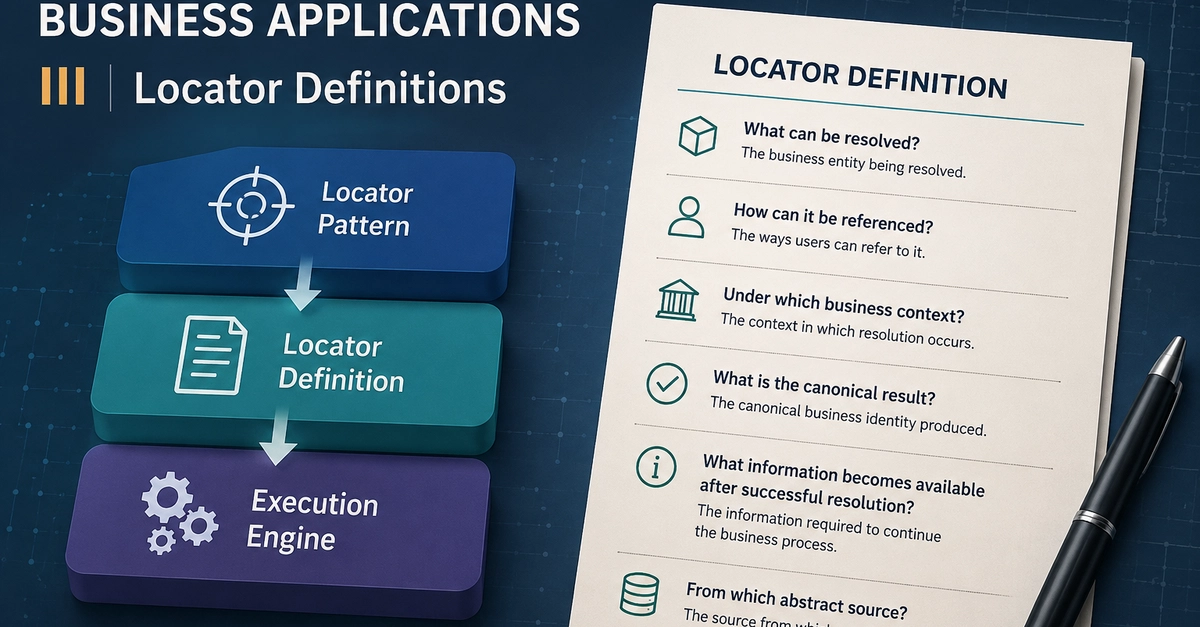
The immediate, and most important, question that arises from this architectural view is: How can a Locator be described independently of its implementation? This isn't about how to code a Locator, or how a specific framework executes one. It's about defining the Locator's essence, its purpose, and its contract, in a way that two different development teams, using entirely different technologies, could agree they are both implementing the same fundamental concept.
The answer lies in abstraction. Just as a `List` in programming is an abstract data type that can be implemented by arrays, linked lists, or other structures, a Locator must be separable from its concrete implementation. This separation allows for a shared understanding and a common language when discussing Locator strategies. Without this, discussions about Locators would devolve into debates about specific libraries, programming languages, or frameworks, hindering interoperability and conceptual clarity.
Consider the challenge of two teams building systems that need to interact. If both teams implement a 'Customer Locator' using different methods – one perhaps using a REST API with specific search parameters, the other using a direct database query with JOINs – how do they ensure their Locators serve the same architectural purpose? They can't, unless they agree on a higher-level definition of what a Customer Locator *is* and what it *does*, irrespective of the underlying technology.
The Contract of a Locator
To achieve this implementation-independent description, we can define a Locator by its contract. A Locator's contract specifies what it guarantees to do, what inputs it accepts, and what outputs it provides, without dictating the internal mechanisms. This contract serves as the blueprint for any Locator implementation.
At its core, a Locator's contract involves two key aspects:
- Resolution: The Locator takes a set of business references (which might be incomplete, ambiguous, or contextual) and resolves them. For example, it might take a customer's name and recent order ID to find their definitive customer ID.
- Canonical Identity Transformation: The resolved business reference is transformed into a canonical business identity. This canonical identity is a stable, unambiguous identifier that the rest of the system can use reliably. It's the single source of truth for that business entity within the application's context.
This contract acts as a universal interface. Any system component needing to find a business entity can rely on this contract. It doesn't need to know *how* the Locator finds the entity – whether it's querying a cache, calling an external service, or performing a complex database lookup. It only needs to know that by providing the correct business references, it will receive the canonical identity.
Implications for System Design and Development
Decoupling Locator definitions from their implementations has profound implications for system design and development. It enables:
- Technology Agnosticism: Teams can choose the best implementation technology for a Locator based on performance, cost, or existing infrastructure, without impacting the business logic that consumes the Locator.
- Interoperability: Different services or modules, potentially developed by different teams or even different companies, can communicate and resolve references consistently if they adhere to the same Locator contract.
- Testability: Locators can be tested against their contract. Mock implementations can be used to simulate Locator behavior, allowing other parts of the system to be tested in isolation.
- Maintainability and Evolution: The underlying implementation of a Locator can be refactored or rewritten entirely without affecting the consuming components, as long as the contract remains the same. This allows systems to adapt to new technologies or performance requirements over time.
Think of it like a universal power adapter. You don't need to know the internal circuitry of the adapter to plug your device into different outlets worldwide. You only need to know its standard input and output interfaces. Similarly, a well-defined Locator contract allows different parts of a business application, or even different applications, to interface with the concept of resolving business references without needing to understand the specific mechanism employed.
The Unanswered Question: Governance of Canonical Identities
While defining Locators abstractly solves the problem of implementation variance, it raises a related, yet distinct, challenge: the governance of these canonical business identities. If a Locator's job is to produce these stable, unambiguous identifiers, who decides what constitutes a 'canonical' identity? What happens when business rules change, requiring a different interpretation of what makes an identity canonical? For instance, should a customer's identity be based solely on their unique ID, or should it also incorporate their primary business role within an organization? The definition of 'canonical' is itself a business decision, and managing these decisions across an organization, especially as it scales, presents a significant governance hurdle that the Locator concept itself doesn't fully address, but rather highlights.
Conclusion: A Foundation for Robust Business Logic
By defining Locators as an architectural concept—a mechanism for resolving business references into canonical identities, independent of implementation—we establish a foundation for building more robust, maintainable, and interoperable business applications. This abstraction allows developers to focus on the business logic that *uses* these references, confident that the underlying resolution mechanism can be optimized or changed without disrupting the system. The focus shifts from 'how do we find this?' to 'what does it mean to find this, and what is its definitive identity?' This conceptual clarity is essential for managing complexity in modern software development.