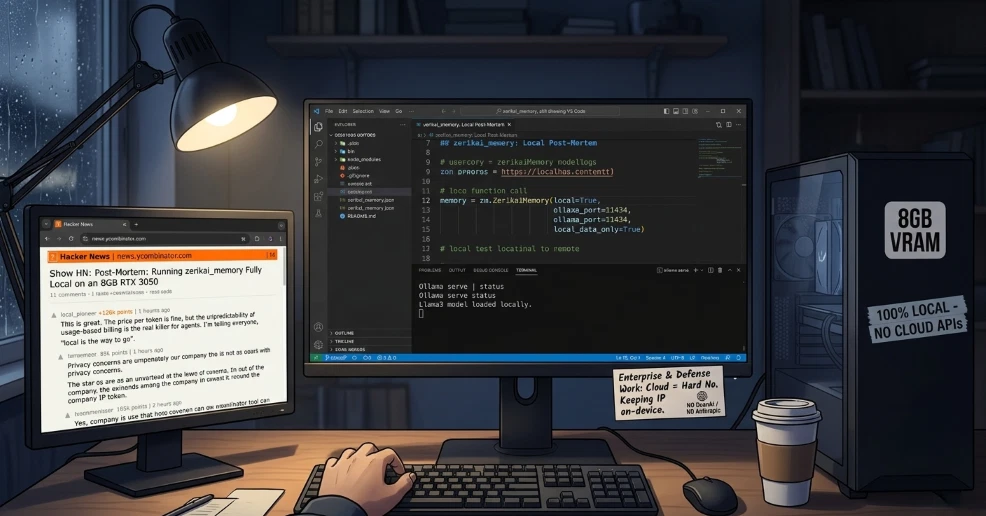
The Shift Away from Cloud LLM APIs
Developers are increasingly resistant to cloud-based LLM APIs, citing two primary concerns: unpredictable billing and data privacy. A recent Hacker News discussion highlighted that the issue isn't just the per-token cost, but the escalating, unpredictable expenses incurred by continuously polling AI agents. On platforms like Reddit, the privacy aspect is even more critical. For companies handling sensitive intellectual property, especially in enterprise and defense sectors, sending proprietary codebases to third-party providers like OpenAI or Anthropic is a non-starter, irrespective of cost.
This sentiment is driving a demand for local, on-premises solutions. The zerikai_memory project, specifically its local mode, addresses this need directly. This mode ensures that all processing occurs on the user's machine, with no data leaving the local environment. For their default local model, they selected mistral:7b. In June 2026, ornith:9b, a model specifically trained for agentic coding tasks, became available, prompting a comparative test between the two.
Testing Local Models: Mistral 7B vs. Ornith 9B
The zerikai_memory project's local mode leverages Ollama to run large language models (LLMs) directly on a developer's hardware. This approach bypasses the need for external API calls, thereby eliminating usage-based billing surprises and ensuring that sensitive codebases remain within the developer's control. The initial default model for this local setup was mistral:7b, a widely recognized and capable open-source LLM.
With the release of ornith:9b, a model engineered with agentic coding tasks in mind, a direct comparison became necessary. The goal was to assess which model offered superior performance for codebase memory and agentic code generation within the zerikai_memory framework. The tests involved evaluating both models on a variety of coding-related tasks, focusing on their ability to understand context, generate relevant code snippets, and maintain state across complex queries.
Technical Implementation: Ollama and ChromaDB Integration
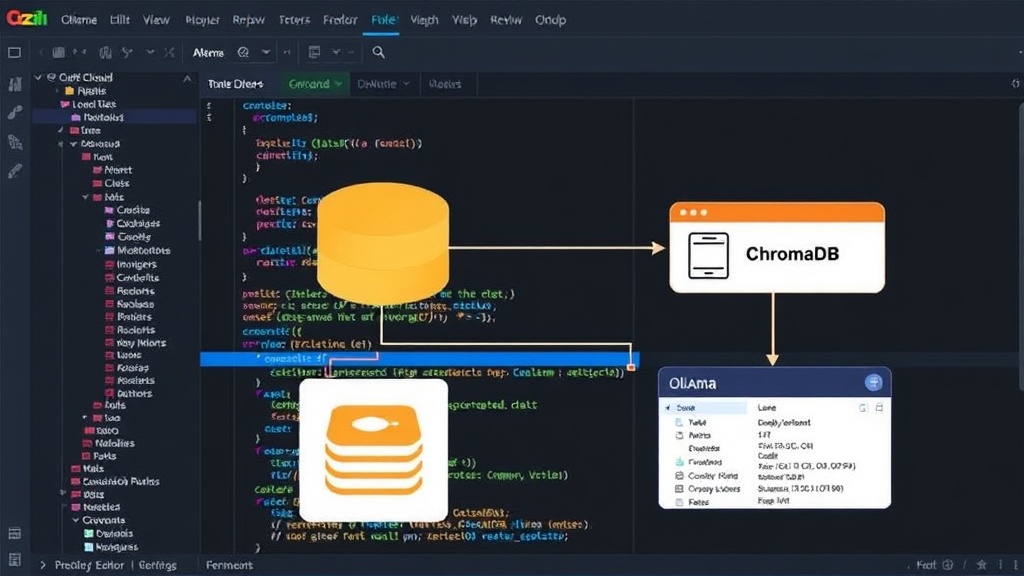
At the core of zerikai_memory's local mode are Ollama and ChromaDB. Ollama serves as the inference engine, managing the loading and execution of local LLMs. It simplifies the process of running models like Mistral 7B and Ornith 9B, abstracting away much of the complexity associated with model deployment. Developers can easily switch between different models offered through Ollama, including those specifically fine-tuned for coding tasks.
ChromaDB functions as the vector database, providing the persistent memory for the AI agent. When dealing with codebases, the process involves converting code snippets, documentation, and relevant context into vector embeddings. These embeddings are then stored and indexed in ChromaDB. When a query is made, the system searches ChromaDB for the most relevant code segments based on semantic similarity. These retrieved segments are then fed into the LLM along with the original query, enabling the model to generate contextually aware responses or code. This retrieval-augmented generation (RAG) pattern is crucial for giving the LLM access to specific knowledge from the codebase that it wasn't explicitly trained on.
Performance Benchmarks and Findings
The comparative analysis between mistral:7b and ornith:9b revealed distinct performance characteristics. While Mistral 7B demonstrated solid general capabilities, Ornith 9B consistently outperformed it in tasks directly related to agentic coding and codebase comprehension. This was expected, given Ornith 9B's specialized training.
Specifically, Ornith 9B showed improvements in:
- Contextual Understanding: Accurately interpreting complex code structures and dependencies.
- Code Generation Quality: Producing more relevant, efficient, and syntactically correct code snippets.
- Memory Recall: Better retrieval and utilization of information from the ChromaDB vector store, leading to more coherent and contextually grounded responses over longer interactions.
The surprising detail here is not necessarily that a specialized model outperformed a general one, but the magnitude of the difference in agentic coding tasks. Ornith 9B's ability to maintain context and leverage the vector database felt significantly more robust. This suggests that for applications requiring deep integration with and understanding of a specific codebase, specialized models offer a substantial advantage over general-purpose ones, even if the latter are more widely known.
Challenges and Future Directions
Despite the success, building and maintaining a local MCP server presents challenges. Resource requirements for running LLMs locally can be substantial, demanding significant GPU memory and processing power. Managing dependencies and ensuring smooth operation of Ollama, ChromaDB, and the zerikai_memory application itself requires a certain level of technical expertise. Furthermore, keeping local models updated with the latest versions and improvements necessitates ongoing effort.
The project's roadmap includes exploring larger, more capable local models as hardware improves, as well as optimizing the RAG pipeline for even faster retrieval and more accurate context injection. Enhancements to the user interface and additional features for managing multiple codebases are also under consideration. The overarching goal remains to provide a secure, cost-effective, and powerful alternative to cloud-based AI solutions for developers working with proprietary code.
What nobody has addressed yet is the long-term impact on developer workflows when local, highly specialized AI coding assistants become commonplace. Will this lead to a fragmentation of toolchains, or a new standard for secure, private AI development?