The Maturing Landscape of Local LLM Inference
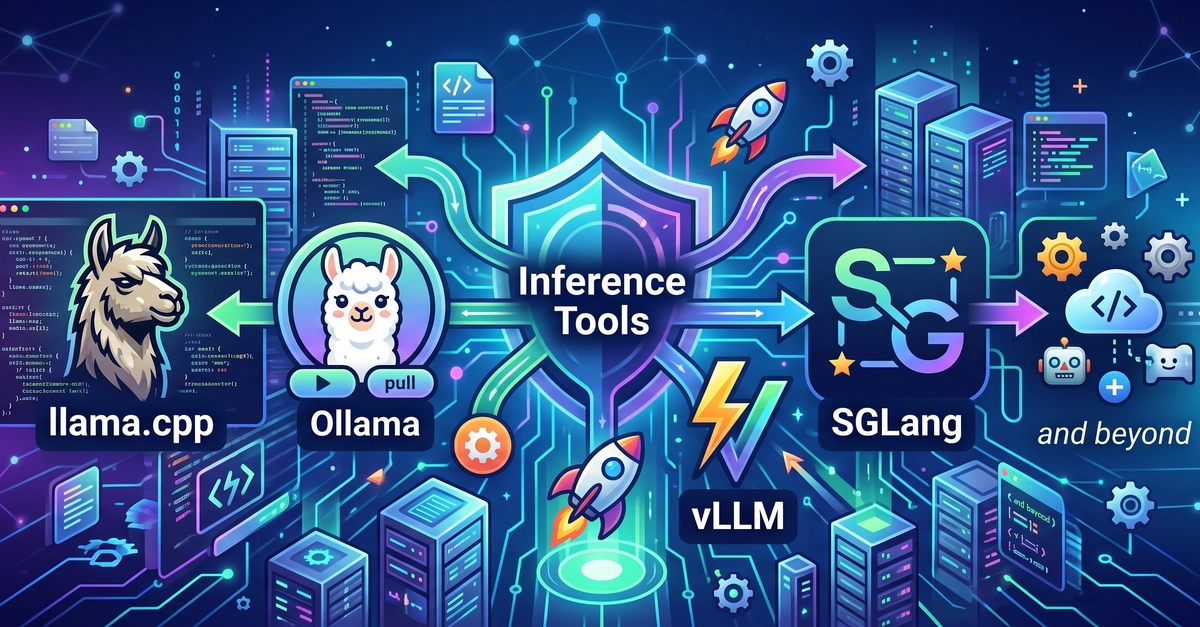
The open-source AI stack has a crucial, often overlooked, layer: local LLM inference. By 2026, the capabilities are staggering. You can run massive models like Qwen3-235B on consumer hardware like a Mac Studio, scale DeepSeek V4 to serve hundreds of users from a single H100 GPU, or even deploy Gemma 3 on a Raspberry Pi. All this is possible without cloud APIs, subscriptions, or sending sensitive data externally. However, the choice of inference tool is far from trivial. Selecting the wrong one can cripple performance, break your architecture, or introduce unnecessary friction. Deploying vLLM on a MacBook, for instance, is impractical. Running Ollama for fifty concurrent users will reveal scaling limitations. Using llama.cpp for agent loops requiring structured JSON output adds complexity that could be avoided.
The fundamental truth is that these tools do not occupy the same niche. They are optimized for different use cases, hardware, and scaling requirements. Think of them less like interchangeable parts and more like specialized tools in a mechanic's toolbox – each designed for a specific job, and using the wrong one leads to poor results or outright failure.
Understanding the Layers of Inference Tools
The landscape of local LLM inference tools can be broadly categorized into three layers:
1. Core Inference Engines
These are the foundational libraries that handle the heavy lifting of loading models and performing inference. They are typically written in performance-critical languages like C++ or Rust and often expose Python bindings for broader accessibility. Their primary focus is raw speed and efficient memory management.
Key Players:
- llama.cpp: Perhaps the most well-known, llama.cpp excels at running Llama and Llama-like models on a wide range of hardware, including CPUs and Apple Silicon. It is highly optimized for quantization and memory efficiency, making it ideal for running models on consumer-grade hardware. Its extensibility allows it to support various model architectures beyond Llama.
- vLLM: vLLM is designed for high-throughput serving of large language models, particularly on server-grade GPUs. It introduces PagedAttention, a novel attention algorithm that significantly improves memory utilization and allows for higher batch sizes, leading to superior performance in production environments. It's the go-to for demanding, high-concurrency workloads.
- TensorRT-LLM: NVIDIA's solution for optimizing LLM inference on their GPUs. It leverages TensorRT, NVIDIA's inference optimizer and runtime, to deliver maximum performance. It supports a wide range of NVIDIA hardware and offers advanced features like in-flight batching and quantization. It requires NVIDIA hardware and is often more complex to set up than other options.
2. Orchestration and Serving Frameworks
These tools build upon core inference engines to provide higher-level abstractions for serving models, managing multiple models, and integrating with applications. They often handle tasks like API creation, request batching, and model loading/unloading.
Key Players:
- Ollama: Ollama has rapidly become a favorite for its ease of use. It simplifies downloading, setting up, and running LLMs locally with a single command. It provides a local API endpoint and manages model versions, making it incredibly accessible for developers and hobbyists. It often uses llama.cpp under the hood but abstracts away much of the complexity.
- SGLang: SGLang focuses on providing a Pythonic API for LLM applications, particularly for complex agentic workflows and dialogue systems. It offers features for efficient multi-turn conversation management, tool use, and structured output generation, making it easier to build sophisticated AI applications that go beyond simple text generation.
- Text Generation Inference (TGI): Developed by Hugging Face, TGI is a production-ready inference server optimized for serving large language models from the Hugging Face ecosystem. It supports features like continuous batching, quantization, and quantization-aware training, making it a robust choice for deploying models at scale.
3. Application-Specific Libraries and Tools
This layer includes tools that are tailored for specific applications or offer unique functionalities that might not be covered by general-purpose inference engines or frameworks. They often bridge the gap between raw inference and end-user applications.
Key Players:
- LM Studio: A popular desktop application that provides a graphical user interface for downloading, configuring, and running LLMs locally. It simplifies the process for users who prefer not to work with the command line, offering a user-friendly way to experiment with various models.
- Jan: Similar to LM Studio, Jan is an open-source, privacy-focused desktop application for running LLMs locally. It aims to provide a seamless user experience with features like a chat interface, local model management, and extensibility through plugins.
- GPT4All: GPT4All is an ecosystem that provides chat models trained on a massive corpus of curated data. It offers a GUI application and Python bindings for running these models locally on consumer hardware, with a focus on privacy and accessibility.
A Decision Framework for Local LLM Inference
Choosing the right tool depends heavily on your specific requirements. Here’s a simplified framework:
- For ease of use and quick local experimentation: Ollama, LM Studio, Jan, GPT4All. These abstract away complexity and provide immediate chat interfaces or simple API endpoints.
- For running models on consumer hardware (especially Macs): llama.cpp is the undisputed champion due to its optimization for CPU and Apple Silicon, and its support for various quantized model formats.
- For high-throughput production serving on GPUs: vLLM and TensorRT-LLM are the top contenders. vLLM's PagedAttention offers excellent memory efficiency, while TensorRT-LLM provides NVIDIA-specific optimizations. Text Generation Inference is also a strong production-ready option.
- For building complex AI applications and agentic workflows: SGLang shines with its Pythonic API and features for managing dialogue state, tool use, and structured output.
The surprising detail here is not the sheer number of tools, but how distinctly they cater to different needs. What was once a niche problem of running models on a single GPU has exploded into a complex ecosystem with specialized solutions for everything from edge devices to massive server farms.
The Future is Local and Open
The trend towards local LLM inference is driven by a desire for privacy, cost savings, and greater control over AI deployments. As hardware continues to improve and inference techniques become more efficient, we can expect even more powerful models to become accessible on local machines. The choice of inference tool will remain a critical architectural decision for developers and organizations building with AI in 2026 and beyond.