Local AI Pipelines: Keeping Sensitive Workloads Off the Cloud
For many AI tasks, the default cloud API approach is wrong. Privacy, cost, and reliability dictate keeping certain workloads on-device.
By NowRift Editorial|Updated 13 Jul 2026
The Cloud AI Default and Its Limits
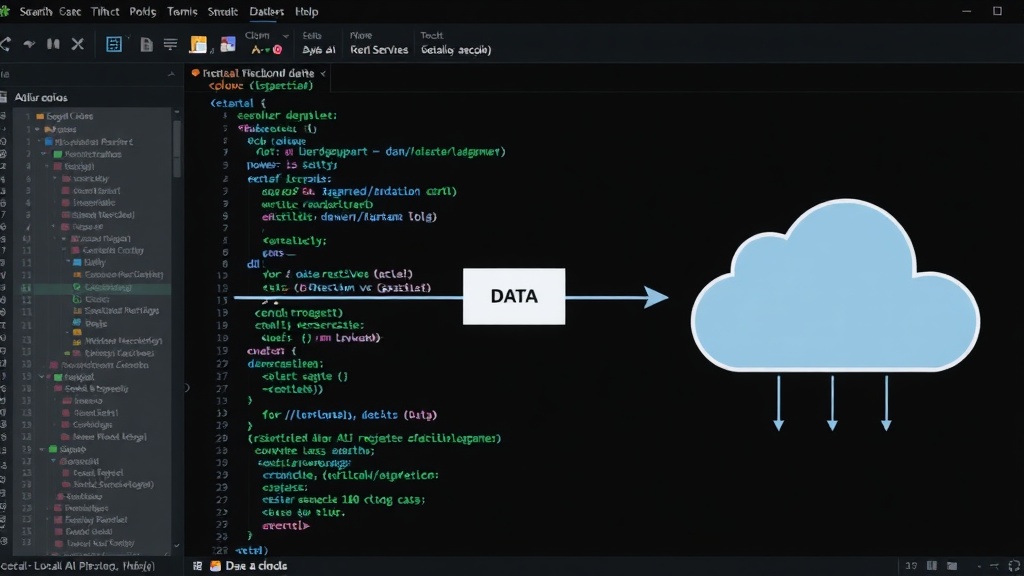
The prevailing assumption in AI is straightforward: send your data to a cloud API, pay for processing, and receive the output. This model works for a vast number of applications, from general text generation to broad data analysis. However, it’s the wrong default for a specific, and growing, class of tasks. For these, the optimal solution is to run AI workloads locally, on your own hardware, within your own network. This approach ensures that sensitive content—like private documents, dictation transcripts, or financial invoices—never leaves your control.
This isn't about a philosophical stance on local versus cloud computing. It's a pragmatic decision-making framework driven by concrete factors: privacy, cost, and reliability. Understanding these drivers is key to architecting effective AI pipelines.
Privacy: A Non-Negotiable Imperative
For tasks involving inherently private data, such as transcribing sensitive dictations, tagging confidential invoices, or making internal company documents searchable, privacy is paramount. The moment this content is sent to an external endpoint, data processing occurs outside your controlled environment. This raises significant questions: Who has access to the data? What are their data retention policies? How is the data secured both in transit and at rest? In regions like the DACH area (Germany, Austria, Switzerland), these are not peripheral concerns but critical legal and ethical requirements. Local processing eliminates these risks by keeping data confined to your secure infrastructure.
Cost: The Hidden Economics of Cloud AI
While cloud AI services offer a pay-per-token model that seems accessible, the costs can escalate rapidly, especially for high-volume or continuous processing tasks. Consider the expense of transcribing hours of audio daily or performing continuous document analysis. The cumulative cost of sending large datasets to external APIs, paying for each token processed, and potentially incurring data egress fees can quickly outweigh the initial investment in local hardware. A dedicated local setup, even with powerful GPUs, can offer a significantly lower total cost of ownership for predictable, high-throughput workloads. This is particularly true when factoring in the potential for fine-tuning open-source models on your specific data, which can yield better results at a fraction of the ongoing cloud cost.
Reliability and Latency: The Network Factor
External AI APIs are subject to network latency, service outages, and rate limiting. For applications requiring real-time or near-real-time responses, relying on cloud services introduces unacceptable delays and potential points of failure. Imagine a live transcription service that buffers or drops words due to network congestion, or an automated document tagging system that stalls because the API is temporarily unavailable. Local AI pipelines, running on dedicated hardware, eliminate network dependency for inference. This ensures consistent, low-latency performance and high availability, critical for mission-critical applications. The speed of local inference can also be superior for tasks where the model size is manageable and the hardware is optimized. This is akin to having a highly skilled expert on staff versus relying on a consultant who might be busy with other clients or stuck in traffic.
The Hybrid Approach: Best of Both Worlds
It is not an either/or proposition. Many AI pipelines benefit from a hybrid architecture. Cloud services remain ideal for tasks that are non-sensitive, require massive scale beyond local capacity, or involve models that are not yet efficiently deployable locally. For instance, initial large-scale data exploration or training massive foundation models might still be best suited for the cloud. However, once models are trained or fine-tuned, and for inference tasks involving sensitive data or requiring low latency, a local deployment becomes the more sensible choice. This hybrid approach allows organizations to leverage the scalability and accessibility of the cloud while maintaining control and efficiency for critical on-premise workloads.
Building Your Local AI Pipeline
Implementing a local AI pipeline involves several considerations. Firstly, selecting the right hardware is crucial. This often means investing in GPUs with sufficient VRAM to load the desired models. Secondly, choosing appropriate open-source models is key. Models from Hugging Face, or specialized models for tasks like transcription (e.g., Whisper) or document understanding, can be deployed locally. Frameworks like Ollama, LM Studio, or custom Python deployments using libraries like Transformers simplify this process. Finally, integration with existing workflows requires careful planning. This could involve developing local APIs that mimic cloud endpoints or integrating directly into existing software. The effort is often repaid by enhanced security, reduced costs, and improved performance for the targeted workloads.