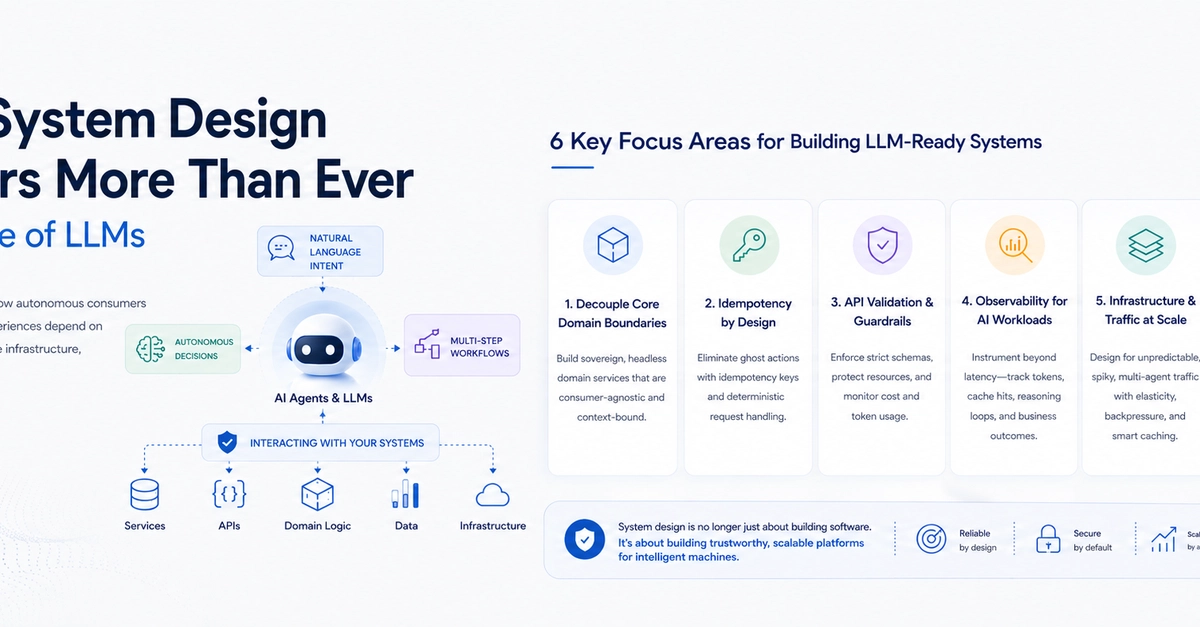
The Agentic Engineer: A New Paradigm
The software development landscape is undergoing a seismic shift. Large Language Models (LLMs) are no longer just tools for generating snippets of code; they are increasingly capable of architecting entire microservices, defining infrastructure layouts, and producing functional code in mere seconds. This acceleration, while powerful, fundamentally redefines the role of the software engineer. The industry's current obsession with LLMs outputting complex software components highlights a critical evolution: the value is migrating from manual implementation details to the higher-level orchestration of macro system topology, the establishment of deterministic boundaries, and the rigorous enforcement of zero-trust constraints. We are entering the era of the Agentic Engineer.
This new paradigm demands a robust approach to system design. When the consumers of software are not just human eyes interacting through a browser, but autonomous AI agents executing multi-step workflows, the underlying system architecture cannot afford to be loosely defined. AI agents operate with strict adherence to the structural constraints provided to them. If an AI is instructed to build within a tightly-coupled system, it will generate highly sophisticated code that reflects those limitations, potentially leading to brittle, unmaintainable systems. Conversely, a well-defined, modular architecture will guide the AI to produce more adaptable and scalable solutions.

Why Traditional Design Patterns Aren't Enough
The ability of modern LLMs to parse code syntax and understand standard architectural design patterns is unprecedented. They can ingest vast amounts of information on established practices like microservices, event-driven architectures, and monolithic structures, and then apply them with remarkable speed. However, this speed and breadth of application can mask underlying design flaws if not guided by human expertise. LLMs excel at pattern matching and generation based on their training data, but they lack the nuanced understanding of long-term maintainability, scalability under unforeseen loads, and security implications that experienced engineers possess. The challenge lies not in the LLM's ability to generate code, but in ensuring that the code it generates is part of a system that is resilient, secure, and aligned with business objectives.
Consider the implications for system boundaries. In a traditional development cycle, engineers meticulously define APIs, data contracts, and service interactions. LLMs can automate much of this, but they need clear, unambiguous specifications. If the specifications are vague, the LLM might generate interdependencies that are difficult to untangle later, creating a "spaghetti architecture" that is opaque to human developers. This is where the Agentic Engineer's role becomes paramount. They must act as the architect, defining the blueprints with extreme precision, leaving the LLM to execute the construction within those well-defined parameters. This involves setting up robust communication protocols, defining clear data schemas, and implementing strict access controls for each component.
The Rise of Deterministic Systems and Zero-Trust
The increasing reliance on AI agents necessitates a move towards more deterministic systems. Unlike human developers who can often infer intent or adapt to ambiguity, AI agents require predictable inputs and outputs. This means that system design must prioritize clarity and consistency. Error handling, state management, and data validation need to be explicitly defined and enforced, not left to implicit assumptions. The system must behave in a predictable manner, regardless of the complexity of the tasks the AI agent is performing.
Furthermore, the concept of zero-trust architecture becomes non-negotiable. As AI agents interact with various system components, potentially across different networks and services, assuming trust is a critical vulnerability. Every interaction, every data access request, must be authenticated and authorized. This means implementing granular access controls, micro-segmentation, and continuous monitoring. The system design must bake in security from the ground up, treating every component and every connection as potentially hostile until proven otherwise. The LLM can generate the code for these security measures, but the strategic decision to implement a zero-trust model and define its specific parameters falls squarely on the engineer.
What nobody has addressed yet is what happens to the thousands of developers who built entire careers on mastering the intricacies of manual code implementation and low-level system tuning. Will they be able to adapt to this new, more abstract role, or will a significant portion of the workforce be displaced by AI's ability to execute these tasks faster and cheaper?
Designing for the AI Consumer
The core shift is from designing systems for human users to designing systems that can be effectively consumed and extended by AI agents. This requires a deeper understanding of how AI