The Moment You Press Enter: A Cascade of Calculations
Millions of us interact with AI assistants like ChatGPT, Gemini, and Claude daily. We type a query, press Enter, and receive a near-instantaneous response. This seamless experience belies a complex, high-speed computational process. The question is: what exactly happens between that keystroke and the generated answer, and why does it require specialized hardware?
The core of modern AI, particularly Large Language Models (LLMs), relies on an immense number of mathematical operations. When you ask an AI a question, you're not just retrieving information; you're initiating a complex inference process. This process involves billions, sometimes trillions, of calculations to predict the most probable sequence of words that form a coherent and relevant answer. This is fundamentally different from how traditional software operates. Instead of executing a set of predefined instructions sequentially, LLMs engage in a form of parallel pattern matching and prediction on a massive scale.
Why CPUs Struggle with LLM Computations
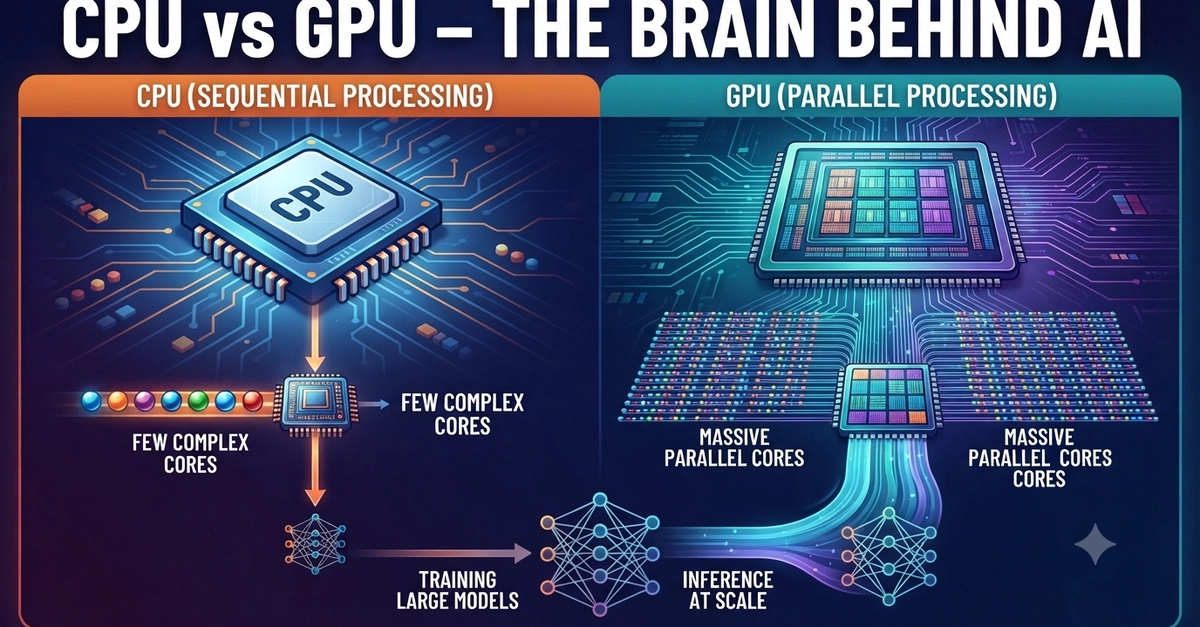
To understand why GPUs are indispensable, we first need to examine the limitations of Central Processing Units (CPUs). A CPU is designed for versatility and general-purpose computing. Think of a CPU as a highly skilled, incredibly fast employee at an office tasked with processing a mountain of incoming mail. This employee can handle any type of letter, sort them, draft responses, and manage complex administrative tasks. However, this employee works sequentially. They open one letter, process it, then move to the next. If there are 10,000 letters, even the fastest employee will take a significant amount of time to get through them all, one by one.
CPUs excel at tasks that require complex logic, decision-making, and sequential processing. They have a few very powerful cores, each capable of handling intricate instructions. This architecture makes them ideal for operating systems, running most applications, and performing single-threaded tasks. However, the computations required by LLMs, especially during inference (generating responses), are not primarily about complex logic; they are about performing the same relatively simple mathematical operation (like matrix multiplication) on vast amounts of data simultaneously. A CPU, with its limited number of powerful cores, simply cannot perform these operations fast enough to meet the demand for real-time AI interaction. It would be like asking that one super-fast employee to open 10,000 letters concurrently – it’s fundamentally not what they are built for.
The Power of Parallelism: How GPUs Excel
Graphics Processing Units (GPUs), on the other hand, were originally designed for rendering graphics. This task involves processing millions of pixels simultaneously to create complex images and animations. This requirement for massive parallelism directly translates to their suitability for AI. Imagine the office again, but this time, instead of one super-fast employee, you have 10,000 employees, each capable of opening and processing a single letter. If you have 10,000 letters, each employee can work on one letter at the exact same time. The entire pile is processed almost instantaneously.
This is the essence of a GPU. A GPU contains thousands of smaller, less powerful cores compared to a CPU. These cores are designed to perform the same operation across many different data points concurrently. For LLMs, this means that the billions of mathematical operations, such as matrix multiplications and additions, can be distributed across these thousands of cores and executed in parallel. This massive parallelism dramatically accelerates the inference process. Instead of taking minutes or hours, an LLM can generate a response in milliseconds or seconds, making AI assistants feel almost instantaneous.
The Economics of AI: Why Billions are Spent on GPUs
The sheer scale of computation required by LLMs explains why companies invest billions in GPU hardware. Training and running these models demand immense processing power. Data centers are filled with racks of high-end GPUs, specifically designed for AI workloads. Companies like NVIDIA have become dominant players in this space because their GPUs are optimized for the parallel processing needs of deep learning. The cost is substantial, not just in hardware acquisition but also in power consumption and cooling infrastructure.
The choice between CPU and GPU for LLMs is not merely a matter of speed; it's a fundamental architectural necessity. While CPUs are crucial for managing the overall system, orchestrating tasks, and handling the less parallelizable aspects of software, they are ill-suited for the core computational heavy lifting of LLMs. GPUs provide the necessary parallel processing power that makes real-time AI interaction feasible. Without them, the AI we interact with daily would be prohibitively slow, rendering it impractical for most applications.
Beyond Inference: The Role of GPUs in AI Development
It's important to note that GPUs are not only critical for inference (generating responses) but also for the training of LLMs. Training involves feeding the model massive datasets and adjusting its parameters over countless iterations to learn patterns and relationships. This process is even more computationally intensive than inference. The parallel architecture of GPUs allows researchers and engineers to train increasingly complex models in a reasonable timeframe. Without GPUs, training state-of-the-art LLMs would be practically impossible, requiring years or even decades of computation on CPUs.
The ongoing development in AI hinges on advancements in hardware, particularly GPUs. As models become larger and more sophisticated, the demand for even greater parallel processing capabilities will continue to grow. This has spurred innovation not only in GPU design but also in specialized AI accelerators and distributed computing frameworks that can leverage these powerful parallel processors more effectively. The synergy between software algorithms and hardware architecture, epitomized by the CPU-GPU dynamic, is what drives the rapid progress we see in artificial intelligence today.