
The AGI Bottleneck: Continual Learning
The quest for Artificial General Intelligence (AGI) hinges on many factors, but one critical, often-cited component is the ability of AI systems to learn continuously. This means acquiring new knowledge and skills over time, adapting to new information, and integrating it without forgetting previously learned material – a process humans perform effortlessly. However, a recent provocative claim circulating in AI communities posits that current Large Language Models (LLMs) are fundamentally incapable of achieving genuine continual learning. This assertion challenges the prevailing trajectory of LLM development and raises significant questions about our path to AGI.
The core of the argument rests on the observed limitations and inherent architectural constraints of LLMs. Unlike biological brains that exhibit plasticity and can integrate new information dynamically, LLMs are typically trained in discrete, massive batches. Once trained, their knowledge is largely fixed. While techniques like fine-tuning allow for updates, they often require retraining on substantial datasets and can lead to 'catastrophic forgetting,' where new learning overwrites or degrades old knowledge. This is not true continual learning; it's more akin to periodic, costly overhauls.
A significant bottleneck highlighted by proponents of this view is the LLM's context window. This finite memory dictates how much information the model can process at any given moment. While context windows are expanding, they remain a hard limit on the amount of new information that can be actively considered during inference or even during certain forms of updating. For true continual learning, a system would need to integrate new data seamlessly, potentially without explicit memory limits or the need to reprocess vast historical datasets. The current architecture, heavily reliant on attention mechanisms operating over fixed-length sequences, struggles to achieve this.
Hallucinations and Reliability: A Sign of Inherent Flaws?
Beyond architectural constraints, the very nature of LLM outputs is cited as evidence against their capacity for continual learning. The persistent issue of 'hallucinations' – where models generate factually incorrect or nonsensical information – suggests a fragile grasp on truth and consistency. A truly continually learning system should, in theory, become more reliable and accurate over time as it integrates more data. The fact that LLMs can generate confident-sounding misinformation, even after extensive training, implies that their learning process might be more akin to sophisticated pattern matching and probabilistic generation rather than genuine understanding or knowledge acquisition. This makes them prone to incorporating new, incorrect information into their repertoire if not meticulously curated.
Consider the analogy of a student who memorizes facts for a test but doesn't truly understand the underlying principles. They might pass the test, but their knowledge is brittle and easily confused. LLMs, in this view, are brilliant memorizers and pattern synthesizers, but their learning is not robust enough to build a stable, ever-expanding base of knowledge that can be reliably added to. Each new piece of information, rather than being seamlessly integrated, risks corrupting existing structures or leading to unpredictable emergent behaviors.
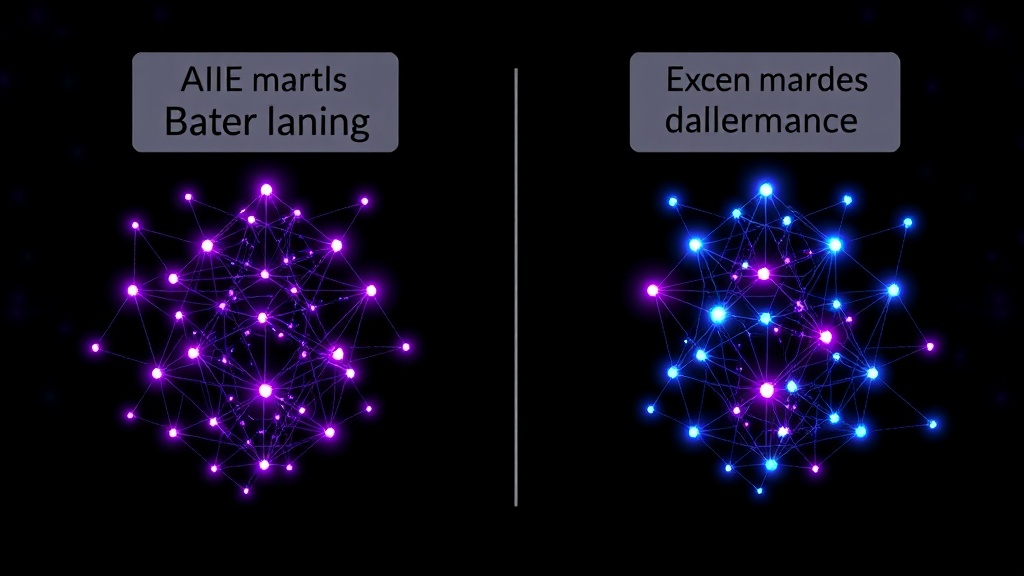
The debate isn't merely academic. If LLMs, in their current form, cannot be continual learners, it has profound implications for the development of AI. It suggests that the current path, focused on scaling up existing LLM architectures and training them on ever-larger datasets, might hit a fundamental ceiling. Reaching AGI may require a paradigm shift, perhaps incorporating entirely new architectural principles or hybrid approaches that combine symbolic reasoning with neural networks, or drawing deeper inspiration from biological learning processes.
The Counterarguments and Future Directions
Not everyone agrees with this stark assessment. Many researchers are actively working on methods to improve LLM adaptability and reduce catastrophic forgetting. Techniques such as experience replay, elastic weight consolidation, and dynamic network expansion are being explored to allow models to learn from new data streams without degrading performance on old tasks. These methods aim to mimic aspects of biological continual learning more closely.
Furthermore, the definition of 'continual learning' itself is subject to interpretation. If the goal is simply to update a model's knowledge base with new factual information or adapt its style, then current LLMs, through fine-tuning and prompt engineering, can achieve a functional semblance of this. The debate intensifies when 'continual learning' implies a deep, robust, and self-correcting integration of knowledge that underpins general intelligence.
The context window argument, while valid, is also evolving. Researchers are developing techniques for more efficient context management and retrieval-augmented generation (RAG) systems, which allow LLMs to access and incorporate external, up-to-date information dynamically. While RAG isn't true internal learning, it offers a practical solution for keeping LLMs informed in real-time, bypassing some of the limitations of static knowledge bases.
What remains unaddressed is the precise threshold at which a system can be considered a 'continual learner.' Is it when it can adapt to a new fact? A new concept? A new modality? Establishing clear, measurable benchmarks for continual learning in AI is crucial for moving beyond philosophical debate and towards tangible progress. Without such benchmarks, claims about LLMs' inherent limitations, while thought-provoking, remain difficult to definitively prove or disprove.
Implications for the AGI Trajectory
If the skeptical view holds, then the current multi-billion dollar investment in scaling LLMs might be misdirected for the ultimate goal of AGI. It would necessitate a pivot towards more biologically inspired architectures or novel computational paradigms. The focus would shift from brute-force data and parameter scaling to developing systems capable of intrinsic motivation, curiosity, and adaptive knowledge integration. This would mean a longer, potentially more complex road to AGI, one that requires fundamental breakthroughs rather than incremental improvements on existing models.
Conversely, if ongoing research in continual learning for LLMs proves successful, it could validate the current approach and accelerate progress. The challenge then becomes not whether LLMs *can* learn continually, but how efficiently and reliably they can achieve it, and how we can engineer systems that avoid the pitfalls of forgetting and hallucination. The resolution of this debate will fundamentally shape the future of AI research and development for years to come.