
The Fundamental Unit: Understanding Tokens in LLMs
Large language models (LLMs) do not process text the way humans do. They don't see entire words or individual letters in isolation. Instead, LLMs operate on a concept called tokens, which are essentially compressed chunks of text. These tokens form the fundamental unit of language for AI models.
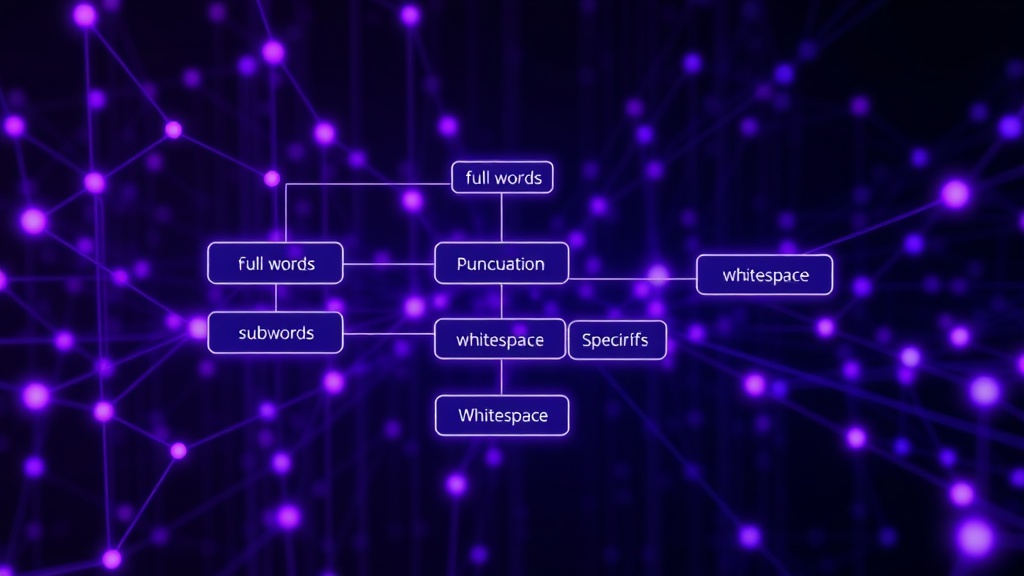
A token can represent various linguistic elements:
- A complete word (e.g., "error")
- A word fragment (e.g., "stra", "wberry")
- A punctuation mark (e.g., ".")
- Even whitespace patterns
Think of text as a sophisticated construction kit. Tokens are the pre-shaped, modular components that the AI uses to build meaning. Rather than assembling language from raw characters or entire words, LLMs assemble understanding from these pre-defined linguistic "blocks." This process is crucial because it directly influences how models interpret input, generate output, and, critically, how much computational resource they consume.
Tokenization: The Process and Its Impact
The process of converting raw text into these tokens is called tokenization. Different LLMs employ various tokenization strategies, but the goal remains the same: to break down text into manageable pieces that the model can efficiently process. Common methods include Byte Pair Encoding (BPE), WordPiece, and SentencePiece.
BPE, for instance, starts with individual characters and iteratively merges the most frequent adjacent pairs of characters or sub-words to form new tokens. This approach allows the model to handle rare words by breaking them down into known sub-word tokens, while common words can remain as single tokens. This creates a vocabulary that is large enough to cover most linguistic variations without being prohibitively enormous.
The choice of tokenizer and its vocabulary size has significant implications:
- Cost: Most LLM APIs charge based on the number of tokens processed (both input and output). A more efficient tokenization scheme can lead to lower operational costs for users. If a model breaks down common words into multiple tokens, the cost for processing text increases.
- Performance: The number of tokens directly impacts the computational load. Processing fewer tokens generally means faster inference times and lower latency.
- Reasoning and Context Window: The context window of an LLM, the maximum number of tokens it can consider at once, is a hard limit. Understanding tokenization helps users manage the amount of information they feed into the model and better predict its ability to maintain coherence over long interactions. A poorly chosen tokenizer might consume the context window faster with less meaningful information.
- Model Capabilities: The way text is tokenized can subtly influence how a model understands nuances, special characters, or even different languages. Some tokenizers are multilingual, while others are optimized for specific languages or domains.
The Trade-offs: Vocabulary Size vs. Token Length
Tokenization involves a fundamental trade-off between vocabulary size and the average length of a token sequence. A larger vocabulary means more unique tokens can be represented as single units. This can lead to shorter sequences for common words and phrases, potentially reducing processing time and cost.
However, a very large vocabulary can increase the memory footprint of the model, as it needs to store embeddings for every token in its vocabulary. Conversely, a smaller vocabulary means more words and sub-words will be broken down into smaller pieces. This can result in longer token sequences for the same amount of text, increasing computational load and potentially degrading performance. It also means the model has to perform more operations to assemble meaning from these smaller fragments.
Consider the word "tokenization." A model with a large vocabulary might have a single token for this word. A model with a smaller vocabulary might represent it as "token", "iz", "ation" or even "tok", "en", "iz", "ation". The latter requires more processing steps and consumes more tokens within the context window.
Navigating the Token Landscape: Practical Implications
For developers and users of LLMs, understanding tokenization is not just an academic exercise; it has direct practical consequences. When interacting with LLMs, especially through APIs, being mindful of token counts is essential for managing expenses and optimizing performance.
Cost Management: Always check the pricing models of LLM providers. Understand how they count input and output tokens. Developers can often reduce costs by carefully crafting prompts, using more concise language, and pre-processing text to reduce unnecessary tokens (e.g., removing redundant whitespace or standardizing punctuation).
Prompt Engineering: Effective prompt engineering involves not only instructing the model clearly but also being aware of the token limit. A prompt that is too long might be truncated, or it might consume so many tokens that it leaves little room for the model's response, leading to incomplete or nonsensical output. Developers can experiment with different phrasing to see which versions result in fewer tokens for the same instructional content.
Model Selection: Different models use different tokenizers. If you are working with multilingual data or specialized jargon, researching the tokenizer used by a particular model can help you select one that is best suited for your task. Some models might perform better with your specific data due to their tokenization strategy.
The underlying mechanics of tokenization are a critical, yet often overlooked, aspect of working with modern LLMs. By understanding how text is broken down into tokens, users can gain better control over AI costs, improve model performance, and unlock more sophisticated reasoning capabilities.