
LLM Struggles with Contextual Nuance in Security Analysis
Large Language Models (LLMs) are increasingly being deployed for complex tasks, from code generation to data analysis. However, a recent user experience with the Gemma 4 12B model highlights a persistent challenge: the difficulty LLMs face in nuanced contextual reasoning, particularly in security-sensitive applications like network configuration analysis. The user, who operates within a 4080 VRAM constraint, found that even a relatively capable model like Gemma 4 12B struggled to accurately determine the applicability of Common Vulnerabilities and Exposures (CVEs) to specific network device configurations, achieving only a ~77.8% pass rate.
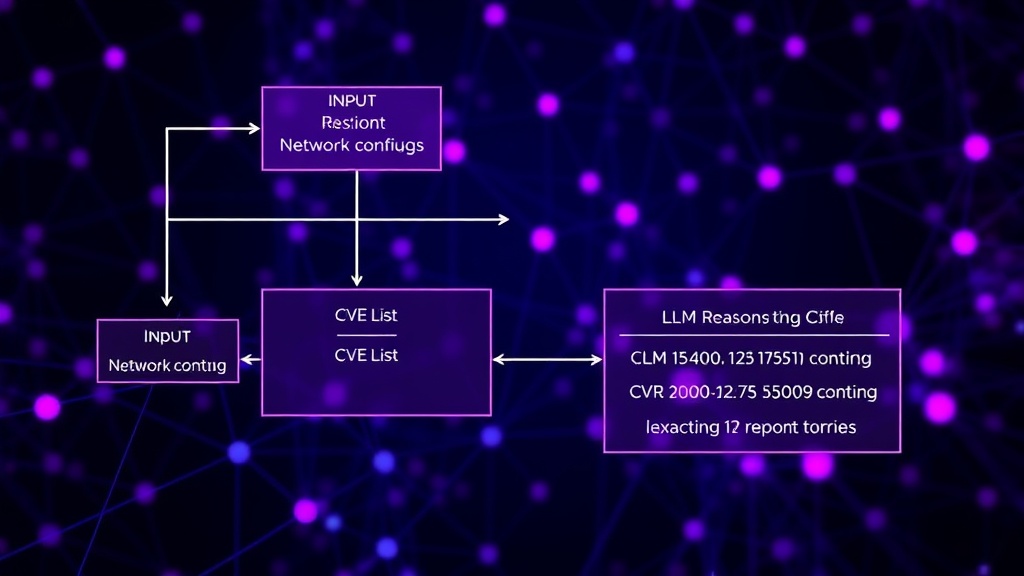
The core of the problem lies in the LLM's inability to consistently grasp the 'why' behind a vulnerability's applicability. The user's workflow involves feeding the model a device's running configuration alongside a batch of approximately 10 CVEs. The LLM is tasked with returning a verdict for each CVE: applicable, not applicable, or undetermined, supported by verbatim evidence from the configuration. The failure mode appears when the LLM incorrectly flags a CVE as applicable or not applicable due to a superficial match or a misunderstanding of the configuration's intent.
Consider a critical CVE related to an IPv6 bug. If a network device's configuration explicitly shows no IPv6 protocols enabled, the CVE is demonstrably not applicable. Similarly, if a CVE pertains to a vulnerability in a web interface, but the device configuration clearly indicates that no web services are running, the CVE should be dismissed. These are straightforward, rule-based exclusions that a human analyst would immediately identify. Yet, the Gemma 4 12B model, even with temperature set to 0 (minimizing randomness), exhibited a failure rate that suggests a fundamental gap in its reasoning capabilities when faced with these conditional logic checks.
The Nature of the Reasoning Deficit
The ~77.8% pass rate indicates that the model is correct over three-quarters of the time, which might seem acceptable in some contexts. However, for security analysis, even a 22.2% error rate can have significant consequences. False positives could lead to unnecessary patching efforts or alert fatigue, while false negatives could leave critical vulnerabilities unaddressed. The user explicitly identifies this as a "reasoning issue." This suggests the model can parse the text of the configuration and the CVE descriptions but fails to build a coherent mental model of the system's state and how the CVE's exploit conditions map onto that state.
This problem is not unique to network configurations. LLMs often struggle with tasks that require understanding implicit relationships, conditional logic, and real-world constraints. For instance, a CVE might mention a specific software version or a particular feature flag. The LLM might see the CVE text and the configuration text and find superficial keywords, but it doesn't truly *understand* that the absence of a specific feature flag means the vulnerability cannot be triggered, or that a version mismatch renders the CVE irrelevant. It's like a student who can memorize facts but can't apply them to solve a novel problem.
Implications for LLM Deployment in Security
The user's experience serves as a critical reminder that LLMs are tools, not infallible oracles. Their deployment in high-stakes domains like cybersecurity requires rigorous validation and a clear understanding of their limitations. While LLMs can accelerate initial triage or information retrieval, they cannot yet fully replace human expertise, especially when subtle reasoning and contextual understanding are paramount.
The challenge is particularly acute because the user is running the model locally via Ollama. This implies an effort to maintain data privacy and control, avoiding sending sensitive network configurations to external cloud-based APIs. The fact that even a local, specialized deployment hits a wall suggests that the underlying architectural limitations in LLM reasoning are a broader industry concern. It points to a need for more robust evaluation methodologies that go beyond simple accuracy metrics and probe the depth of an LLM's understanding.
Further research might explore techniques to improve this contextual reasoning. This could involve:
- Fine-tuning on domain-specific datasets: Training models on curated datasets of network configurations and their corresponding CVE applicability assessments.
- Retrieval-Augmented Generation (RAG) enhancements: Developing more sophisticated RAG systems that can explicitly reason over retrieved evidence.
- Symbolic reasoning integration: Exploring hybrid approaches that combine neural network pattern matching with symbolic logic engines.
- Prompt engineering innovations: Crafting more detailed and structured prompts that guide the LLM through a step-by-step reasoning process.
Until these advancements mature, practitioners using LLMs for security analysis must remain vigilant. Relying solely on an LLM's judgment without human oversight for critical decisions like vulnerability management is a risk that few organizations can afford to take. The current state of LLM reasoning, as demonstrated by this user's experience, suggests that while they can assist, they are not yet ready to be the final arbiters of complex security assessments.
An Unanswered Question: The Scalability of Human Oversight
What nobody has addressed yet is the scalability of human oversight in LLM-assisted security workflows. As LLMs become more pervasive and capable of processing vast amounts of data, the volume of potential false positives and negatives they generate will also increase. How do we design security teams and processes that can effectively review and validate LLM outputs without becoming overwhelmed? This poses a significant operational challenge that needs to be solved as LLM adoption accelerates.