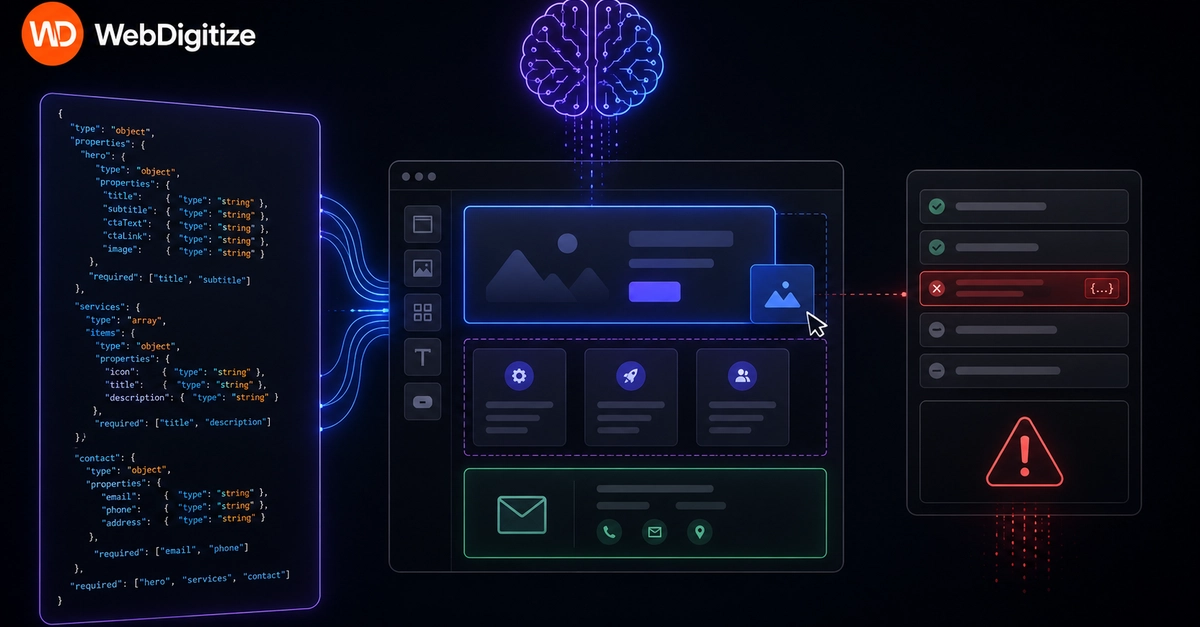
The Structural Integrity Problem
When you integrate an AI generation step into a drag-and-drop editor, you face a problem that is rarely discussed in LLM tutorials: the model's output must be structurally valid, not just semantically good. A hallucinated CSS class name is a style regression. A hallucinated prop key in an editor schema is a broken component. This is the core lesson learned from building WebDigitize, an AI-powered website generator and editor for Nigerian small businesses, using Puck as the editor layer.
Unlike typical LLM applications where the output is text that a human reads and interprets, the output of an LLM embedded in a structured editor must conform to a predefined schema. Puck, for instance, stores its page state as a JSON document. Any AI-generated content must fit precisely into this structure, defining components, their properties, and their relationships. A failure to do so means the editor cannot render the content, effectively breaking the user experience.
Puck's JSON Schema Expectation
Puck expects page state to be represented as a JSON document. This document defines the structure of the page, including its root element and its properties. For example, a simplified representation might look like this:
{
  "root": {
    "props": {
      "title": "My Awesome Page",
      "backgroundColor": "#ffffff"
    },
    "children": [
      // ... other components go here
    ]
  }
}
When an LLM generates content intended to be rendered within this editor, its output must align with this JSON structure. This means the AI cannot simply generate free-form text or code. It must produce JSON objects that represent components with valid prop names and values, and correctly nested children. If the LLM hallucinates a prop name, like an incorrect CSS class or a non-existent component prop, the editor will fail to parse and render the page correctly. This is a fundamental departure from prompt-based LLM use cases where minor semantic errors are often acceptable if the overall meaning is conveyed.
Bridging the Gap: LLM Output to Editor Schema
The challenge, therefore, lies in ensuring the LLM's output is not only semantically coherent but also syntactically and structurally compliant with the editor's schema. This requires a multi-stage approach:
1. Prompt Engineering for Structure
The initial step involves carefully crafting prompts that guide the LLM towards generating structured output. This might include providing examples of the desired JSON format, explicitly defining the available components and their props, and instructing the model to adhere strictly to these definitions. However, even with meticulous prompt engineering, LLMs can still deviate from the expected structure due to their inherent probabilistic nature.
2. Post-Processing and Validation
A robust validation layer is essential. After the LLM generates its output, it must be parsed and validated against the editor's schema. This involves:
- JSON Schema Validation: Ensuring the output conforms to the expected JSON schema, checking for valid keys, data types, and nesting.
- Component-Specific Validation: For each component type, validating that the generated props are recognized and have appropriate values. For instance, a color prop should be a valid color string, and a CSS class prop should resolve to a known class.
- Sanitization: Removing any extraneous characters or code that the LLM might have inadvertently included.
If the output fails validation, it needs to be either corrected or rejected. Correction might involve programmatic attempts to fix minor errors, while rejection means asking the LLM to regenerate the content, potentially with refined prompts based on the validation feedback.
3. Iterative Refinement and Feedback Loops
Building a reliable AI generation feature within a structured editor often requires an iterative process. Developers must monitor the types of structural errors that occur and use this information to refine the prompts, improve the validation logic, or even fine-tune the LLM itself. This feedback loop is critical for gradually improving the accuracy and reliability of the AI-generated content.
The Broader Implications
This challenge extends beyond simple website builders. Any application that relies on LLMs to generate structured data—whether it's code for a development environment, configuration files for a system, or data for a database—faces similar hurdles. The expectation that an LLM can reliably produce output that adheres to strict structural constraints is a significant technical challenge that requires more than just sophisticated natural language understanding. It demands a deep integration with the target system's data models and validation mechanisms.
The success of projects like WebDigitize hinges on solving this structural integrity problem. It's a testament to the fact that for AI to be truly useful in complex applications, its outputs must be as predictable and reliable as the systems they interact with. The lesson is clear: for AI in structured environments, semantic correctness is only half the battle; structural validity is the other, often more difficult, half.