%22%20%2F%3E%0A%20%20%3C%2Fsvg%3E)
The Blind Spots in Production LLM Monitoring
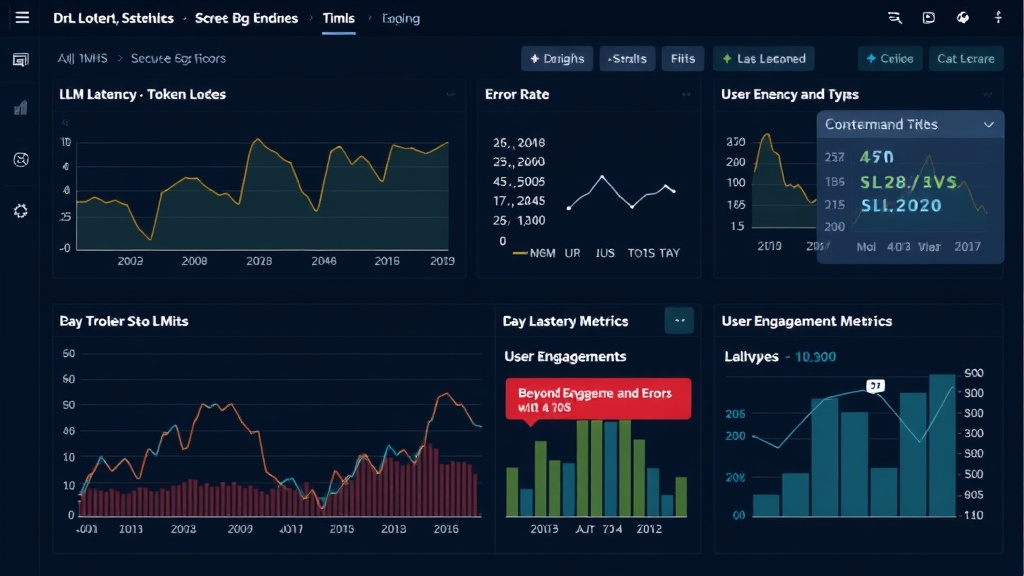
As teams ship large language model (LLM) products, the focus on monitoring often centers on readily quantifiable metrics. Latency tracking, token cost, and basic error rates are standard fare. Even advanced setups might incorporate LLM-as-a-judge scoring for output quality. However, a significant gap exists between what these systems catch and the reality of how LLMs perform in the wild. The common monitoring stacks, while essential, frequently miss more insidious failures that erode user experience and degrade model effectiveness over time.
One of the most pervasive issues is the disconnect between offline evaluation metrics and real-world performance. Models can score exceptionally well on benchmark datasets and automated evaluations, yet falter when applied to nuanced, domain-specific downstream tasks. This discrepancy arises because evals often simplify complexity, failing to capture the subtle contextual understanding or specific knowledge required for genuine user utility. A model might correctly answer factual questions in a test set but struggle with the implicit requirements of a customer support query or a creative writing prompt.
This leads to a critical blind spot: failures that only surface after users have disengaged. These are not flagged errors; they are 'silent failures.' A user might receive an output that is technically not an error, not nonsensical, but simply unhelpful, slightly off-topic, or lacking the precise tone. Instead of reporting the issue, the user abandons the task or stops using the product. This gradual erosion of engagement is difficult to detect with traditional monitoring, which typically relies on explicit error signals or user feedback. The absence of a complaint doesn't equate to a successful interaction.
Furthermore, models can exhibit regressive behavior that goes unnoticed. It's common for an LLM to improve on one metric—say, summarization conciseness—while quietly degrading on another, such as factual accuracy or coherence. This 'metric trade-off' is a complex optimization problem. Without comprehensive, multi-dimensional monitoring that tracks these interdependencies, teams may inadvertently introduce subtle performance regressions during fine-tuning or updates. These regressions can accumulate, leading to a gradual decline in overall model utility that is hard to pinpoint.
Consider the case of a customer service chatbot. It might achieve a high score for response speed and a decent score for relevance in offline tests. However, in production, it could be consistently failing to de-escalate frustrated customer emotions, leading to increased churn. This failure isn't a technical error; it's a failure in emotional intelligence or nuanced communication. Monitoring systems focused on factual accuracy or task completion would completely miss this critical flaw.
Bridging the Gap: From Production Data to Model Improvement
The ultimate goal of monitoring is not just to detect problems but to facilitate improvement. The question then becomes: how do we close the loop, where production failure data directly informs model development or routing decisions? This requires a paradigm shift from passive observation to active learning from real-world usage.
One approach involves more sophisticated user feedback mechanisms. Beyond simple thumbs up/down, systems could prompt users for specific reasons when they disengage or indicate dissatisfaction. This unstructured feedback, though harder to process, can provide invaluable qualitative data. Natural language processing techniques can then be employed to categorize these issues, identifying patterns of failure that might otherwise be missed.
Another strategy is to build 'failure detection' modules that analyze output characteristics beyond simple error codes. This could involve looking for signs of hallucination (e.g., confident assertions of non-existent facts), repetitive or generic phrasing indicative of low engagement, or outputs that deviate significantly from expected user intent. These modules would act as a secondary layer of monitoring, flagging potentially problematic responses before they lead to user abandonment.
For teams using multiple models or employing routing strategies, production data can inform dynamic adjustments. If a particular user segment consistently finds a specific model's output unhelpful for a certain task, that routing decision can be re-evaluated. This requires infrastructure that can correlate user behavior, input prompts, model responses, and subsequent engagement metrics. It's akin to an A/B testing framework, but continuously operating and learning from live traffic.
The challenge lies in the engineering effort and the complexity of data analysis. Implementing these advanced monitoring techniques demands robust logging, sophisticated analytical tools, and a dedicated team capable of interpreting the results. It also requires a cultural shift within product teams to prioritize understanding user experience nuances over solely optimizing for synthetic benchmarks. Without this commitment, LLM monitoring will continue to operate with significant blind spots, leaving potential product failures undetected and unaddressed.