
The FLOPs Fallacy in LLM Inference
The conversation around running large language models (LLMs) invariably begins with FLOPs – Floating Point Operations Per Second. GPU manufacturers tout their teraFLOPs, cost calculators use FLOPs to estimate hourly rates, and vendors highlight their raw compute power. However, for the vast majority of production LLM workloads, this focus is misplaced. The true bottleneck, and consequently the primary driver of cost, is not compute power but memory bandwidth. Specifically, the challenge lies in efficiently moving the Key-Value (KV) cache in and out of GPU memory during each decoding step of autoregressive generation.
Teams that prioritize compute utilization over memory traffic often end up overpaying for GPU capacity they never fully leverage. This is because the core operation in LLM inference, especially for tasks like text generation, involves repeated access to and modification of the KV cache. This cache stores intermediate states of the model’s attention mechanism, and its size grows with the context length of the input. Each new token generated requires fetching this cache, updating it, and writing it back. The speed at which this data can be moved between the GPU’s compute cores and its high-bandwidth memory (HBM) directly dictates the inference speed and, by extension, the cost.
Consider the process of generating a single token. The model needs to access the KV cache for all previous tokens to compute the attention scores. This involves reading from memory. Then, it computes the new KV pair for the current token and writes it back to memory. This read-modify-write cycle, repeated for every token generated, becomes a significant memory-bound operation. While FLOPs are critical for training large models, where massive parallel matrix multiplications are the norm, inference at scale is a different beast. It’s characterized by sequential operations that are heavily reliant on rapid data access. The effective throughput of the GPU is thus limited by how quickly it can feed the compute units with the necessary data from memory, rather than how many operations those units can perform per second.
This memory bandwidth limitation is compounded by the nature of autoregressive decoding. Unlike training, where computations can often be structured for maximum parallelism, decoding happens one token at a time. This sequential dependency means that the GPU spends a significant amount of time waiting for data to be loaded or stored. The KV cache, in particular, can become a substantial memory footprint, especially with long context windows, exacerbating the bandwidth problem. If not managed efficiently, the system will spend more time moving data than performing useful computation, leading to underutilized compute cores and inflated operational costs.
Architectural Solutions for Bandwidth Constraints
Addressing the memory bandwidth bottleneck requires an architectural shift in how LLM inference is deployed. The most effective strategies focus on reducing the frequency and volume of data movement, particularly concerning the KV cache. One key architectural approach is disaggregating the prefill and decode phases. During the initial 'prefill' phase, where the model processes the prompt, computations can be batched more effectively, allowing for higher compute utilization. However, during the 'decode' phase, where tokens are generated sequentially, the focus must shift to memory bandwidth. By separating these stages, engineers can optimize each for its specific constraints, rather than trying to find a one-size-fits-all solution.
Right-sizing batch sizes and context lengths is another critical lever. While larger batch sizes can improve compute utilization during prefill, they also increase the memory footprint of the KV cache, potentially overwhelming bandwidth during decode. Similarly, very long context windows, while powerful, dramatically increase the KV cache size. Finding the optimal balance – one that maximizes throughput without saturating memory bandwidth – is essential. This often involves empirical testing and profiling to understand the specific model’s behavior on the target hardware.
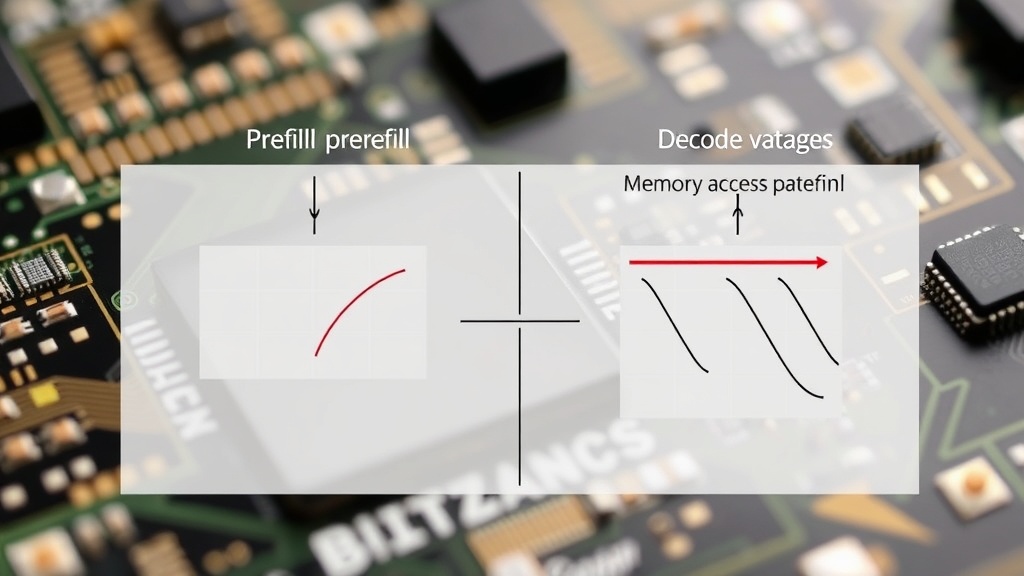
Furthermore, treating memory bandwidth as the scarce resource it is means re-evaluating hardware choices and software optimizations. This could involve selecting GPUs with higher memory bandwidth, employing techniques like quantization to reduce the size of model weights and activations, or even exploring specialized hardware accelerators designed for efficient memory access. Software optimizations might include more sophisticated KV cache management strategies, such as cache eviction policies or speculative decoding, which aim to reduce the number of times the cache needs to be accessed or updated.
The implication for infrastructure teams is clear: stop optimizing solely for FLOPs. Instead, benchmark and tune for memory bandwidth. This involves understanding the memory access patterns of your specific LLM workload and choosing hardware and software configurations that minimize data movement. It means moving away from simply buying more compute and towards a more nuanced approach that considers the entire data pipeline. The real cost savings and performance gains in LLM inference will come from architects and engineers who understand and master the intricacies of memory traffic, not just raw computational power.
The Unanswered Question: Long-Term Architectural Evolution
While current strategies focus on optimizing existing architectures, a significant question remains: what is the long-term architectural evolution needed to fundamentally address the memory bandwidth bottleneck in LLMs? We are seeing incremental improvements in GPU HBM capacity and bandwidth, but LLMs continue to grow in size and complexity. Will future architectures involve even more aggressive disaggregation, perhaps separating KV cache storage onto dedicated, high-speed memory tiers? Or will entirely new model architectures emerge that are inherently less memory-intensive during inference? The current focus on optimizing within existing paradigms is effective for immediate cost reduction, but the industry needs a clearer vision for how LLM inference will become fundamentally more bandwidth-efficient at scale.