
The Dual Imperative for Reliable LLM Extraction
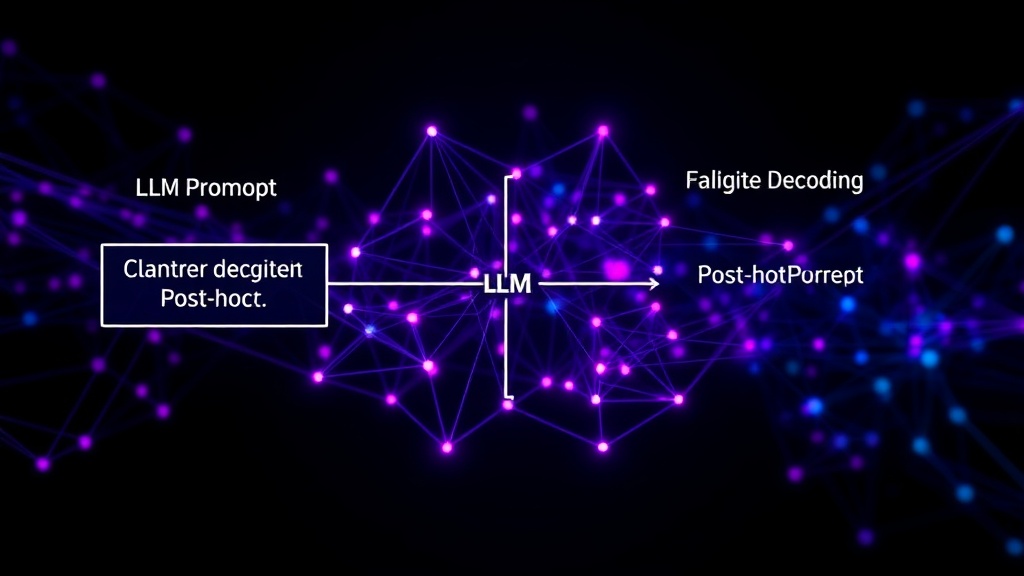
Extracting structured data from Large Language Models (LLMs) in production is a complex challenge. It's not enough for an LLM to understand a prompt and generate text that looks like the desired output. For real-world applications, especially those involving sensitive data or critical workflows, a two-pronged approach is essential: constrained decoding during generation and rigorous post-hoc validation. These methods address fundamentally different failure modes, and relying on only one leaves production systems vulnerable.
Constrained decoding acts as a gatekeeper at the point of generation. Its primary goal is to guide the LLM’s output to conform to specific structural requirements, such as adhering to a predefined JSON schema or a tool’s expected argument format. This technique significantly reduces the likelihood of malformed payloads—think incomplete JSON objects, syntax errors, or unexpected wrapper text that pollutes the output. By enforcing structure early, constrained decoding minimizes the noise and ensures that the LLM’s raw output is already closer to a usable format. This is akin to a chef meticulously following a recipe’s precise measurements and steps; deviations can lead to an inedible dish.
When Structure Isn't Enough: The Need for Validation
However, a perfectly structured payload is not necessarily a correct or safe one. This is where post-hoc validation becomes critical. Post-hoc validation serves as the system’s trust boundary. It’s the process of taking the LLM’s generated output, even if structurally sound, and subjecting it to further scrutiny. This involves coercing the output into a safe and usable state, rejecting any data that falls outside acceptable parameters, and attaching confidence scores where routing decisions depend on the accuracy of the extracted information. For instance, an LLM might perfectly generate a JSON object representing a user’s request for a financial transaction. The JSON might be valid, but the values within—like the transaction amount or recipient account—could be nonsensical or malicious. Post-hoc validation flags these issues, preventing incorrect actions or data corruption. Think of it as a final quality control check on a manufactured product; the parts might fit together perfectly, but the overall function needs to be verified.
A common pitfall is assuming that because an LLM can produce syntactically correct JSON, it will always produce semantically correct or workflow-appropriate data. A payload can be perfectly valid JSON, containing all the required fields with correct data types, yet still be fundamentally wrong for the intended workflow. For example, an LLM tasked with extracting product details might generate valid JSON for a product, but if that product is out of stock or discontinued, the extracted data, while structurally perfect, is unusable for an e-commerce purchase flow. Post-hoc validation catches these contextual errors.
The 'Confident Extract' Philosophy
The necessity of both techniques forms the core philosophy behind projects like confident-extract, developed by Hitarth Desai under the GitHub handle hitarthbuilds. This library embodies the principle that in production LLM extraction, we must constrain early and validate hard, only trusting the output late in the process. This approach acknowledges the inherent probabilistic nature of LLMs and builds safety layers around their outputs.
Constrained decoding offers several key benefits for production systems:
- Reduced Malformed Payloads: By guiding the LLM’s output format during generation, the incidence of syntactically incorrect data (e.g., broken JSON, missing commas, unclosed brackets) is drastically reduced. This means less time spent on error handling and retries due to structural issues.
- Minimized Wrapper Text: LLMs often include conversational filler or explanatory text around the core data. Constrained decoding helps suppress this extraneous information, ensuring that only the desired structured data is returned.
- Schema/Tool Adherence: For applications that integrate with external tools or require data to fit specific schemas, constrained decoding ensures the output matches the required shape, making downstream integration seamless.
Post-hoc validation, on the other hand, provides the essential safety net:
- Data Coercion and Safety: It allows for the transformation of generated data into a safe, canonical format. This might involve cleaning up minor inconsistencies, converting data types, or ensuring values fall within acceptable ranges.
- Rejection of Invalid Data: If the generated data, despite being structurally sound, violates business logic or safety constraints, post-hoc validation provides the mechanism to reject it outright.
- Confidence Scoring for Routing: For complex workflows, assigning a confidence score to the extracted data is crucial. This score informs downstream routing decisions, allowing the system to proceed with high-confidence extractions or trigger human review for low-confidence ones.
The rule of thumb, "Constrain early. Validate hard. Trust late.", encapsulates this robust strategy. Constraining early minimizes the surface area for errors. Validating hard ensures that any output that passes initial structural checks is also contextually and semantically correct. Trusting late means that only data that has successfully navigated both these rigorous stages is considered reliable for critical actions.
The Unanswered Question: Scalability of Human Review
While the dual approach of constrained decoding and post-hoc validation provides a strong framework, a persistent question remains: what is the scalable strategy for handling data that fails the hard validation? As LLMs become more powerful and are applied to increasingly diverse and complex extraction tasks, the volume of data requiring human review could become a significant bottleneck. Developing more sophisticated automated methods for identifying subtle semantic errors or creating efficient, AI-assisted human-in-the-loop systems will be crucial for truly scaling LLM-driven extraction in production environments.
Ultimately, production-ready LLM extraction systems cannot afford to be complacent. They must embrace a layered security and reliability model. Constrained decoding builds a strong foundation, but it is the vigilant post-hoc validation that transforms a merely structured output into a trustworthy component of a larger, critical system.