
The Challenge of RAG Optimization
Retrieval Augmented Generation (RAG) systems promise to imbue large language models (LLMs) with factual accuracy by grounding their responses in external knowledge bases. However, achieving optimal performance in RAG is a complex balancing act, particularly concerning cost and accuracy. The prevailing approach often involves direct interaction with expensive, hosted flagship models for every query, leading to escalating operational expenses. This is especially true for enterprise applications where document intelligence and sophisticated query handling are paramount. The need for a more efficient, layered strategy has become evident.
Introducing Loop Engineering for RAG
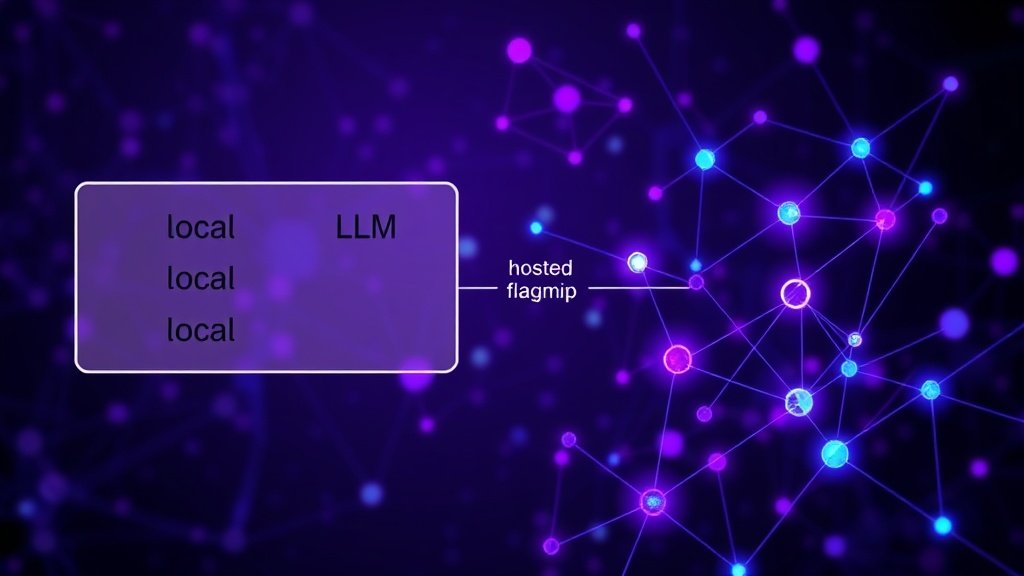
A novel approach termed 'Loop Engineering' proposes a cascaded LLM architecture to tackle this challenge. This method leverages a tiered system of models, starting with inexpensive, locally deployable LLMs and progressively escalating to more powerful, hosted models only when necessary. The core idea is to filter and refine queries, offload simpler tasks to cheaper models, and reserve the computational power and sophistication of flagship models for complex or ambiguous requests. This creates a 'cascade' where each layer acts as a gatekeeper and pre-processor for the next.
The Two-Tiered Cascade: Cost and Validation
Loop Engineering operates on two primary principles: cost efficiency and a validation loop. The cost efficiency is achieved by routing the majority of queries through low-cost local models. These models, while less capable than their hosted counterparts, are sufficient for many common tasks, such as basic information retrieval, query simplification, or identifying intent. By handling these upfront, the system significantly reduces the number of costly API calls to premium models. The validation loop comes into play when a local model's confidence is low or when the query demands higher accuracy. In such cases, the query is passed to a more powerful, hosted model. This ensures that while the system prioritizes cost savings, it does not compromise on the quality of results for critical tasks. The 'loop' aspect suggests an iterative refinement process, where the output of one model can inform or validate the input for another, or where the system learns from the cascade's success and failures.
Empirical Validation with Local Models
To substantiate the efficacy of this cascaded approach, the research involved a comprehensive sweep of twenty different local LLMs. These models were benchmarked against a hosted flagship model in various RAG generation scenarios. The objective was to identify which local models could effectively serve as the initial tier in the cascade, providing a robust and cost-effective first line of defense. This empirical evaluation is critical, as the performance of the cascade hinges on the capability and reliability of the chosen local models. The findings from this sweep would inform practical implementation, guiding users on selecting the most suitable local models based on their specific requirements for speed, accuracy, and cost. This hands-on testing moves beyond theoretical proposals, grounding the Loop Engineering concept in real-world performance data.
Implications for Enterprise Document Intelligence
The implications of Loop Engineering for enterprise document intelligence are substantial. Organizations dealing with vast volumes of internal documents – legal contracts, financial reports, technical manuals – can significantly reduce their LLM expenditure. Instead of querying expensive cloud-based models for every search or summarization task, a local model can triage requests. For instance, a local model could quickly identify relevant sections of a lengthy legal document, and only then pass those specific snippets to a flagship model for detailed legal analysis or summarization. This layered approach allows businesses to scale their AI capabilities without incurring prohibitive costs. Furthermore, the ability to deploy and manage some of the LLM infrastructure locally offers greater control over data privacy and security, a crucial consideration for enterprises handling sensitive information.
Future Directions and Considerations
While Loop Engineering offers a promising path toward more economical and efficient RAG systems, several considerations remain. The optimal configuration of the cascade will vary depending on the specific use case, the types of documents being processed, and the acceptable trade-off between cost and latency. Developing intelligent routing logic that accurately assesses query complexity and model confidence is paramount. Future research could explore dynamic cascade adjustments, where the system learns to optimize its routing strategy over time based on performance feedback. The integration of more sophisticated local models, or even fine-tuned smaller models, could further enhance the upfront filtering capabilities. Ultimately, Loop Engineering represents a pragmatic evolution in LLM application architecture, moving towards more sustainable and scalable AI solutions.