The Problem with LLM Logging
Integrating Large Language Models (LLMs) into production systems is fraught with peril. Teams often face a binary choice for logging: log every prompt and response, or log almost nothing. The former creates significant data exposure risks, potentially spilling sensitive user data or proprietary information into general-purpose logs. The latter leaves developers blind when investigating production issues. Without sufficient context, debugging a faulty LLM response becomes a guessing game, hindering rapid problem resolution and system improvement.
This dilemma arises because LLM interactions can be complex. A single application request might trigger multiple model calls, involve intricate prompt engineering, and undergo various validation steps before a final output is generated. Standard logging practices, designed for simpler API interactions, fall short. They either capture too much sensitive detail or too little actionable operational data.
Consider a scenario where a customer support chatbot, powered by an LLM, provides an incorrect answer. If the logs only contain the model name and a timestamp, pinpointing the exact prompt, the specific policy version used, or any intermediate validation failures becomes impossible. This lack of granular, yet anonymized, operational data cripples the ability to diagnose, fix, and prevent recurrence of such errors.
The Execution Receipt Solution
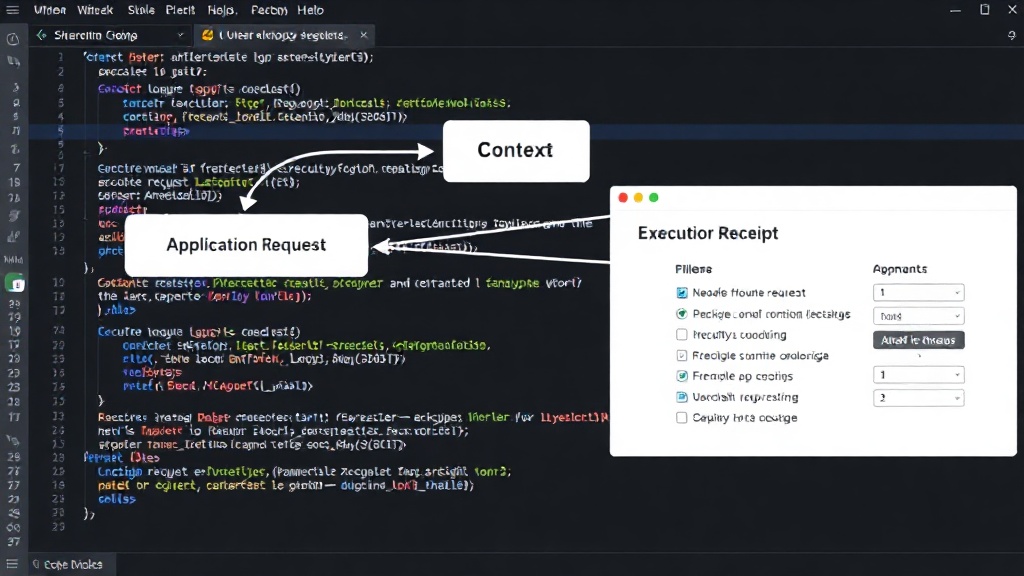
An execution receipt offers a pragmatic middle path. It is a structured record that captures essential operational metadata about an LLM API call without duplicating the entire interaction. Think of it less like a full transcript and more like a detailed, auditable shipping manifest for each LLM request. It provides just enough information to understand the context and outcome of the call, facilitating debugging and auditing without compromising data privacy.
The key to an effective execution receipt lies in its carefully selected fields. These fields should provide a comprehensive snapshot of the request's lifecycle. Essential components include:
- Request and Task Identifiers: Unique IDs to link the receipt back to the originating application request and the specific task being performed.
- Version Information: Tracking the versions of the prompt template, any associated policies (e.g., content moderation, tone guidelines), and the data schema used. This is crucial for reproducibility and understanding how changes in these components affect output.
- Endpoint Alias: A human-readable name for the model endpoint being invoked. This helps differentiate between various model deployments or providers.
- Timing and Performance Metrics: Start time, end time, and latency are vital for performance monitoring and identifying bottlenecks.
- Usage Measurements: Token counts (input and output) and any associated cost metrics provide insight into resource consumption.
- Validation Outcome: The result of any post-processing validation steps, such as schema validation, content filtering, or fact-checking. This indicates whether the model's raw output met predefined quality standards.
- Fallback or Retry Status: Information on whether a fallback model was used or if the request was retried due to transient errors. This is critical for understanding system resilience.
This structured approach transforms opaque LLM interactions into observable, manageable processes. Teams can instrument their LLM integrations to generate these receipts automatically.
Implementing the Wrapper
Building an execution receipt wrapper involves creating an intermediary layer between the application logic and the LLM API. This wrapper intercepts outgoing requests and incoming responses.
The typical flow looks like this:
- Application Request: The main application sends a request that requires LLM processing.
- Redaction and Classification: The wrapper may perform initial redaction of sensitive PII before it even reaches the LLM, or classify the request type.
- Model Endpoint Invocation: The wrapper then calls the actual LLM API, passing the prompt and any necessary parameters. It records the start time.
- Output Validation: Upon receiving the model's response, the wrapper applies predefined validation rules. This could include checking if the output conforms to a JSON schema, adheres to content policies, or meets specific formatting requirements. The outcome of this validation is a key piece of metadata.
- Receipt Generation: The wrapper compiles all the relevant metadata—request IDs, versions, endpoint alias, timing, usage, validation status, and retry information—into a structured execution receipt.
- Execution Receipt Store: This receipt is then sent to a dedicated store (e.g., a database, a logging service optimized for structured data). The raw LLM prompt and response might be logged separately, with sensitive parts redacted, or omitted entirely if the receipt contains sufficient operational context.
This wrapper pattern is flexible. If a team later decides to evaluate or integrate other specialized model engines, such as VectorEngine for retrieval-augmented generation, they can place these engines behind the same application-owned wrapper and utilize the identical receipt format. This ensures consistency in operational monitoring and auditing across different model backends.
Broader Implications
The execution receipt pattern addresses a critical gap in observability for LLM-powered applications. It provides the necessary fidelity for debugging and performance analysis without the security and cost burdens of logging every full interaction. This approach is akin to how financial systems log transaction confirmations and settlements rather than every keystroke made by a trader. It captures the essential state changes and outcomes.
For founders, this means building more robust, auditable, and secure AI-powered products. For security professionals, it reduces the attack surface associated with logging sensitive data. For developers, it provides the tools needed to efficiently troubleshoot production issues. For data scientists, the aggregated receipts can form valuable datasets for analyzing model performance, identifying biases, and optimizing prompts and policies.
The core challenge in production LLM deployment is balancing capability with control. The execution receipt wrapper provides a mechanism to achieve this balance, enabling teams to confidently scale their use of LLMs while maintaining operational integrity and security.