
The Costly Tokenization Round-Trip
Multi-agent systems, where multiple Large Language Models (LLMs) collaborate on complex tasks, promise powerful new capabilities. However, a significant bottleneck exists: the communication overhead between agents. Each time one agent hands off a task or context to another, it often involves serializing its internal state and sending it as text. The receiving agent then must parse this text, tokenize it, and reconstruct the relevant context. This process is computationally expensive and time-consuming, especially as the number of agents and the complexity of their interactions grow. It's akin to every person in a large meeting having to write a detailed memo to the next person, rather than just whispering a key point. This repeated serialization and deserialization, often referred to as a tokenization round-trip, directly impacts the efficiency and scalability of LLM agent pipelines.
Introducing Inductive Latent Context Persistence (ILCP)
A novel approach, Inductive Latent Context Persistence (ILCP), is emerging to address this challenge. Drawing inspiration from concepts in 6G wireless communication, specifically related to handover protocols, ILCP aims to transfer compressed latent states between agents. Instead of sending raw text or fully reconstructed context, ILCP allows an agent to transmit a compressed representation of its internal understanding – its latent state – to the next agent in the chain. This latent state is not merely a snapshot; it's an inductive representation that downstream agents can immediately leverage.
The core idea is to avoid redundant computation. When an agent receives a task, it builds up an internal representation of the problem space. If this agent then passes the task to another, the second agent traditionally starts from scratch, re-processing information that the first agent already understood. ILCP bypasses this. The first agent encapsulates its learned context into a compact, latent form. The second agent receives this compressed state and can continue its work without needing to re-derive the initial context. This is particularly powerful for multi-hop reasoning, where agents build upon the conclusions and context established by previous agents.
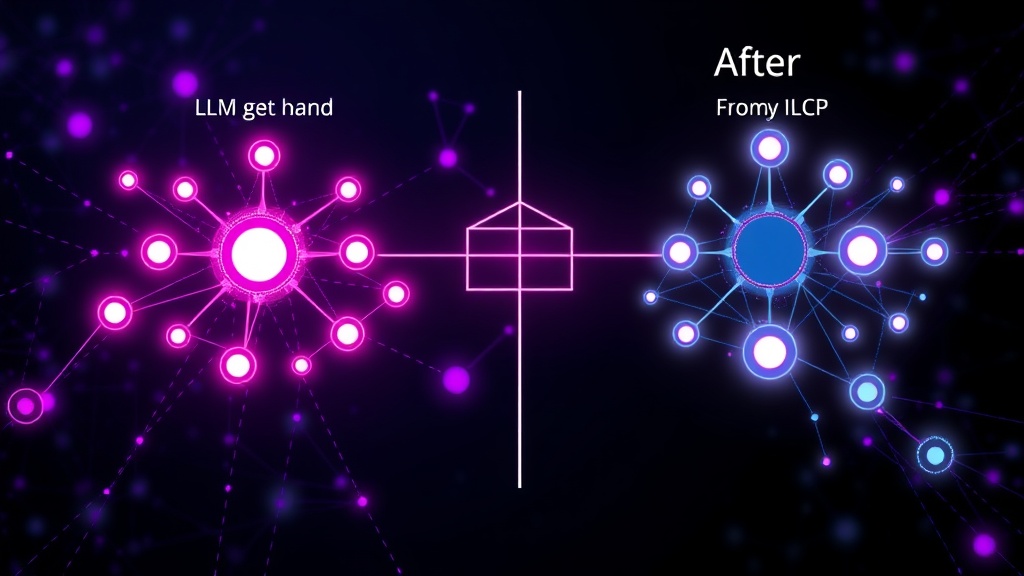
The 6G Handover Analogy
The connection to 6G handover protocols is crucial for understanding ILCP's elegance. In wireless networks, when a mobile device moves from one cell tower to another, a seamless handover is required. This involves transferring the device's connection state and context to the new tower without dropping the call or data session. This handover process is optimized to be fast and efficient, minimizing disruption. ILCP applies a similar principle to LLM agents. The 'handover' is the transfer of context between agents, and the 'connection state' is the agent's internal latent representation. By adapting techniques that ensure efficient state transfer in highly dynamic wireless environments, ILCP provides a robust mechanism for inter-agent communication.
This is more than just a simple passing of data. The 'inductive' nature of ILCP means the transferred latent state isn't just raw data; it's a representation that allows the receiving agent to infer and build upon the preceding context. Think of it less like a detailed instruction manual being passed from one worker to another, and more like a highly skilled apprentice receiving a summary of the current project status and immediately knowing how to proceed with their specific task. This inductive transfer significantly reduces the 'cold-start' problem for downstream agents, which often face the challenge of understanding the context established by prior agents.
Closing the Agent Cold-Start Gap
The 'agent cold-start' problem is a well-known issue in multi-agent LLM systems. When an agent begins processing a task, it needs to build an internal model of the situation. If the task is complex and requires multiple steps handled by different agents, each new agent in the sequence essentially starts 'cold' – without the benefit of the prior agent's processing. ILCP directly addresses this by providing a warm start. The compressed latent state acts as a pre-digested context, allowing the new agent to begin its work immediately with a deep understanding of what has already transpired. This dramatically speeds up execution and reduces the computational load associated with re-establishing context.
The implications for multi-hop LLM agents are profound. These agents are designed to tackle problems that require sequential reasoning, breaking down a large problem into smaller, manageable steps. For example, a research agent might need to find information, synthesize it, and then generate a report. Each of these steps could be handled by a specialized agent. With ILCP, the information-gathering agent's findings can be passed as a compressed latent state to the synthesis agent, which can then immediately begin its work without needing to re-interpret raw search results or re-tokenise large documents. This optimization is critical for building agents that can perform complex, multi-step reasoning efficiently and at scale.
Potential and Future Directions
While the initial inspiration comes from 6G handover protocols, the application of ILCP is not limited to that specific domain. The underlying principle of efficient latent state transfer can be applied to various architectures of multi-agent LLM systems. Further research will likely focus on optimizing the compression algorithms, exploring different methods for latent state representation, and evaluating the trade-offs between compression ratio, information fidelity, and computational cost.
The success of ILCP could pave the way for more sophisticated and efficient LLM agent ecosystems. It addresses a fundamental efficiency problem that has limited the practical deployment of complex multi-agent workflows. By reducing the tokenization burden, ILCP makes multi-agent systems more computationally feasible, faster to execute, and capable of handling more intricate tasks that require deep, sequential reasoning.