The Unforeseen Network Collapse
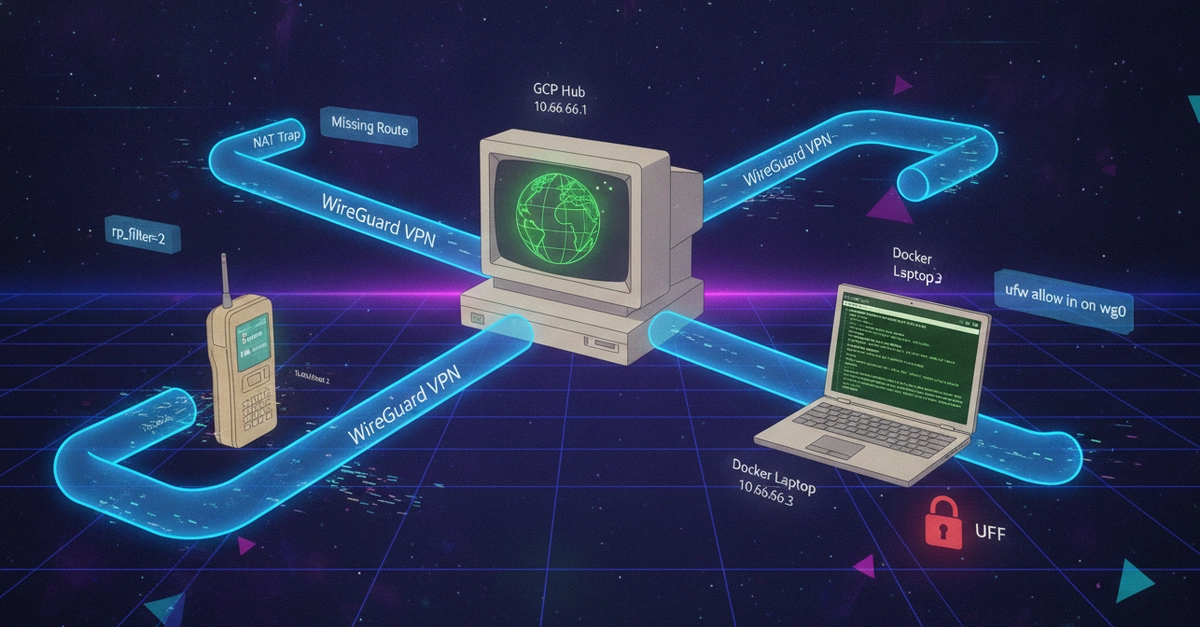
What began as a straightforward project to create a secure, accessible private network devolved into a four-hour debugging nightmare. The goal was simple: connect a mobile phone and a local development laptop via a WireGuard VPN, with a Google Cloud Platform (GCP) e2-micro instance acting as the central hub. The specific use case involved accessing self-hosted Docker services, like Open WebUI, running on the home laptop from the phone over mobile data. The architecture was a basic hub-and-spoke model: the GCP VM (10.66.66.1) as the hub, and the phone (10.66.66.2) and laptop (10.66.66.3) as spokes. IPv4 forwarding was enabled on the hub. However, the setup soon revealed a deeper, more insidious problem.
The initial symptom was baffling: simple pings between the spokes failed. This wasn't a firewall issue or a routing misconfiguration; those were checked and double-checked. The GCP instance could ping both spokes, and the spokes could ping the GCP instance. The problem lay strictly in inter-spoke communication. This pointed towards an issue within the VPN tunnel or the underlying network stack. After hours of troubleshooting, the culprit was traced not to the WireGuard configuration itself, but to a subtle, unannounced regression in the Linux kernel that silently impacted how certain network packets were handled, specifically those traversing through WireGuard interfaces and interacting with containerized environments like Docker Desktop.
The Deep Dive into Kernel Land
The investigation escalated from simple network diagnostics to a deep dive into kernel logs and packet captures. The core of the problem wasn't a missing feature or a deprecated API, but a change in behavior within the Linux kernel's networking stack. Specifically, it affected the handling of UDP packets encapsulated within WireGuard. WireGuard, by design, uses UDP for its transport protocol. When these packets arrived at the GCP VM, they were decrypted, and the inner IP packet was then routed. The issue manifested when the inner packet, destined for the other spoke, was processed. It appeared that a recent kernel update had altered the packet processing path or introduced a subtle bug in how it handled packets that had already been processed by a network layer (like WireGuard) and were being forwarded.
The surprising detail here is not the outage duration, but that such a fundamental regression could go unnoticed and undocumented. This wasn't a feature deprecation with advance warning; it was a silent drop in functionality. The specific kernel version in question, while not explicitly detailed in the initial report, was implicated as the source. It's a stark reminder that even stable-looking kernel versions can harbor regressions that surface under specific, albeit common, usage patterns like VPNs and container networking.
WireGuard and Docker Desktop: An Unfortunate Confluence
The problem was exacerbated by the combination of WireGuard and Docker Desktop. Docker Desktop on Linux (and by extension, its underlying mechanisms on macOS and Windows that often leverage Linux kernel concepts or VMs) relies heavily on sophisticated network configurations. It creates virtual network interfaces, bridges, and uses NAT extensively to manage container networking. When WireGuard was layered on top of this, it introduced a complex interaction. The packets originating from the phone, traversing the WireGuard tunnel to the GCP VM, being decrypted, and then needing to be routed to the laptop (which itself might be running Docker, further complicating the network stack) hit a specific bug in the kernel's forwarding logic. This logic was apparently altered in a way that caused packets destined for the other WireGuard spoke to be dropped silently, without any error message or indication at the application layer.
This confluence of technologies – a modern VPN protocol, a widely used containerization platform, and a specific Linux kernel version – created a perfect storm. The fact that a simple `ping` command, a fundamental network diagnostic tool, was rendered useless highlights the fragility that can exist beneath seemingly robust systems. The issue was not with WireGuard itself, nor with Docker Desktop's implementation, but with the underlying operating system kernel's handling of the network traffic under these combined conditions.
The Silent Regression and Its Implications
The lack of documentation or public disclosure around this kernel change is perhaps the most concerning aspect. Kernel developers and maintainers often make subtle changes to optimize performance, improve security, or refactor code. However, these changes can have unintended consequences. When such a change breaks core functionality for common use cases like VPNs, and especially when it affects widely adopted tools like Docker Desktop, it warrants clear communication. This incident underscores the challenge of maintaining stability across the vast Linux ecosystem, where a change in one component can have ripple effects across many others.
What nobody has addressed yet is the broader impact of such silent regressions. How many other services or configurations are silently affected by similar kernel changes? Without rigorous, end-to-end testing that spans these complex interdependencies, these issues can lie dormant until a specific user encounters them. For developers relying on stable network infrastructure, this incident serves as a potent reminder to scrutinize kernel updates and to be prepared for unexpected behavior, especially when using advanced networking features or containerization platforms.
Resolution and Future-Proofing
The resolution involved identifying the specific kernel version that introduced the regression and, if possible, downgrading to a known stable version or applying a patch. In a production environment, this might require significant downtime or a complex rollback procedure. For the individual developer, it meant reverting the kernel on their GCP instance or, more practically, understanding the nature of the bug to avoid it in future setups. The lesson learned is to treat kernel updates with caution, especially on systems that rely on complex networking configurations. Monitoring kernel mailing lists and security advisories for subtle changes or bug reports related to networking and VPN protocols is crucial. Furthermore, maintaining detailed logs and performing thorough network diagnostics when setting up complex network topologies can save hours of frustrating debugging.
The incident highlights a critical gap: the need for better visibility into kernel changes that impact common user-space applications and network configurations. While the WireGuard VPN and Docker Desktop setup eventually worked, the four-hour outage caused by a silent Linux kernel drop is a testament to the intricate dependencies within modern software stacks and the importance of understanding the layers beneath the applications we build and deploy daily.