
A Modern Take on a Classic Kernel
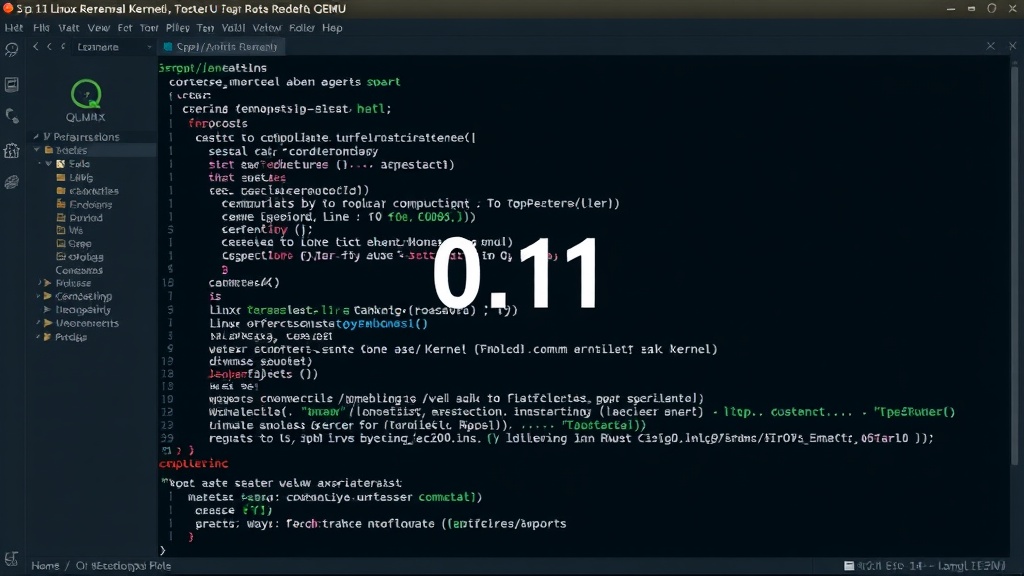
The Linux kernel, a cornerstone of modern computing, has seen a remarkable reimagining: version 0.11 has been painstakingly rewritten in idiomatic Rust. This ambitious project, spearheaded by a dedicated community, successfully boots the re-engineered kernel within the QEMU emulator. This endeavor is not merely an academic exercise; it represents a significant exploration into how modern systems programming languages can be applied to deeply entrenched, foundational software.
Linux 0.11, released in 1992, was one of the earliest public versions of Linus Torvalds' operating system kernel. It laid the groundwork for the vast ecosystem we rely on today. Rewriting such a critical piece of software in Rust, a language known for its memory safety guarantees and concurrency features, presents a unique set of challenges and opportunities. The goal is to leverage Rust's compile-time checks to prevent common programming errors that have plagued C-based systems for decades, such as buffer overflows and null pointer dereferences, without sacrificing performance.
Technical Challenges and Idiomatic Rust Implementation
The primary challenge in this rewrite lies in translating the low-level, C-centric paradigms of the original Linux kernel into Rust's ownership and borrowing system. This requires a deep understanding of both the original kernel's architecture and Rust's core principles. The project emphasizes 'idiomatic Rust,' meaning the code is written in a way that fully embraces Rust's features and best practices, rather than simply being a C-to-Rust transliteration.
Key aspects of the rewrite include:
- Memory Management: Rust's ownership model provides compile-time guarantees against memory errors. The project had to carefully manage memory allocation and deallocation, ensuring that the Rust compiler's checks are satisfied without introducing runtime overhead that would negate the benefits of using Rust.
- Concurrency and Synchronization: The original kernel handles intricate concurrency through low-level locking mechanisms. Rewriting this in Rust required utilizing Rust's robust concurrency primitives and ensuring thread safety through the type system.
- Hardware Interaction: Interfacing with hardware at the kernel level involves direct memory access and manipulation of hardware registers. This segment of the rewrite demanded careful use of Rust's unsafe blocks, judiciously employed where necessary to interact with the bare metal, while encapsulating these operations to maintain as much safety as possible in the surrounding code.
- Boot Process: A crucial part of the success is the kernel's ability to boot. This involves replicating the bootloader interaction and the initial setup routines that prepare the system for kernel execution. The QEMU emulator serves as a controlled environment to test this complex boot sequence.
The success of booting in QEMU is a significant milestone. It validates the core logic and the low-level interactions that are essential for an operating system kernel to function. This is analogous to building a car engine and successfully getting it to turn over on the first try – it proves the fundamental mechanics are sound.
Implications for the Future of Operating Systems
While this is a rewrite of an ancient kernel, the implications ripple outward. Projects like Redox OS have already demonstrated the viability of a full operating system written in Rust. This Linux 0.11 rewrite serves as a powerful proof-of-concept and a learning ground. It showcases that even the most performance-critical and low-level code, traditionally the domain of C and C++, can be approached with modern languages that offer enhanced safety.
For developers, this project highlights the increasing maturity of Rust for systems programming. It suggests that future kernels, or significant portions thereof, could be developed with Rust, potentially leading to more secure and stable operating systems. The careful application of Rust's safety features without compromising performance is the holy grail for systems development.
The surprising detail here is not that a kernel *can* be rewritten in Rust, but the meticulous adherence to 'idiomatic Rust' in such a foundational and historically C-centric project. This suggests a deliberate effort to not just port code, but to truly embrace and demonstrate the language's strengths on a challenging, real-world system.
What Lies Ahead?
The immediate next steps for this project will likely involve expanding the feature set of the rewritten kernel, aiming to match or exceed the capabilities of the original Linux 0.11. This could include implementing more system calls, device drivers, and basic user-space utilities. The long-term vision might involve exploring its integration into more complex systems or using it as a basis for educational purposes, illustrating kernel development with modern tools.
What nobody has addressed yet is the potential for this work to influence the development of future Linux kernel modules or even specific subsystems. Could parts of the modern Linux kernel eventually see idiomatic Rust implementations, building on the lessons learned here?
This rewrite is more than just a technical feat; it's a statement about the evolution of software development practices and the increasing role of safety-conscious languages in critical infrastructure. It proves that robust, low-level code can be built with powerful abstractions and safety guarantees, paving the way for more secure and reliable computing environments.