The Unexpected Break
Waking up to a completely broken browser extension is a developer's nightmare. For months, the JobEasyApply extension helped job seekers autofill applications on LinkedIn. Then, overnight, a massive LinkedIn frontend update rendered it useless. Selectors failed to find form fields, programmatic clicks on buttons had no effect, and even seemingly filled text fields were flagged as blank by validators. The culprit: LinkedIn's transition to a Server-Driven UI (SDUI) architecture for its Easy Apply flow.
This shift presented significant engineering challenges. The core issue was that SDUI applications dynamically generate their UI elements based on data fetched from a server. This means the structure of the page, including the element IDs, classes, and even the DOM structure itself, can change without a traditional frontend code deployment. For extensions relying on static selectors or predictable DOM structures, this is a critical failure point.
Diagnosing the SDUI Shift
The first step in solving the problem was understanding the new architecture. Traditional browser extension selectors, which often target specific IDs or class names, were no longer reliable. The update indicated a move away from a client-side rendered framework to a model where the server dictates the UI. This often involves techniques like componentization and dynamic rendering, making the frontend a more fluid canvas.
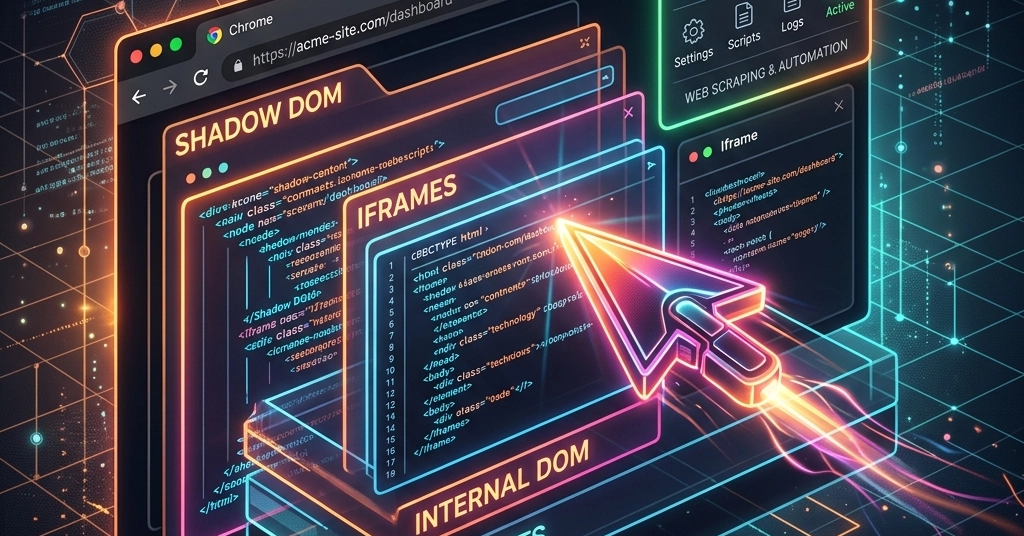
The developer's investigation revealed that LinkedIn was now heavily utilizing Shadow DOMs and Same-Origin Iframes. Shadow DOMs encapsulate a component's styling and markup, isolating it from the main document's DOM. This isolation is a powerful tool for component maintainability but a significant hurdle for external scripts attempting to interact with the encapsulated elements. Similarly, same-origin iframes, while seemingly standard, could also be used to segment parts of the application, further complicating direct DOM manipulation from the parent window.
The immediate problem was that the extension's JavaScript, running in the main window context, could no longer directly query or manipulate elements nested within Shadow DOMs or residing in different iframe contexts, even if they were same-origin. This created a barrier, preventing the extension from accessing and interacting with the form fields and buttons it needed to automate.

Navigating Shadow DOMs
Bypassing Shadow DOMs required a shift in strategy. Instead of relying on direct DOM queries, the approach had to account for the shadow root. The key lies in accessing the shadow root itself, which acts as a boundary. Once the shadow root is accessed, the elements within it become queryable using standard DOM methods like querySelector or querySelectorAll.
The process typically involves:
- Identifying the host element that hosts the shadow root.
- Accessing the shadow root using the
.shadowRootproperty. - Querying elements within the shadow root as if they were part of the main DOM.
This technique allows the extension to pierce the encapsulation of the Shadow DOM and interact with the elements inside, effectively restoring the ability to find and manipulate form fields and buttons.
Conquering Same-Origin Iframes
Same-origin iframes, while less of a strict encapsulation barrier than Shadow DOMs, still present challenges for cross-window scripting. If an iframe's content is from the same origin as the parent page, JavaScript can interact with it, but it requires explicit access to the iframe's content window and document object.
The strategy here involved:
- Identifying all relevant iframes on the page.
- Iterating through each iframe and obtaining its
contentWindowandcontentDocument. - Once the iframe's document is accessed, standard DOM querying can be performed within that iframe's context.
This allows the extension to target elements that might have been placed within an iframe for organizational or modularity reasons, ensuring that no interactive element is missed.
The SDUI Paradigm Shift
LinkedIn's move to SDUI is indicative of a broader trend in modern web development. Companies are increasingly adopting SDUI architectures to achieve greater frontend agility, consistency across platforms, and faster iteration cycles. Instead of shipping new frontend code for every UI change, they can push configuration or template updates from the backend, allowing the client to render the latest UI dynamically.
For developers building browser extensions, third-party tools, or even performing web scraping, this shift necessitates a more robust and adaptable approach. Relying on brittle selectors tied to specific HTML structures is no longer viable. Instead, developers must build tools that can intelligently traverse the DOM, understand encapsulation mechanisms like Shadow DOM, and handle dynamic content loading and rendering. This might involve leveraging mutation observers to detect DOM changes, employing more sophisticated element identification strategies, or even analyzing network requests to understand how the UI is being driven.
The challenge is analogous to trying to navigate a city where the street names and building numbers change daily. You can't rely on a static map. You need a system that can dynamically update its understanding of the city's layout or use more general navigation principles like following signs or landmarks that are less prone to change.
The successful adaptation of JobEasyApply demonstrates that even significant architectural shifts can be overcome with a deep understanding of web technologies and a willingness to adapt. It highlights the ongoing arms race between platform providers and the ecosystem of tools that build upon them, and the critical need for flexibility in development.