
Robotics Tackles Dynamic Environments with Predictive Vision
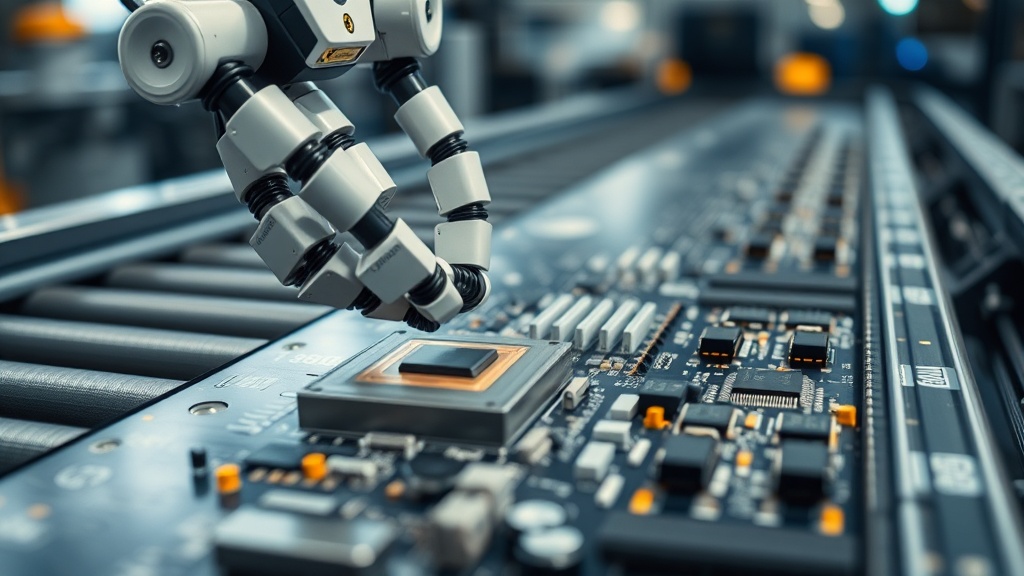
Robots have long struggled with dynamic environments, especially when objects are in constant motion. Traditional vision systems often rely on reacting to the current state of a scene, leading to lag and missed targets. This is particularly challenging for tasks like picking items off a moving conveyor belt, where the target object is never stationary. A new development, the LingBot-VA 2.0 video-action model, demonstrates a significant leap forward by employing predictive capabilities to overcome this limitation. Instead of solely reacting to what the camera sees at any given instant, LingBot-VA 2.0 anticipates the future position of objects based on their trajectory, allowing for proactive action rather than reactive correction.
The core innovation lies in its ability to predict where the scene, and thus the target object, will be in the immediate future. This predictive foresight allows the robot's control system to initiate its pick-and-place action ahead of time, synchronizing with the object's movement rather than chasing it. Furthermore, the system continuously refines its predictions and actions with each new camera frame it receives. This iterative process of prediction and correction ensures remarkable accuracy, even when the conveyor belt is moving at speed. The demonstration, presented at a real-time 1x speed without cuts, showcases the model's ability to maintain pace and execute precise movements, a feat often hindered by latency in conventional robotic vision systems.
Bridging the Gap Between Vision and Action
LingBot-VA 2.0 operates by integrating a sophisticated video-action model. This model is trained to understand not just static images, but sequences of frames, learning the dynamics of motion. When presented with a conveyor belt scenario, the AI analyzes the initial frames to determine the object's velocity and direction. It then uses this information to forecast the object's position a fraction of a second into the future. This predicted position becomes the target for the robot's manipulator. As the conveyor moves, new frames are fed into the system. These frames provide updated information about the object's actual position, allowing the model to immediately compare its prediction with reality and make micro-adjustments to the robot's trajectory. This continuous feedback loop minimizes accumulated error and ensures that the robot's gripper is perfectly aligned with the object at the moment of pickup.
The implications of this approach extend far beyond simple object picking. In manufacturing, this could revolutionize high-speed assembly lines where components need to be precisely placed onto moving parts. In logistics, it could enable automated sorting and packing systems that handle items with greater speed and less damage. For autonomous systems, particularly those operating in environments with unpredictable movement, such as drones interacting with dynamic ground targets or self-driving cars navigating busy streets, predictive vision is a critical component for safe and efficient operation. The ability to not just see, but to anticipate, is what separates current robotic capabilities from truly intelligent automation.
Understanding the Model's Mechanics and Limitations
The success of LingBot-VA 2.0 hinges on its architecture, which likely combines elements of recurrent neural networks (RNNs) or transformers for temporal processing with convolutional neural networks (CNNs) for spatial feature extraction. This fusion allows the model to process visual information over time, capturing the temporal dependencies crucial for motion prediction. The training data for such a model would need to be extensive, featuring a wide variety of objects, speeds, lighting conditions, and conveyor belt configurations to ensure generalization.
However, as with any advanced AI system, there are inherent limitations. The source material indicates that the developers are preparing to share these honest limits. Generally, such models can struggle with highly erratic or unpredictable movements that deviate significantly from learned patterns. Sudden changes in object orientation, occlusions, or the introduction of novel, never-before-seen objects could pose challenges. Furthermore, the computational resources required for real-time prediction and control can be substantial, potentially limiting deployment in resource-constrained environments. The accuracy of the prediction is also directly tied to the quality and frequency of the visual input; poor lighting or low-resolution cameras would degrade performance. The