The Bottleneck in AI Interconnects
The relentless demand for more powerful Artificial Intelligence (AI) systems is pushing the boundaries of hardware, particularly in how data moves between processing units. As AI models grow exponentially in size and complexity, the interconnects that link GPUs, CPUs, and memory become a critical bottleneck. Traditional electrical interconnects, while ubiquitous, face inherent limitations in speed, power consumption, and thermal management as distances increase. This is where linear optics emerges as a promising solution, offering a path to scale AI interconnects by fundamentally rethinking signal processing.
The core challenge lies in the sheer volume of data that needs to traverse the system. AI workloads, especially training large language models (LLMs) or complex neural networks, require constant communication between thousands of processing cores. This communication involves moving massive datasets, gradients, and intermediate results. Electrical signals, while effective over short distances, suffer from signal degradation, electromagnetic interference, and significant power draw as they travel longer paths through cables and PCBs. This not only slows down computation but also generates substantial heat, requiring elaborate and energy-intensive cooling systems. The current paradigm is akin to trying to pour a Niagara Falls worth of data through a garden hose, leading to inefficiencies at every step.
Shifting Processing to the Host with Linear Optics
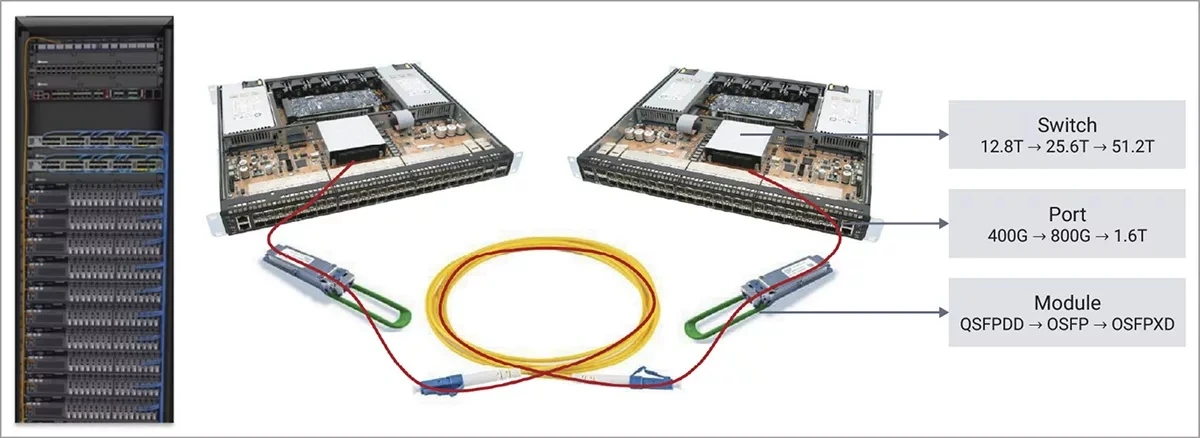
The innovation proposed by linear optics in AI interconnects centers on a strategic shift: moving signal processing functions away from the optical transceivers themselves and back onto the host system, typically the CPU or GPU's SerDes (Serializer/Deserializer) blocks. Traditionally, optical modules have incorporated significant digital signal processing (DSP) capabilities to compensate for signal impairments introduced during optical transmission and to manage complex modulation schemes. This onboard processing, while necessary for electrical-to-optical conversion and vice-versa, adds to the power, latency, and cost of each individual optical module.
Linear optics offers a way to simplify these optical modules. By leveraging advanced optical components that perform signal manipulation in the analog domain with high linearity, the need for complex, power-hungry digital processing within the optical module is drastically reduced. These linear optical components can handle signal splitting, combining, and routing with minimal energy expenditure and without introducing the non-linear distortions that plague simpler optical systems. The idea is to make the optical path as transparent and efficient as possible, akin to a perfectly clear pane of glass rather than a complex, multi-stage filter.
The signal processing workload is then offloaded to the host SerDes. Modern SerDes are highly sophisticated and can already perform complex equalization, clock recovery, and error correction. By integrating the necessary signal conditioning for optical transmission into these existing host capabilities, designers can create simpler, lower-power, and lower-latency optical modules. This approach effectively decouples the raw data transmission from the complex signal conditioning, allowing each part of the system to do what it does best: the host SerDes handles the digital signal processing, and the linear optics handle the efficient, low-distortion optical transmission.
Benefits: Power, Latency, and Thermal Load Reduction
The implications of this architectural shift are substantial. The most immediate benefit is a significant reduction in system power consumption. By removing power-hungry DSP chips from every optical module, the overall energy footprint of the AI system can be dramatically lowered. This is crucial for large-scale AI deployments, where power costs and cooling infrastructure represent a major operational expense. Imagine reducing the power draw of hundreds or thousands of optical links by even 20-30%; the savings are enormous.
Latency is another key area of improvement. The digital processing within traditional optical modules introduces a certain amount of delay. By simplifying the optical path and relying on the host's high-speed SerDes, this processing latency can be minimized. For AI workloads that are highly sensitive to communication delays, such as distributed training or real-time inference, even a few nanoseconds shaved off each link can lead to noticeable performance gains across the entire system. This reduction in latency is like removing speed bumps from a highway; traffic flows more smoothly and quickly.
Finally, the reduction in power consumption directly translates to a lower thermal load. Less power dissipated as heat means less strain on cooling systems, potentially allowing for denser compute configurations or reducing the need for expensive liquid cooling solutions in some cases. This makes AI hardware more sustainable and cost-effective to operate, especially in large data centers.
The Path Forward and Challenges
The adoption of linear optics for AI interconnects is not without its challenges. It requires close collaboration between semiconductor manufacturers, optical component vendors, and system architects. New standards and interoperability agreements will be necessary to ensure that components from different vendors can work together seamlessly. Furthermore, the design and integration of host SerDes with linear optical front-ends demand advanced co-design methodologies.
However, the potential rewards are immense. As AI continues to evolve, the need for scalable, efficient, and high-performance interconnects will only grow. Linear optics, by offering a way to break through the current limitations of electrical signaling and simplify optical modules, represents a critical step towards building the next generation of AI infrastructure. The move to offload signal processing to the host is not just an incremental improvement; it's a paradigm shift that could define the future of high-performance computing interconnects.