The Problem with Diagramming
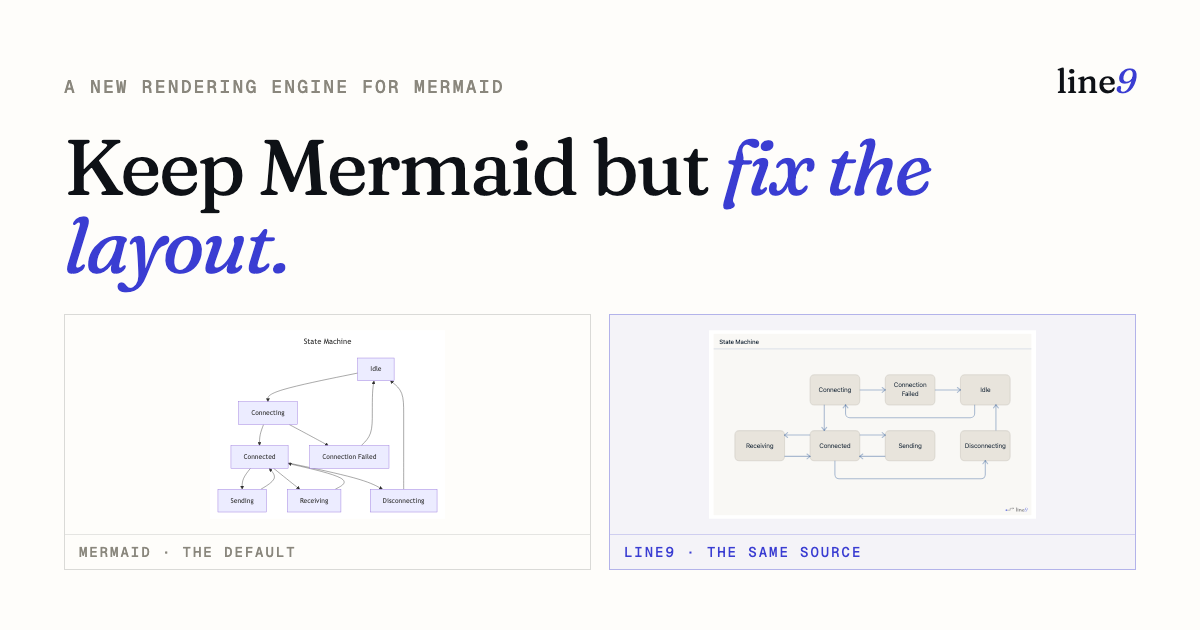
Generating diagrams from text-based descriptions has become a staple for developers, technical writers, and project managers. Tools like Mermaid have democratized this process, allowing users to create flowcharts, sequence diagrams, and more using simple, Markdown-like syntax. However, a persistent challenge has been the quality and control over the generated layouts. Existing renderers often rely on general-purpose graph layout algorithms that can produce cramped, unintuitive, or simply unappealing diagrams, especially for complex structures.
This is where Line9 enters the scene. The project, recently showcased on Hacker News, presents a novel approach: a dedicated Mermaid rendering engine built from the ground up with its own layout algorithms. The goal is not just to render Mermaid syntax, but to render it *well*, offering developers more predictable and aesthetically pleasing diagram outputs.
Introducing Line9's Core Innovation: Custom Layouts
Line9's primary differentiator is its proprietary layout engine. Unlike many existing solutions that might leverage libraries like Dagre or Graphviz, Line9 has developed its own algorithms tailored specifically for the nuances of Mermaid's various diagram types. This allows for finer control over element spacing, connector routing, and overall diagram composition.
The project's creator, who goes by the handle 'danopia' on Hacker News, emphasized that the engine is designed to provide more deterministic and visually coherent layouts. This means that for the same Mermaid code, Line9 should consistently produce a diagram that looks good, without manual tweaking of layout parameters. This is a significant improvement for scenarios where automated diagram generation is crucial, such as in documentation pipelines or real-time collaborative editing tools.
Technical Underpinnings and Architecture
While the exact algorithms are proprietary, the project's open-source nature allows for inspection of its architecture. Line9 is built using Rust, a systems programming language known for its performance, memory safety, and concurrency. This choice suggests a focus on efficiency and reliability, important factors for a rendering engine that might be used in performance-sensitive applications.
The engine parses Mermaid syntax and then applies its specialized layout algorithms. The output can be rendered into various formats, including SVG, which is ideal for web integration due to its scalability and accessibility. The project's repository likely contains the core logic for parsing, layout, and rendering. The emphasis on custom layouts means that the engine understands the semantic meaning of different diagram elements (nodes, edges, subgraphs) and uses this understanding to place them optimally.
Developer Experience and Use Cases
For developers already familiar with Mermaid, adopting Line9 should be relatively straightforward. The core benefit lies in the improved output quality. Imagine generating API documentation that automatically includes clear, well-formatted sequence diagrams, or creating architectural diagrams for a project that remain consistent and readable across multiple generations. This reduces the cognitive load on the reader and enhances the perceived professionalism of the documentation or presentation.
Potential use cases abound:
- Automated Documentation: Integrating Line9 into CI/CD pipelines to generate up-to-date diagrams from code comments or specifications.
- Real-time Collaboration: Powering collaborative diagramming tools where users can input Mermaid code and see immediate, high-quality visual feedback.
- Educational Tools: Creating interactive learning platforms where complex processes are visualized with clear, easy-to-follow diagrams.
- Internal Tooling: Building custom dashboards or internal wikis that leverage text-based diagramming for clarity.
Comparison to Existing Solutions
Mermaid itself is a JavaScript library, and many renderers are built upon it, often using JavaScript-based layout engines. Line9's Rust-based approach offers a potential performance advantage. More importantly, its dedicated, custom layout engine sets it apart from renderers that might simply wrap existing graph visualization libraries. These general-purpose libraries, while powerful, are not always optimized for the specific constraints and visual idioms of diagram types commonly expressed in Mermaid.
The surprising detail here is not the existence of a new Mermaid renderer, but the explicit focus on building a bespoke layout engine. This suggests a deep understanding of the shortcomings of generic graph layout algorithms when applied to the specific problem of diagramming for technical communication. It moves beyond mere syntax translation to a focus on visual communication effectiveness.
The Road Ahead and Community Involvement
As a