Automated Debugging for Playwright Tests
Debugging end-to-end (E2E) tests is a persistent pain point for development teams. When tests fail, developers often spend significant time manually inspecting logs, screenshots, and browser states to pinpoint the root cause. This process can be particularly time-consuming for flaky tests – those that pass and fail intermittently without a clear reason. Libretto, a startup focused on developer tooling, has introduced a new feature designed to alleviate this burden: Playwright Debugging Agents, or Libretto PR agents.
These agents leverage artificial intelligence to automatically diagnose and suggest fixes for failing Playwright scripts. The core idea is to reduce the Mean Time To Resolution (MTTR) for E2E test failures, freeing up developers to focus on building features rather than fixing test infrastructure. The agents analyze various signals from a failed test run, including error messages, DOM snapshots, network logs, and console output, to understand why the test did not behave as expected.
The process begins when a Playwright test fails. Instead of requiring a developer to manually intervene, the Libretto agent intercepts the failure. It then acts as an automated detective, sifting through the available diagnostic data. For instance, if a test fails because an element is not visible, the agent might analyze the DOM to see if the element is hidden by another element, or if it simply hasn't loaded yet. It can also correlate this with network activity to determine if API calls are taking too long or returning unexpected data.
How Libretto PR Agents Work
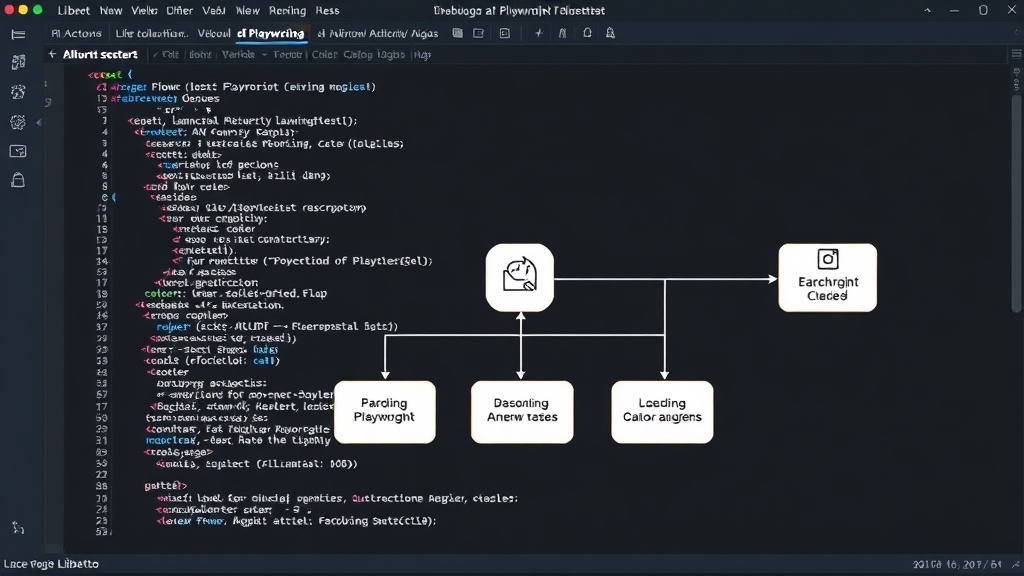
Libretto's approach is to abstract away the tedious manual debugging steps. When a test fails, the agent collects a comprehensive set of artifacts. This includes the full Playwright trace, which captures detailed execution information, screenshots of the browser state at the time of failure, console logs, and network requests. The AI then processes this information.
The agents are trained on a vast dataset of common E2E test failure patterns. This allows them to recognize scenarios such as element locators being incorrect, race conditions where the test tries to interact with an element before it's ready, unexpected page redirects, or API failures impacting UI state. Once the agent identifies a likely cause, it doesn't just report the problem; it attempts to suggest a concrete fix. This might involve modifying a locator string, adding a wait condition, or adjusting the timing of an interaction.
For example, if a test fails because a button is not clickable due to an overlay, the agent might suggest either waiting for the overlay to disappear or adjusting the click action to account for it. The output provided to the developer is actionable. It includes the identified issue, the reasoning behind the diagnosis, and the proposed code change. This could be a direct modification to the Playwright script or a suggestion for an additional assertion or wait command.
The system is designed to integrate seamlessly into existing CI/CD pipelines. When a Playwright test fails in a CI environment, the Libretto agent can be triggered to analyze the failure. The results, including the suggested fix, are then reported back, often as a comment on the pull request or a notification in a team's communication channel. This allows developers to review and apply the fix with minimal context switching.
Addressing Flaky Tests
Flaky tests are a significant drain on developer productivity and can erode confidence in automated testing. They create noise in the CI/CD pipeline, leading developers to ignore failures or spend excessive time chasing down transient issues. Libretto PR agents aim to tackle this head-on by providing a systematic way to debug these unpredictable failures.
The AI's ability to analyze multiple data points simultaneously is key. A human might struggle to correlate a network timeout with a specific DOM element not appearing. An AI agent, however, can process these disparate pieces of information and draw a connection. This is akin to a seasoned detective who has seen countless cases and can recognize subtle patterns that a novice might miss.
By automating the initial triage and diagnosis of test failures, Libretto positions its agents as a force multiplier for QA engineers and developers. The goal is not to replace human oversight but to augment it, handling the repetitive, time-consuming aspects of debugging. This allows human testers to focus on more complex scenarios, exploratory testing, and strategic improvements to the testing framework itself.
The Future of E2E Test Debugging
The introduction of Libretto PR agents signals a broader trend towards AI-powered developer tools. As E2E testing frameworks like Playwright become more sophisticated and test suites grow in complexity, the need for intelligent automation in debugging will only increase. Libretto is betting that by providing AI that can understand and act upon test failure artifacts, they can significantly improve the developer experience and the reliability of automated testing.
What remains to be seen is the agent's efficacy across the vast spectrum of potential E2E test failures. While common patterns are well-understood, novel or highly specific application logic errors might still pose a challenge. Furthermore, the cost and infrastructure required to run these AI agents at scale will be a factor for teams considering adoption. However, the potential to reclaim hours lost to debugging makes this an area worth watching closely for anyone invested in efficient software development and robust automated testing.