
The MCP Server: Automating AI Workflows
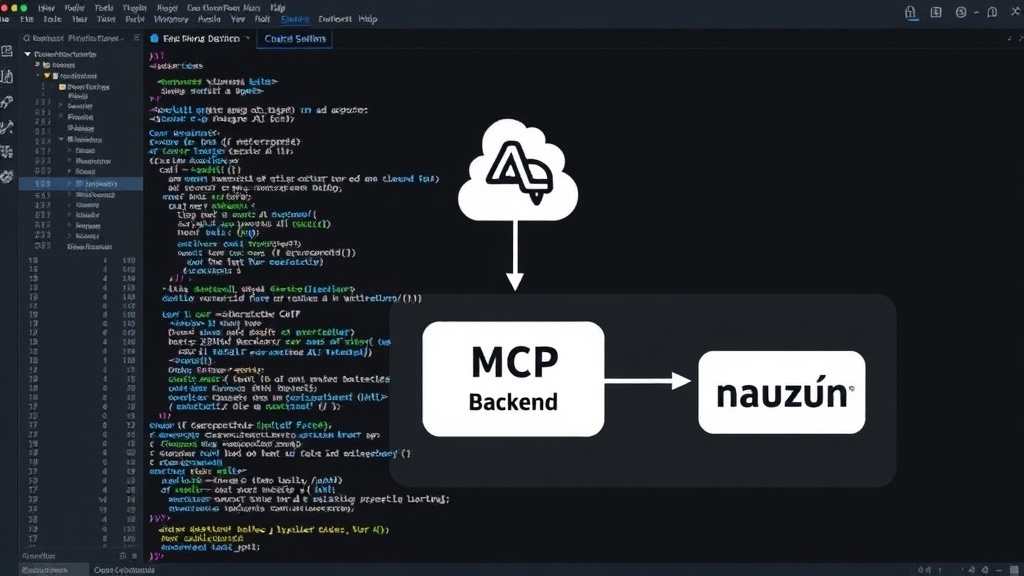
Integrating AI models with external tools and data sources is becoming essential for sophisticated workflows. The Model Context Protocol (MCP), an open standard created by Anthropic in 2024, aims to standardize this integration, acting as a universal adapter for AI assistants and agents. For the nuzur project, building a custom MCP server proved to be a natural fit for automating complex data flows, from schema design to managing data changes.
The core challenge was to create a system that could efficiently connect an AI agent to nuzur's project management backend. This involved translating high-level AI requests into specific, actionable commands that the nuzur system could understand and execute. The goal was to streamline the process, reducing manual intervention and speeding up development cycles.
Granular Tools: The Double-Edged Sword
Initial development focused on implementing basic CRUD (Create, Read, Update, Delete) operations as tools within the MCP server. These tools allow the AI agent to directly manipulate project data. For example, an agent could be tasked with creating a new project version or updating an entity within an existing version. The nuzur project manages projects, and each project can have multiple project versions, with each version containing various entities. This structure necessitates fine-grained control over data manipulation.
However, the practical application of these granular tools revealed significant drawbacks. Firstly, the cost associated with executing these operations, particularly when dealing with large data payloads, became a concern. Each API call, especially those involving extensive data transfer, incurs computational expense. Secondly, the time it takes for an agent to complete a task using these tools can be substantial. An agent might spend several minutes processing a single request, which can be a bottleneck for real-time or time-sensitive applications.
The complexity arises from the need to serialize and deserialize data efficiently. When an AI model generates a complex instruction, it must be translated into a structured format that the MCP server can parse. This often involves JSON or similar formats. The server then needs to validate this request, map it to the appropriate nuzur API endpoint, execute the operation, and return a structured response. Each step adds latency. For instance, if an agent needs to update a project's configuration, the payload might include thousands of lines of code or configuration parameters. Sending this payload, processing it, and confirming the update can easily take minutes.
The Cost of Latency and Large Payloads
The latency issue is not merely an inconvenience; it directly impacts the usability and efficiency of the AI-driven workflow. If an agent takes several minutes to perform a simple data update, it negates the automation benefits. Developers might find themselves waiting longer for AI-assisted tasks than they would for manual execution. This is particularly problematic in environments where rapid iteration is key, such as during the schema design phase or when debugging complex project configurations.
The cost factor is also critical. Cloud infrastructure, especially for AI workloads, can be expensive. Each API call, each data transfer, contributes to the overall operational expenditure. When granular tools require large payloads or multiple sequential calls to achieve a single logical outcome, the costs can escalate rapidly. This necessitates a careful balance between the expressiveness of the tools and their economic viability. For nuzur, which manages a large number of projects and versions, the cumulative cost of inefficient tool usage could become a significant financial burden.
Rethinking Tool Design: Towards Efficiency
The learnings from building and deploying these granular tools point towards a need for more abstract and efficient primitives. Instead of exposing raw CRUD operations, future iterations should consider higher-level commands that encapsulate common, complex sequences of actions. For example, instead of separate tools for creating a project version, adding entities, and then updating their properties, a single tool like
update_project_version_configuration
could be developed. This tool would internally handle the necessary API calls and data transformations, presenting a simpler interface to the AI agent and reducing the number of round trips required.
Another avenue for improvement involves optimizing data handling. Techniques like delta updates, where only changed portions of data are transmitted, or using more efficient serialization formats could significantly reduce payload sizes and processing times. Furthermore, batching operations—allowing an agent to submit multiple related requests in a single call—could drastically improve throughput. The MCP server could then optimize the execution of these batched requests on the backend.
The Unanswered Question: Scalability and Agent Behavior
While the MCP server provides a framework for tool integration, a crucial aspect that remains largely unaddressed is how AI agents will learn to use these tools optimally. How do we ensure agents don't default to inefficient, costly, or slow operations? Developing effective prompting strategies and fine-tuning agent behavior to prioritize efficiency and cost-effectiveness is a significant challenge. Without this, even well-designed tools can be misused, leading back to the original problems of latency and expense. The transition from a functional tool to an intelligently utilized one is a complex research problem in itself.
Broader Implications for AI Integration
The experience of building this MCP server for nuzur offers valuable lessons for anyone looking to integrate AI agents with complex backend systems. The initial approach of exposing low-level primitives is often the most straightforward from a development perspective but can lead to performance and cost issues in practice. A more effective strategy involves designing tools that are abstract, efficient, and aligned with the actual business logic and data structures of the target system.
This requires a deep understanding of both the AI agent's capabilities and the backend system's constraints. It's a balancing act between providing the AI with enough flexibility to perform complex tasks and ensuring that those tasks can be executed reliably and economically. As AI agents become more pervasive, the design of these integration layers, like the MCP server, will be critical to unlocking their full potential without incurring prohibitive costs or performance penalties.